

Reading – & Now: 2026
Quick links to this page's content ∨
A love affair with books
Appetizer:
"Work is service not gain. The object of work is life not income. The reward of production is plenty, not private property. We should measure the prosperity of the nation not by the number of millionaires, but by the absence of poverty; the prevalence of health; the efficiency of the public schools; and the number of people who can, do read worthwhile books."
– W.E.B. Du Bois, Understanding Economics⩘ , a speech delivered at the California Peace Crusade, 1953.
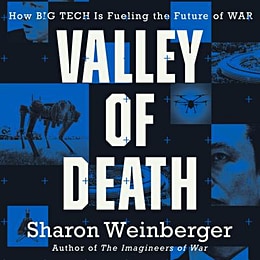
Sharon Weinberger, Valley of Death: How Big Tech Is Fueling the Future of War
 Narrated by Teri Schnaubelt
An in-depth look into how Silicon Valley startups funded by venture capital are taking the lead manufacturing the weapons and systems of war, quite often including AI.
Of course, this is leading to difficult and challenging ethical dilemmas such as what happens when the control over the weapons and systems of war is shifting from our military with oversight by our government to for-profit companies and even ultra-rich individuals.
Overall, the book is pretty dry, like a series of classroom lectures, but I appreciate having gained a deeper insight into what is happening, and of the attitudes and actions of the key companies and individuals who are involved.
Little, Brown and Company, 2026; Bookshop.org⩘ ; audiobook: Hachette Audio, 2026; Libro.fm⩘ .
Robyn Gigl, All We Hide
 Well narrated by Jen Richards
A captivating detective procedural set in a conservative county in a red state with a twist: the main character, Lt. Lauren Kelly, is a trans woman, providing me with insights into a life experience I know little about, which I appreciated.
Importantly, I trusted what I was reading as the author, Robyn Gigl, is a trans woman who is an attorney and advocate who has been honored by the New Jersey Women Lawyers Association, the ACLU-NJ, and the NJ Pride Network for her work on behalf of the LGBTQ+ community.
I've said this before, but why should it matter whether we are heterosexual cisgender males, as I am, or CIS females, or LGBTQIA+ individuals? In fact, I think we benefit from and should celebrate the diversity amongst us.
From the author's note at the end of the book:
These are difficult times for transgender and nonbinary people. On his first day in office, the president of the United States issued a series of executive orders declaring his belief that trans people don't have the right to exist. That's not hyperbole—just his words and actions taken at face value. And he's not alone in this view. Governors and state legislatures in approximately twenty-seven states have passed laws banning or prohibiting trans people from certain fundamental rights—like receiving appropriate healthcare, using a bathroom, changing their identity documents, or participating in sports. Policies that everyone from the Supreme Court of the United States to major media outlets have found no fault with.
I will confess that, as a transgender woman, it's hard for me to fathom why rich and powerful people fear me and other trans people. We make up a tiny fraction of the population, and like every other human being inhabiting this planet, all we're trying to do is live our best lives possible without hurting or interfering with anyone else's right to do the same. Yet, for some reason, powerful people view folks like me as an existential threat.
I certainly don't have the power or prestige that those attacking my community have, but, as a novelist, I do have a voice. As Walter Mosley once said, "Every novel that's worth its salt is about something other than the story." In my case, the something else is an effort to educate people who aren't trans as to what it's like to be a transgender woman and, hopefully, to show them that we're just like everyone else—no better, no worse—just trying to find happiness in this mixed up, jumbled up world.
Admittedly, there are times when I feel like my words are powerless against the forces arrayed against my community. But then I remind myself that I'm not alone—there are all of you. No matter what lens you view life through—cis, trans, nonbinary, or none of the above—we all should remember that we don't need to understand those who are different from us; we just need to be understanding of them. Together, let's reclaim the virtues of understanding, kindness, and empathy toward our fellow humans and once again embrace those virtues as strengths, not weaknesses. If we do, love can conquer fear.With love,
Robyn Gigl
Soho Crime, 2026; Bookshop.org⩘ ; audiobook: Recorded Books, 2026; Libro.fm⩘ .
Related: From her website, RobynGigl.com⩘ , I learned that she also wrote a series of crime novels, the Erin McCabe series, well narrated by Marguerite Gavin, which has been well received. Really good stories about a lawyer, a trans woman, who tackles a series of complex and dangerous cases. I deeply appreciate how much the stories taught me about the experience of LGBTQ+ people.
The series begins with By Way of Sorrow, 2021. Next in the series is Survivor's Guilt, 2022, named by Time magazine as one of "The 100 Best Mystery and Thriller Books of All Time". It also won the Joseph Hansen Award for LGBTQ Crime Writing at the 2023 Triangle Awards for LGBT literature.


The series concludes with Remain Silent, 2023, and Nothing but the Truth, 2024.
By Way of Sorrow: Kensington Books, 2021; audiobook: Recorded Books, 2021.
Survivor's Guilt: Kensington Books, 2022; audiobook: Recorded Books, 2022.
Remain Silent: Kensington Books, 2023; audiobook: Recorded Books, 2023.
Nothing but the Truth: Kensington Books, 2024; audiobook: Recorded Books, 2024.
Printed books: Bookshop.org⩘ ; audiobooks: Libro.fm⩘ .
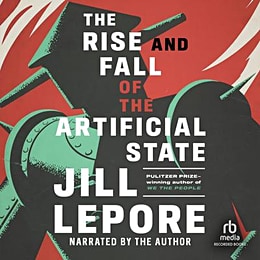
Jill Lepore, The Rise and Fall of the Artificial State
 Narrated by the Author
I've read or listened to several books by Jill Lepore⩘ over the years and have deeply appreciated what she has helped me to better understand about our world. This isn't my favorite of her books, but I once again appreciate what she has helped me to better understand. In particular, I value the deep historical context she provides about machine domination of the development of our societies.
Liveright, 2026; Bookshop.org⩘ ; audiobook: Recorded Books, 2026; Libro.fm⩘ .
See also: The Rise and Fall of the Artificial State by Jill Lepore review – an ominous warning of tech takeover: A historian charts the emergence of a democracy-crushing dystopia that is – in some ways – already with us⩘ , interview by Farrah Jarral, The Guardian, Aug 19, 2026.
Pulitzer prize-winning US historian Jill Lepore's new book addresses the threat posed to liberal democracy by artificial intelligence. According to Lepore, the extraordinary power of private tech companies led by men whose priorities may not align with the wellbeing of the Earth or its inhabitants is set to destroy civilisation as we know it.
Lepore's concept of the Artificial State is capacious. It includes both a fantasy desired by a select few and a reality that is already with us. The fantasy is of an atomised society in which an elite can transcend biological and planetary restrictions, "abandoning constitutional democracy, the liberal nation-state, and even humanity itself for rule by automation, government by machine, and replacement by artificial intelligence". The reality is that of public discourse having shifted to privately owned platforms on which monetised attention is valued above all else.…
According to Lepore, the Artificial State is not just the dream, but "the actual plan of a very small number of staggeringly powerful 21st-century merchant princes, Silicon Valley billionaires". When our priority ought to be climate change, these "princes" – Lepore mentions Elon Musk, Mark Zuckerberg, Jeff Bezos, Peter Thiel and Sam Altman – would rather focus on space travel or ramping up "compute" to beat China in the AI arms race. After scorching the Earth with energy-guzzling datacentres, she notes, their plan is to escape to Mars, hide in a bunker in New Zealand, or have their frozen brains uploaded.…
By her own admission, Lepore has written "a grumpy book". Almost every chapter ends with a deeply ominous line. However, she is not a true AI doomer at heart. She clarifies that it is not the technology itself that is the problem, but our lack of a coherent, democratically forged strategy about how to develop and use it.
Gil Durán, The Nerd Reich: Silicon Valley Fascism and the War on Democracy
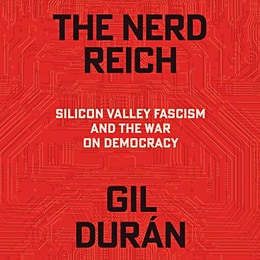 Well narrated by the author
Chilling! These people appear to have forsaken their humanity in their selfish pursuit of wealth and power, and of their fantasies of a future that they totally dominate and control.
We must rethink our relationship with technology, which means rethinking what it means to be human. Tech oligarchs find their own existence so empty that they want to leave the planet, become gods, merge with machines, and live forever in the cold and lifeless universe. None of us are invited to that future, which can only come about after they sort the human species down to the worst and most amoral version possible. But it doesn't have to be this way. Those of us who are okay with being human beings, who know it is our fate to live and die on Earth, who understand that humans are imperfect but have a destiny rooted in community and love, we don't have to sign up for these nightmares.
Avid Reader Press, 2026; Bookshop.org⩘ ; audiobook: Simon & Schuster Audio, 2026; Libro.fm⩘ .
See also: 'If we don't fight back, we don't have a future': the journalist taking on the 'tech fascists' of Silicon Valle⩘ by Steve Rose, The Guardian, Aug 5, 2026.
E.J. Swift, When There Are Wolves Again
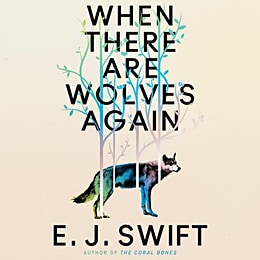 Well narrated by Olivia Darnley & Rebecca Norfolk
Interesting tale, well told from the points of view of two women beginning in the current time when they are young girls, and wandering slowly into the future until about 2070 when their two lives intersect. Through their experiences, the story of how climate change devastates Great Britain is revealed, along with how their actions slowly lead to reversals of the factors contributing to climate change and habitat loss. Most of the story is fairly horrifying, but there is a glimmer of hope at the end.
Arcadia Books, 2025; Bookshop.org⩘ ; audiobook: Quercus, 2025; Libro.fm⩘ .
Thich Nhat Hanh, Peace Is Every Step: The Path of Mindfulness in Everday Life
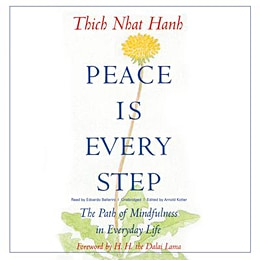 Beautifully narrated by Edoardo Ballerini
What a wonderful book, simple yet profound.
I like to listen to a few chapters most evenings just before falling asleep as a way to center myself and get beyond the turmoil that so often surrounds us these days. I don't think I'll ever tire of listening to these wise words.
Peace is every step … peace is every breath.
Bantam, 1991; Bookshop.org⩘ ; audiobook: Blackstone Publishing, 2015; Libro.fm⩘ .
See also: The fourteen precepts of the Order of Interbeing from Peace Is Every Step by Thich Nhat Hanh⩘ .
Kiyoshi Tanimoto, Hiroshima, 8:15: The Lost Memoir
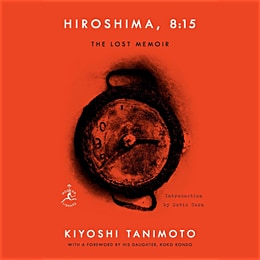 With a foreword by his daughter Koko Tanimoto Kondo and an introduction by David Corn; well narrated by Ren Hanami, Fred Sanders, and Brian Nishii
An important firsthand insight into what it was like to experience the atomic bomb dropped on Hiroshima on August 6th, 1945 at 8:15 AM. For me, it was particularly powerful to listen to what he saw and felt the moment the bomb exploded, as well as over the following minutes, hours, days, and weeks as he fought to help others and to survive his own radiation sickness. That he took this experience and turned it into dedicating his life to peace is astonishing.
I especially appreciated the foreword written by his daughter, Koko Tanimoto Kondo. Here's a key excerpt:
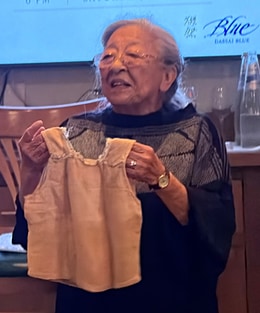
Every year on the morning of August 6, I go to the gathering at the [Hiroshima Peace Memorial] park's Memorial Mound, which is called the Tsuchimanjū. It's possible to go inside. Steps lead down below ground, where there are shelves of urns or boxes containing the remains of thousands of people whose lives vanished in an instant. Some have names, but many do not and there's no way of knowing who they were, or to which faith they belonged. So Shinto priests, Buddhist monks, Catholic priests and nuns, and Muslim clerics all attend the anniversary. We come together and sing, side by side. On occasions like these, the things that divide us are revealed to be illusions. We are all human beings, living our lives in the same world. Nothing divides us. This is the greatest lesson my father taught me. It is the most important lesson one human can teach another.
– From the passionate and insightful forward by Koko Tanimoto Kondo, who "was born in Hiroshima, Japan, and was just nine months old when the atomic bomb was dropped in 1945. Her father, Kiyoshi Tanimoto, became globally known for his work helping victims of the bomb. Koko is now a prominent peace activist and has campaigned against the use of nuclear weapons for most of her life."
Note: The photo shows her with the pink dress she was wearing when the atomic bomb fell on Hiroshima. Courtesy of Koko Kondo.
Modern Library, 2026; Bookshop.org⩘ ; audiobook: Penguin Random House Audio, 2026; Libro.fm⩘ .
See also:
- 'I never mentioned it for 25 years. I didn't want to be a victim of the bomb': Hiroshima survivor Koko Kondo on horror, anger and forgiveness⩘ by Simon Hattenstone, The Guardian, Jul 25, 2026.
- "A few years ago, an astonishing historical document was discovered in Hersey's archive at Yale University: [Kiyoshi] Tanimoto's own real-time account of the disaster, and his hellish search for survivors of the Methodist church he ran. Apart from a handful of academics, nobody knew this 230-page diary existed. It is being published in book form, with a moving introduction by Koko [Kondo, Kiyoshi Tanimoto's daughter]. 'I am 81 years old now. I am grateful for the life I almost didn't have, and I love this world. There are not many of us still alive – the hibakusha, as the survivors are called. We are the only people left who experienced an event that remains unique in human history,' she writes. 'My father had been a direct witness to a singular event.' And it has taken until now for the world to read this astonishing testimony to our capacity for barbarity and the power of human resilience."
- Hiroshima by John Hersey⩘ , The New Yorker, Aug 31, 1946.
- Related book review: Hiroshima by John Hersey⩘ .
Claire Stapleton, Don't Be Evil: Bad Bosses, Fake Promises, and My Escape from Big Tech
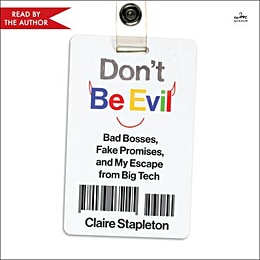 Narrated by the author
Corporate environments are so soul-crushingly fucking awful.
William Morrow, 2026; Bookshop.org⩘ ; audiobook: William Morrow, 2026; Libro.fm⩘ .
See also: A Google insider spills the tea on how the company forsook its founding ideals⩘ by Jennifer Ouellette, Ars Technica, Aug 11, 2026.
Maggie Haberman & Jonathan Swan, Regime Change: Inside the Imperial Presidency of Donald Trump
 Well narrated by Robert Petkoff
Yuck, disgusting!
It was challenging to convince myself to keep listening to this book, but it's well researched and written, so worth the effort.
What a repulsive, humiliating embarrassment.
Simon & Schuster, 2026; Bookshop.org⩘ ; audiobook: Simon & Schuster Audio, 2026; Libro.fm⩘ .
See also: New Trump book's authors detail how they pried loose White House secrets: We nearly killed ourselves' … the reporters behind Regime Change, were up against an administration that is 'very good at keeping secrets'⩘ by Martin Pengelly, The Guardian, Jun 23, 2026.
Eyal Weizman, Ungrounding: The Architecture of Genocide
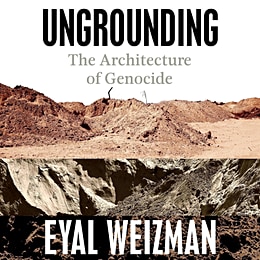 Very well narrated by Khalid Abdalla
Since October 7, 2023, I've been closely following the events in Palestine (see Broken Heart: Palestine, Gaza, the West Bank, Israel⩘ ). At the same time, I've been doing a great deal of reading about the history of this devastating conflict.
This book, more than anything else I've come across, has greatly expanded my awareness of the horrendous devastation that Israel is perpetrating upon the Palestinians, and has been for many decades. I can say only that I'm horrified and disgusted by the blatant and intentional disregard for human life with which Israel has been and is conducting what can only be described as one of the most grievous instances of brutal settler colonialism as well as among the worst genocides in human history.
Some context is important.
The author, Eyal Weizman, is a British Israeli architect. He is director of the research agency Forensic Architecture, at Goldsmiths, University of London, where he is Professor of Spatial and Visual Cultures and founding director of the Centre for Research Architecture at the department of Visual Cultures. In 2019 he was elected Fellow of the British Academy. He was born in Haifa, Israel, studied architecture at the Architectural Association in London, and completed his PhD at the London Consortium.
"Ungrounding" is one of the key findings of the forensic architecture that he and the team he works with have been performing.
Ungrounding is unlike other kinds of destruction in which the surface markings of inhabited areas – plot lines, roads, fields, gardens, walking paths – remain identifiable. In all other wartime destruction that I have studied, even when buildings collapse, one can still tell where they once stood, and understand something of the social reality that the urban surface held together. After a conflict ends, buildings and neighbourhoods can be extruded from their footprints. Ungrounding, on the other hand, aims to remove a society from its place and erase all traces to its previous existence. It extends from buildings down to the soil beneath them. It is a type of violence that is earth-shaping, terra-forming. Ungrounding is not a by-product of military confrontation but rather its aim. It destroys all conditions that sustain life and produces an empty slate, a tabula rasa. The monochrome desert of upturned soil is the material signature of Israel's genocide.
The book is extremely well researched and written, blending scientific findings and explanations, deeply personal stories of what has been and is occurring, and extraordinary insights into what the Israeli military and government have been doing, with the full backing of the U.S. government, over generations.
This was a deeply disturbing book to listen to and read (as I do with books that have complex subject matter, I followed along in the written book as I was listening in order to gain a more in-depth comprehension), but I'm deeply grateful for the insights and understanding that it provided me with.
Re-grounding: the soil's capacity to generate life. Thankfully, this book left me with one final and important insight: to never abandon hope that the future can be better.
Acts of ungrounding connected the expulsions and destructions of 1948 with those of the present-day genocide. The scraping of the surface sought then and now to make impossible the return of Palestinians. However, for those willing and able to look closely, through the vale of the total devastation, faint traces always remain. A close and careful reading of the ground, through a combination of memory and photography, testimony and material traces, as this book has tried to demonstrate, can reveal not only what exists, but also the subtle traces of that which Israel has attempted to erase. These faint markers are anchors for return. When such return will take place, a process of re-grounding must slowly restore the life-giving quality of the damaged soil and its capacity to generate life.
Penguin Press, 2026; Bookshop.org⩘ ; audiobook: Penguin Random House Audio, 2026; Libro.fm⩘ .
See also:
- Israel is building a miles-long earthen barrier inside Gaza, entrenching its division⩘ by Lee Keath and Julia Frankel, The Associated Press, Jul 21, 2026.
- 'Israeli settlers are in partnership with the army,' say Palestinians after two shot dead in West Bank: Residents of Deir Jarir say raids late on Sunday, also involving security forces, are part of pattern of violence⩘ by Andrew Roth and Sufian Taha in Deir Jarir, West Bank, The Guardian, Jul 20, 2026.
Douglas E. Richards & Joshua T. Calvert, Nexus
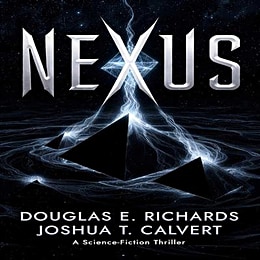 Well narrated by Erin Bennett & Timothy Andrés Pabon
An entertaining book, though at times a bit silly (for example, the totally unrealistic meeting with the president in the Oval Office).
As I got towards the end of the book, I was thinking that this wouldn't be one I'd write about. But then came the last two chapters and the authors' notes after the end of the story in which they reveal the real-life sources of many of the elements of the story. Fascinating.
I especially appreciate the way they wove in Flatland: A Romance of Many Dimensions by Edwin A. Abbott⩘ . Although I read that and several other books about dimensions beyond our four-dimensional experience of existence, I've never been able to grasp what that extra-dimensional experience might be like. This book and the authors' note provided more of a glimpse than I've ever had before.
Independently published, 2026; Bookshop.org⩘ ; audiobook: Simon Maverick, 2026; Libro.fm⩘ .
Francesca Albanese, When the World Sleeps: Stories, Words, and Wounds of Palestine
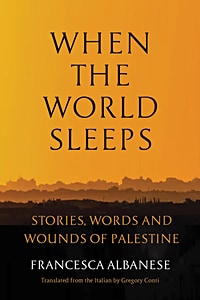 Translated from the Italian by Gregory Conti; very well narrated by Lameece Issaq
Francesca Albanese is someone I greatly admire for her clear vision reporting on the situation in Palestine in her role as UN Special Rapporteur on the Occupied Palestinian Territory since 2022, her commitment to telling the truth, and her unwavering courage, especially in the face of organizations, politicians, and countries who have been trying desperately to silence her.
I am the eighth person, and first woman, to serve as the UN Special Rapporteur on the human rights situation in the Palestinian territory occupied by Israel since 1967. Though the work is pro bono, the mandate is demanding.
In this role, as one among more than fifty UN independent experts (the crown jewel of the UN, as late UN secretary-general Kofi Annan used to call us), I strive to embody what Said modeled: a truthful witness. Impartiality does not mean indifference; it means investigating rigorously, judging facts against the law, and speaking truth to power – even when it's inconvenient. In Palestine, this entails exposing the deep asymmetry between occupier and occupied, colonizer and colonized, and showing how decades of dispossession have been normalized by an international community that is unwilling to act.
This powerful book she has written shares the stories of ten people who provide clarity about Palestine. She shares the firsthand experience of several Palestinians who have been witnessing and experiencing the genocide and colonial oppression, as well as several over people who provide deep context.
AT THE BEGINNING OF THIS BOOK I said that I had chosen ten people as the focal point for my stories, since from each of them I learned something essential about Palestine. The first is Hind; the second is Abu Hassan; the third is George; the fourth is Alon; the fifth is Ingrid; the sixth is Ghassan; the seventh is Eyal; the eighth is Malak; the ninth is Gabor.
The tenth is Max. My life partner, the person with whom I set foot for the first time in Palestine and the one with whom, three years later, I decided to leave Palestine. But Palestine is like that: You can also choose to leave it, but for those who have been there, have seen it and experienced it, it will not be the one who leaves you. My life is proof of this.
Despite the horrors of genocide and colonial oppression that the people of Palestine are suffering and that Albanese has been bearing witness to, she maintains an optimistic outlook.
I strongly believe in the possibility of coming together as a human family, rediscovering the true and profound meaning of solidarity.
If there is one lesson I carry with me, it is this: standing together with courage, even against entrenched power, makes change not only possible, but inevitable.
I appreciate the insights and wisdom she shares of several Jewish and Jewish Israeli scholars and experts who are colleagues and friends.
I also very much appreciate the chapter, "ALON: How do you recognize anti-semitism?
TODAY MORE THAN EVER, when Palestinians and those who defend them are accused of anti-Semitism, we must understand what is meant by anti-Semitism and what dangers can derive from the misuse of this term.
It is crucial to understand the answer to this question, especially now when many people, politicians, organizations, and governments who support Israel's actions are accusing people who criticize Israel's actions of being anti-Semitic.
And I appreciate the glimpse of what the future might look like that she shares.
What might that future look like? Though any long-term solution will need to be decided upon by Israelis and Palestinians themselves, I can say with confidence that a lasting peace will require sacrifice from everyone, most of all from Israelis—not of their rights as human beings, to live in peace, security, and dignity with their neighbors, but of their privileges as citizens of a settler colony built on the denial of indigenous self-determination. True peace can only be built on equality and freedom for all, grounded in a vision of universal justice that affords equal rights and responsibilities to all, regardless of their race or nationality.
Not to betray [author Edward] Said's message, I resolutely include the Israelis in this rehumanizing discourse. Like the Palestinians, they are part of an anachronistic settler-colonial endeavor, of course with unequal responsibilities and suffering. Ending Jewish Israeli domination will be a rehumanizing act. No one can oppress and brutalize others without themselves experiencing a loss of humanity in the process.
And meanwhile, one thing is for certain: This future will be made possible only by the work we do today. What matters now is that the current injustice is stopped immediately and further injustice is prevented; it is up to us, international civil society, lawyers, students, and citizens of the world, to take responsibility and use our voices to demand our governments meet their obligations and protect the multilateral international order that is threatened now more than ever.
When the world sleeps, it falls on us, we the people, to wake it up—and now more than ever the world needs an awakening.
Finally, I was deeply touched by something Francesca Albanese shares in her Conclusion chapter:
FEBRUARY 2025. I returned home, to Tunis, after a difficult experience in Germany. Between the fear of being arrested and separated from my family for who knows how long, and the awareness of the seriousness of what was happening in Europe, I felt an inner agitation that I don't think I had ever felt before. I felt like I was in a state of post-traumatic stress, and maybe I was. The fact is that my nerves were on edge, I was spouting off for everything, I found myself arguing with my children, raising my voice for trivial things. I was not myself. My own family looked at me without seeing me, without finding me.
Then something very special happened. While my husband had taken the children out for a walk and I continued to pace around the house like a caged lion trying to regain my composure, a small book caught my attention as I walked past the bookcase in my bedroom. Peace Is Every Step, by the Vietnamese monk Thich Nhat Hanh.
Without even realizing it, I began to leaf through the book and it struck me like lightning, as if suddenly those pages had begun to speak to me. If they were to read it, many of my friends probably would not understand my enthusiasm, since Nhat Hanh uses such essential language that it could perhaps be misunderstood as simplistic. Instead, those words hit the mark precisely because they were so clear and spoke to me of something that at that moment was both unfeasible and necessary: the idea of bringing back within me that peace for which I fight every day. It reminded me that, if you want to achieve change, first of all you have to be change, and that you cannot change anything if you do not change yourself in some way; that you cannot work for peace in the world if you do not first of all have inner peace, if you are not a true peacemaker.…
Thich Nhat Hanh's words made me reflect very deeply. With how much anger, with how much violence was I stamping my feet on the earth that supports me? For the first time in too many days, I remembered my yoga practice and took a truly deep breath. I let myself fall back into the sofa, I squeezed my eyes closed for a moment, and then I started reading again.When I was in Vietnam, so many of our villages were being bombed. Along with my monastic brothers and sisters, I had to decide what to do. Should we continue to practice in our monasteries, or should we leave the meditation halls in order to help the people who were suffering under the bombs? After careful reflection, we decided to do both—to go out to help people and to do so in mindfulness. We called it engaged Buddhism. Mindfulness must be engaged. Once there is seeing, there must be acting. Otherwise, what is the use of seeing?
We must be aware of the real problems of the world. Then, with mindfulness, we will know what to do and what not to do to be of help. If we maintain awareness of our breathing and continue to practice smiling, even in difficult situations, many people, animals, and plants will benefit from our way of doing things. Are you massaging our Mother Earth every time your foot touches her? Are you planting seeds of joy and peace? I try to do do that with every step, and I know that our Mother Earth is most appreciative. Peace is every step. Shall we continue our journey?PEACE IS ALSO MINDFULNESS: being aware of what you are doing at any given moment. When we eat, when we move, when we think, when we are with our children. How many times do we lose presence, in every action of our day? How many times do we hurry unnecessarily or let ourselves be distracted by something that seems more important than what we are doing? These are the questions that little book brought me back to, inviting me to give myself time for a few breaths without gasping, bringing my attention to the air that enters and leaves my body.
At that moment I remembered an evening a few years ago, when I was in Rome to participate in a conference. At that time—it was December 2023—the genocide was already underway and in response to the externalization of my fear, I said: "One day there will be peace in Palestine, but at what price? I am terrified of what will come next, because, with all the pain and suffering that is being done to those in the West Bank and Gaza, I dare not imagine the violence that could be unleashed against the Israelis." A man from the audience raised his hand and asked to speak.
It was Wasim Dabash, an Italian Palestinian professor of history at Sapienza University in Rome, who replied to me: "No. There will be no violence. If all this stops, when it stops, if there is no more violence, there will be no more violence. Because we Palestinians are not sustained by a thirst for revenge but for justice. From 1948 to today we have tried, as it was before, to return to Palestine, and to live in peace. And it is clear that there were reactions to oppression, actions of resistance, when the cup was overflowing. But most Palestinians have never taken part in violent actions against Israelis. For almost all of us, being religious does not mean being bigoted, it means having God inside, that is, the love of life, honoring both what remains and what is gone as something that must be brought into this life, and not as something for which one may want to die."
For me it was a very important revelation, which allowed me to understand that even there, at that conference, without realizing it, I had brought my Western lens, which is accustomed to thinking in terms of the law of retaliation. The words of that wise teacher, however, reassured me and also taught me something important about the meaning of hope.
The cover of the book is a painting by Malak Mallar titled "No Words", which has come to be known as the Guernica of Gaza,".
I looked at Malak's lunar face, very sweet but marked and hardened by violence, by oppression, while she told me that even there in London many things are very difficult for her. For example, now she is looking for a house that can accommodate the whole family when her parents manage to join her, but the rents are too expensive and, with her scholarship, it's really complex. Theirs is a wonderful scenario, because they are all alive, especially when compared to the constant anguish that Malak felt before her family managed to get to Egypt, when she knew that they had no food, that they were under a rain of bombs, and that they risked death every moment. Yet, she told me that every time they could talk on the phone, her father only asked her: "So, what are you painting these days?"
At first, Malak did not understand: "But what does it matter, Dad?"
Then he explained it to her: "You are there for a reason, Malak. You have to paint our lives, our struggle, all that we are going through. You are an artist, so "you are our voice."
Those words, she told me, she will never forget. Hearing the survivor of a genocide ask her to give voice, through painting, to what her people were experiencing, was an enormous responsibility for her, and what an honor. It was from there that the idea of a monumental work took shape: a painting of almost sixteen by six feet in which she tried to convey everything she could not say in words. It came to be known as "the Guernica of Gaza," even though its real title is No Words. It is a work that was born from the heart of the ongoing genocide and is entirely in black and white, because, as she explained in an interview, "only black can reflect reality, a horrible reality that silences us." Malak no longer sees the colors of her homeland.
On the walls, graffiti shouts in Arabic and English: "Gaza will live forever" and "Gaza will persecute you." In the canvas you can see animals feeding on the corpses left to rot. In the center, a distraught man rides a donkey, his mouth wide open with pain, shock, shame. Around him, bodies and rubble: women, men, children. The composition is dense with raw details, with a violence that saturates the space. Houses, schools, mosques, cultural centers: Everything has been destroyed. No one speaks anymore in that work.
Malak has painted silence. She has painted the disappearance of journalists, artists, poets, intellectuals. A work that freezes the blood in your veins, Malak knows that.
But her art is pure expression, without filters, both when she sees the world in black and white, and when she uses colors in her own unique way, as in the painting that illustrates the cover of this book and from which we have drawn inspiration for the title: When the World Sleeps.
Other Press, 2026; via Apple Books⩘ ; audiobook: Blackstone Publishing; Libro.fm⩘ .
Hettie O'Brien, The Asset Class: How Private Equity Turned Capitalism Against Itself
 Well narrated by the author
A thoroughly researched and well written book discussing the appalling trend in economics to favor the wealthy at a severe cost to everyone else. In a nutshell: private equity sucks and degrades a humane and functioning society.
It's interesting to note that as I was in the final sections of this book, I had my annual maintenance inspection of our heat pump, performed by a really good, privately owned local company. After the technician finished his inspection, we chatted for a few minutes. He told me that during the past year, the firm's original owner had retired, and two of the longterm employees, one of whom I had previously met, had purchased the company. I told him I was glad to hear this update and mentioned the book I was reading, which made me doubly glad that the company would continue to be privately owned. He shook his head and said that their company has been recently approached by multiple private equity firms wanting to take it over, that the owners were adamantly opposed to such a takeover, and that a lot of the employees would leave the company if that ever happened. I was left contemplating how badly the company's service would be degraded and how huge the price increases would be if that ever happened. What an appalling way to run an economy.
Grand Central Publishing, 2026; Bookshop.org⩘ ; audiobook: Hachette Audio, 2026; Libro.fm⩘ .
See also:
- Condemned to plutocracy? The relentless rise of US inequality⩘ by Eduardo Porter, The Guardian, Jun 21, 2026.
- Wheelchair users say private equity is making repairs harder⩘ by Meghan H Smith, heard on All Things Considered⩘ , NPR, Jun 29, 2026.
Note: The initial release of the audiobook contains a couple really stupid errors. (Possibly due to the publisher using AI in assembling it? It's hard to imagine a reasonably intelligent human editor making these errors.) First, Chapter Ten is inserted between the Introduction and Chapter One instead of between Chapter Nine and the Closing Credits. Despite this, the audiobook's chapter titles are presented in the correct order, so each chapter has an incorrect title. Second, the title of Chapter Ten contains a blatantly misspelled word: "Beaurocrats". I informed Libro.fm about these errors and they quickly replied saying they informed the publisher. Hopefully, the publisher will release a corrected version quickly.
Update: A corrected version of the audiobook has been released.
Cory Doctorow, The Reverse Centaur's Guide to Life After AI: How to Think About Artificial Intelligence—Before It's Too Late
 Well narrated by the author
An interesting deep dive into what AI is and isn't, the likelihood that the AI bubble will burst, and what to expect afterwards.
Doctorow is someone I've paid attention to for many years. I respect the work he does at the Electronic Freedom Foundation as well as his books, especially his nonfiction works.
I appreciate the balance he brings to this book, revealing what he thinks are the pure scam aspects of AI development as well as what he thinks AI models are and will be useful for. While I don't agree with everything he thinks will be useful, I respect his emphasis on the necessity of humans using AI as a tool that requires thoughtful and careful monitoring and review to compensate for its abundance of errors.
MCD, 2026; Bookshop.org⩘ ; audiobook: Macmillan Audio, 2026; Libro.fm⩘ .
See also: 'You cant' make billions without hurting people': Cory Doctorow on Elon Musk, the AI bubble and bosses' cruel fantasies⩘ by Zoe Williams, The Guardian, Jun 24, 2026.
Joseph Eckert, The Traveler
 Well narrated by Ray Porter
This story has an absolutely insane premise, but it enables Eckert to launch us on an entertaining adventure through time until the end of time, and perhaps even beyond.
The journey is vivid, at times hopeful and other times tragic, as it explores the future of humanity and of our home, this crazy, impossible to fully understand yet inspiring to ponder universe of ours.
Tor Books, 2026; Bookshop.org⩘ ; audiobook: Macmillan Audio, 2026; Libro.fm⩘ .
David Fideler, Breakfast with Seneca: A Stoic Guide to the Art of Living
 Well narrated by Paul Heitsch
While reading an excellent article ("Waiting for the missiles to pass": The living book in wartime Ukraine⩘ by Timothy Snyder) about a book festival in Kyiv during genocidal Russian air raids, I came across this snippet:
One knows when the air raids are coming from apps and from Telegram channels. The danger can be judged and navigated. The stoic philosopher Seneca, who is much read now in Ukraine, reminds us that life is long enough if we do what is important. Reading good books is important.
This made me realize that it was time to listen to Breakfast with Seneca again.
I find this to be a really good book. Fideler's insights into Seneca's Stoic guidelines really bring them to life. My previous review⩘ includes a link to a summary of Fideler's overview of the eight core teachings of Roman Stoicism, which are well worth reading and pondering.
W. W. Norton & Company, 2021; Bookshop.org⩘ ; audiobook: Ascent Audio, 2021; Libro.fm⩘ .
Jessica Riskin, The Power of Life: The Invention of Biology and the Revolutionary Science of Jean-Baptiste Lamarck
 Very well narrated by Ellen Adair
An interesting, thoroughly researched, and beautifully written book about the courageous pursuit of evidence-based science in the face of opposition, sometimes extreme, from establishment scientists as well as political and religious orthodoxy adversaries, during the massive social upheavals taking place in France during the late 1700s and early 1800s.
Lamarck was the first proponent of a fully thought out theory of evolution (well before Darwin), though he is mostly forgotten today because he and his ideas were so vehemently opposed and even scorned by other leading figures of his time. It's amusing to read the totally self-assured and snobbishly conceited opinions of those figures in the light of the fact that we now can see they how so very wrong they were. It's sad to realize that some of those same incorrect theories—for example, the inherent superiority of the white race—are still being repeated by misguided and snobbishly conceited people today.
At the conclusion of the book, Riskin us takes into our current time, showing how some of Lamarck's core ideas are finally being re-evaluated and being revealed as fundamentally correct, especially his "central idea that living beings play an active role in their own transformation".
Riskin then shares an observation of Lamarck's that was so prescient:
The environment is not a box or container with organisms inside. It is itself alive, dynamic, engaging, and transforming. It is the mutual interactions among all living beings and the changing landscape and climate. Organisms are the environment, and they are also always making and remaking the environment even as it is making and remaking them.
Denying the agency of living beings has not been a purely intellectual mistake. It has informed two centuries of environmental destruction, allowing people to regard the living world as so much raw material to exploit for economic, industrial, and imperial gain. Lamarck, who witnessed the Industrial Revolution firsthand, warned of this. In his last work, the Analytical System of Human Knowledge, written with Rosalie in 1820 when Lamarck was infirm, blind, and dismissed and ridiculed by most of the powerful figures in science and politics, he lamented in a fit of despondency that people were selfish and shortsighted, careless for the future, wantonly annihilating their own means of conservation, and working toward the destruction of their own species and of all living things.
Perhaps he was thinking of the mines and quarries he had toured with Buffonet and, no doubt, of their ever-accelerating growth in the intervening decades. He pointed out deforestation and its consequences. Destroying the trees and large plants that protected the soil trees and large plants that protected the soil to "satisfy the greed of the moment, [man] quickly brings sterility to this soil … causes the springs to dry up, drives away the animals who found their subsistence there, and causes great parts of the globe, once very fertile and highly populated, to now be bare, barren, uninhabited and deserted." Human beings' passions led them to ignore experience, to carry on waging wars and plundering nature for riches. "It looks," Lamarck concluded despairingly, "as if man were destined to exterminate himself after making the globe uninhabitable." Alas, it seems he was right about much of this, but let's hope not all of it.
Riverhead Books, 2026; Bookshop.org⩘ ; audiobook: Penguin Random House Audio, 2026; Libro.fm⩘ .
Steve Rosenbaum with a forward by Maria Ressa, The Future of Truth: How AI Reshapes Reality
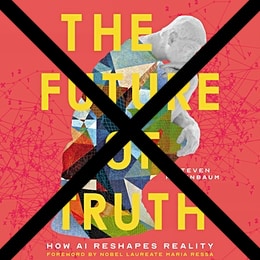 Well narrated by Chris Ciulla
Update, May 22, 2026: I was incredibly disappointed this morning to learn that it has been discovered that Rosenbaum's The Future of Truth contains improperly attributed or synthetic quotes generated by AI. In my opinion, he has lost his credibility due to his sloppy research and diligence. As a customer who purchased the audiobook and ebook versions of this book so I could carefully listen to and read it, I feel cheated and let down by Rosenbaum. This feels fraudulent to me. I wonder how Maria Ressa, someone I greatly respect, feels about having her name associated with this book. Normally, I would not leave a review of a disgraced book like this on my site, but I'm going to leave this one up with this update preface as a warning that it is not a reliable book. I guess this is the future of truth. Obviously, I need to redouble my skepticism.
Journalist and author Steven Rosenbaum has more reasons than most to distrust AI.
His new book, The Future of Truth: How AI Reshapes Reality, is all about "how Truth is being bent, blurred, and synthesized" thanks to the "pressure of fast-moving, profit-driven AI." Yet a New York Times investigation this week found what Rosenbaum now acknowledges are "a handful of improperly attributed or synthetic quotes" linked to his use of AI tools while researching the book.– AI put "synthetic quotes" in his book. But this author wants to keep using it.⩘ by Kyle Orland, Ars Technica, May 22, 2026.
Related: My letter to the publisher, Matt Holt Books⩘ , an imprint of Benbella Books:
May 23, 2026. You should be ashamed to have published this book. Your editor obviously failed in their job, and you are failing as a publisher. After learning how Steve Rosenbaum failed in his work as the author of this book, I feel cheated and let down. His flippant interview with Ars Technica worsens this situation. Maria Ressa is a person I greatly admire. I'm guessing she now feels dismayed to be associated with this book. It is certainly not a non-fiction work. I'm absolutely flabbergasted that you have not already withdrawn this book from distribution. Where is your integrity as a publisher? You haven't even added a caveat on your website page for this book revealing that it contains fake quotes attributed to real people. Again, you should be ashamed.
Original review:
A thoughtful dive into what truth is and how our modern society, social media, and AI are reshaping and distorting it.
It reinforces my viewpoint that the best way to navigate today's world is with a very healthy dose of skepticism.
One phrase I particularly appreciated was introduced when discussing algorithmic judgment systems and the related AI truth assessment systems: prejudice engines.
This episode revealed a fundamental Truth about algorithmic judgment systems: They are, at their core, prejudice engines. When an algorithm turns historical data into a predictive model, it operates on the assumption that the future will mirror the past.…
The parallels to today's AI truth assessment systems are striking. Whether judging exam integrity, job applications, or insurance claims, these systems perpetuate existing biases under the guise of objective assessment. As [Timandra] Harkness presciently noted, "Isn't it strange that we are repelled by prejudice in other contexts, but accept it when it's automated?"
Matt Holt Books, 2026; Bookshop.org⩘ ; audiobook: Brilliance Audio, 2026; via Apple Books.
See also:
- How to Stand Up to a Dictator: The Fight for Our Future by Maria Ressa⩘
- Why I dislike artificial intelligence⩘
Simon Elegant, City on Fire: A Novel of Hong Kong
 Well narrated by Mike Chamberlain
This novel, set during the period of the Hong Kong protests of 2019 - 2020, tackles both some very tough and some very disturbing topics, for example, the breakdown of a society transitioning from democracy to a totalitarian oligarchy, corruption and violence within the political class and the police forces, and pedophilia. I didn't find it a pleasant story to listen to*, yet it is vividly written, and holds deep lessons about the rapid social degradation that can happen even when huge segments of a society are protesting against and trying to prevent the loss of freedom and democracy.
Simon Elegant is China bureau chief for The Washington Post, based in Taiwan. Previously, he held a variety of reporting and editing jobs in Asia including Beijing bureau chief and Southeast Asia correspondent for Time magazine.
(* Sometimes I find it so off key when, at the end of an audiobook that covers a particularly disturbing or an especially dark subject, the narrator says, "We hope you have enjoyed this recording…." In instances where the book tackles a disturbing or dark subject, it seems to me that it would be much better to say something like, "We hope you have appreciated this recording….")
Pegasus Crime, 2026; Bookshop.org⩘ ; audiobook: Dreamscape Media, 2026; Libro.fm⩘ .
See also: Character list⩘
Quinn Slobodian & Ben Tarnoff, Muskism: A Guide for the Perplexed
 Narrated by Adam Grupper
I'm not perplexed about Musk, but I was curious to hear the perspective of the authors.
My own view is that he is a person who has dedicated his life to entirely selfish personal gain rather than compassion-based progress.
Harper, 2026; Bookshop.org⩘ ; audiobook: Harper, 2026; Libro.fm⩘ .
Gal Beckerman, How to Be a Dissident
 Well narrated by the author
An thought provoking deep dive into some of the most famous dissidents over the centuries and up into our current age. Beckerman explores what motivated them to become dissidents, the actions they took, and the impact of those actions. The chapters are organized by the ten qualities he identifies as effective ways to express dissidence.
A key factor that provoked many dissidents was the loss of autonomy under authoritarian rule, which of course is occurring again today.
Authoritarianism is currently on the rise globally: 72 percent of the earth's population now live under such rule.
And politics, of course, is not the only force in modern life where our sense of autonomy feels threatened. Digital technology that seemed to be so liberating when it first emerged has had this effect as well. Can we live with ourselves when algorithms reduce our choices to a narrowing set of feedback loops, when total surveillance robs us of privacy, or artificial intelligence thinks for us, eliminating idiosyncrasy and the ineffability of lived experience?
Crown, 2026; Bookshop.org⩘ ; audiobook: Penguin Random House Audio, 2026; Libro.fm⩘ .
Leo Tolstoy, The Death of Ivan Ilyich
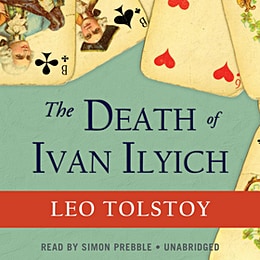 Well narrated by Simon Prebble; translated by Constance Garnett
I came across a reference to this story in another book I was reading and was curious enough about what was said to want to listen to it.
A short story describing the life and death of Ivan Ilyich, who becomes an official in the Court of Appeals in Russia. He suffers an injury when falling off a ladder while he is decorating their new home, which eventually proves fatal after a prolonged and very painful illness. In the moments of his death, his rather dreary and superficial life is offset when he experiences a flash of clarity, acceptance, and even exuberance.
See also: Wikipedia: List of characters⩘
Originally published in Russia in 1886; first published in English in 1902; Bookshop.org⩘ ; audiobook: Blackstone Publishing, 2026; Libro.fm⩘ .
Omer Bartov, Israel: What Went Wrong?
 Well narrated by James McNaughton
Powerful book.
Omer Bartov is an Israeli-born historian. He is the Samuel Pisar Professor of Holocaust and Genocide Studies at Brown University, where he has taught since 2000. Bartov is a noted historian of the Holocaust and is considered one of the world's leading authorities on the subject of genocide. He is the author of many books, including Anatomy of a Genocide: The Life and Death of a Town Called Buczacz, which won the National Jewish Book Award; Tales from the Borderlands: Making and Unmaking the Galician Past; and Genocide, the Holocaust and Israel-Palestine: First-Person History in Times of Crisis.
I think the publisher's summary presents a really good overview of this book, so I'm just going to share it as is:
The distinguished historian Omer Bartov was born on a kibbutz, grew up in Tel Aviv, and served in the Israel Defense Forces during the Yom Kippur War. He went on to become a leading scholar of the German army and the Holocaust, before turning his attention to his native country.
In Israel: What Went Wrong?, Bartov sketches the tragic transformation of Zionism, a movement that sought to emancipate European Jewry from oppression, into a state ideology of ethno-nationalism. How is it possible, he asks, that a state founded in the immediate aftermath of the Holocaust, an event that gave legitimacy to a national home for the Jews, stands credibly accused of perpetrating large-scale war crimes? How do we come to terms with the fact that' war of destruction is being conducted with the support, laced with denial and indifference, of so many of its Jewish citizens?
Tracing the roots of the violent events currently unfolding in Israel and the occupied territories, Bartov tracks his country's moral tribulations and considers the origins of Zionism, the intertwining of Israel's independence with Palestinian displacement, the politics of the Holocaust, controversies over the term "genocide," and the uncertain future. The result is a searing and urgent critique that addresses today's debates over Zionism and the future of Israel with rigor and depth.
Here's an excerpt that all of us who are Americans should reflect on:
In retrospect, we know that had the Biden administration put down its foot in November or December 2023, it could have indeed averted genocide. But for domestic political reasons, as well as out of ignorance of the realities of Middle East politics and deference to a lying, corrupt, and extremist Israeli leadership, it did not. Instead, it plied the IDF with an endless supply of munitions with which to destroy Gaza, giving Israel a diplomatic iron dome that allowed it to proceed with impunity. President Joe Biden and his team will forever be tainted with complicity in this crime, and the American people, who paid for its implementation with billions of their own tax dollars, will have to bear this burden for generations to come. But it is the State of Israel that will carry the mark of Cain on its conscience for as long as it exists.
Finally, I want to share a longer excerpt from the Introduction that I think sums up really well the situation, the dangers it presents, and a possible path of promise.
As we observe the current situation on the ground, we need to ask ourselves what the possible future scenarios for this devastated region might be, and what implications they will have for the nature of the State of Israel. Will the country persist on the course it is on at the moment, compounding all that has gone wrong with Israeli politics and society in an irreversible plunge into the abyss of authoritarianism, violence, and oppression? Or will it radically change course and set about the long process of repair, reconciliation, and achieving long-delayed but urgently needed justice? As I write this, I can envision two alternatives. The first is that despite current American efforts to stop the violence, Israel will persist in its attempt to empty Gaza of its Palestinian population or, as seems more likely, to subject it to ever more inhumane conditions in the wasteland of what had once been its home. Right-wing pressures to annex parts of Gaza and the West Bank, de facto if not de jure in view of Trump's current opposition, may bring about the eventual creation of an even stricter apartheid regime in all or much of the occupied territories.
This system will inevitably seep into Israel proper, first targeting Palestinian citizens and rendering their citizenship increasingly meaningless and then also turning against any Jewish citizens who oppose it or fail to conform to its increasingly regressive, unjust, and undemocratic norms. As the regime becomes more and more authoritarian, its legal establishment weakens and adapts, and violence becomes ever more prevalent, Israel will grow isolated and less affluent, a pariah state that Jewish communities around the world will be embarrassed to associate with even as they will likely also face a growing tide of antisemitism. Members of the liberal professions and persuasions will leave, and many of Israel's allies will distance themselves from it, as its claim to be the only democracy in the Middle East will be shown to be nothing more than a farce. This condition could last for a few decades but is eventually likely to lead to the state's implosion, as transpired in South Africa. But by then much blood will have been shed and much suffering endured, and the civil rights struggle that will follow might be just as bloody.
The second, more optimistic but less likely scenario is that Israel and the Palestinians will be compelled to change the entire political paradigm under which they have been living since 1948. Among outside actors, only the United States is in a position to use the current tragedy as an opportunity to seek a political solution for the fourteen million Jews and Palestinians living between the river and the sea. Such a solution would enable them to share the land within whichever political framework they choose—a binational state, two states, or a confederation, ensuring equality, justice, and dignity for all. Some opinion polls suggest that even today this is what most people in Israel and Palestine prefer—but they will support such an option only when it is realistic and presented by a reliable, steadfast political leadership. The desire for peace on its own is no recipe for defusing the fear and rage on both sides. A political solution is also what most Sunni Arab countries in the region support. But it can happen only under firm and determined American leadership. Whether the current American administration can remain focused on its peace plan and translate it into long-term, concrete steps appears doubtful.
Nonetheless, all those who care about Israel and Palestine, as I do, must work toward this second scenario by whichever means are at their disposal. As a historian, I believe that the first step in building a better future is understanding the hopes and aspirations, as well as errors and sins, of the past. It is for this reason that I have written this book. My goal is neither to praise Zionism and the state it created nor to condemn it. There are many good, thoughtful, creative, and deeply humane people in that land, Jews and Palestinians, who hope for, and deserve, a different reality from the one they are currently subjected to. The blanket condemnation or dismissal that fills the air these days does not reflect this far more complex reality. I can only hope that this book will contribute to an opening of minds, that in its own small way it may help reverse the tide of hatred and destruction by allowing us all to understand how we got here in the first place, and perhaps even how we might clamber out of the abyss.
One sad thing I learned is that while this book is being published in at least nine languages, and while Bartov himself offered to translate it into Hebrew, no Israeli publishers are willing to publish it. I think this is a true loss because I think the perspective that Bartov shares needs to be carefully considered by everyone.
Farrar, Straus and Giroux, 2026; Bookshop.org⩘ ; audiobook: Macmillan Audio, 2026; Libro.fm⩘ .
See also: What went wrong in Israel? A genocide scholar examines ‘what Zionism became': In his new book, Omer Bartov tracks how a liberatory strand of Zionism transformed into an extremist ideology that he sees as responsible for genocide in Gaza⩘ by Aaron Gell, The Guardian, Apr 21, 2026.
Speaking on a video call from his home in Providence, Bartov is reserved and unassuming, his white hair and scholarly demeanor offering a sober counterpoint to his fitted black T-shirt and stylish gray hoodie. Bartov's insistence that Zionism, as originally conceived, was essentially a movement of liberation helps explain his refusal to identify as an anti-Zionist. "I don't even know what that means," he said, emphasizing that he believes that Jews have a right to self-determination as long as they don't "trample over other people's rights". Accordingly, he does declare himself "completely, vehemently opposed to the kind of Zionism that exists today in Israel".…
Additionally, the charge of antisemitism has grown hollow, Bartov said, due to its flagrant "weaponization" as "a tool to shut people up" as the state wreaks destruction on its neighbors. "Having claimed to be the definitive answer to antisemitism," he writes in What Went Wrong?, "Israel is now the best excuse for antisemites everywhere, a nation whose addiction to violence and oppression, reliance on great powers and financial clout, and constant harping on the horrors of the Holocaust as an excuse for untethered violence against Palestinians are making even some of its erstwhile supporters shrink from it in discomfort, or horror and disgust."
Mark Harmon and Leon Carroll, Ghosts of Sicily: The True Story of the Naval Intelligence Agents Who Courted the Mob to Fight Nazis in America and the Battlefields of Italy
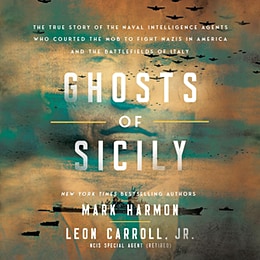 Narrated by Scott Brick
Harmon and Carroll continue their series about the history of the Naval Criminal Investigative Service (NCIS), which was originally named the Office of Naval Intelligence (ONI).
This book covers something I'd never heard of before, which is that during World War II, the ONI worked with the American Mob and their connections in Sicily and other parts of Italy to help gather intelligence that aided the Allies in their war to free Italy from the Nazis. It's a pretty crazy story.
One thing that really stood out for me is the incredible courage displayed by the ONI officers who took part in the initial landings of Allied troops on the beaches of Sicily, then changed into civilian clothing and made their way through and behind enemy lines in order to establish contacts and gather intelligence. They definitely contributed to changing the course of the war.
My one criticism of the audiobook is that they changed the narrator from Mark Harmon, who did an excellent job of narrating the previous two books in this series, Ghosts of Honolulu⩘ and Ghosts of Panama⩘ . I usually avoid audiobooks narrated by Scott Brick who, though he is a popular narrator, I personally find grating to listen to. But I made a reluctant exception this time because I really wanted to continue to listen to this series. Unfortunately, if there are more audiobooks in this series and they continue to be narrated by Brick, I'll be skipping them.
Harper Select, 2026; Bookshop.org⩘ ; audiobook: Harper Select, 2026; Libro.fm⩘ .
See also: Wikipedia: Lucky Luciano⩘ .
Aziz Abu Sarah & Maoz Inon, The Future Is Peace: A Shared Journey Across the Holy Land
 Well narrated by Aziz Abu Sarah & Magen Inon reading for his brother Maoz
Astonishing!
This is the story of Palestinian Arab, Aziz, and a Jewish Israeli, Maoz, who both experienced deeply painful personal losses due to the conflict between Israelis and Palestinians, but both of whom overcame their anger and even desire for revenge to become advocates for peace between their peoples, and who also became brothers to each other.
While our friendship is unusual, we are not unique. The two of us are part of a growing coalition of Israelis and Palestinians, working locally and globally to build a bridge to a shared future. Together, we are creating a new story. We do not see ourselves as Palestinians and Israelis, or as Jews and Arabs, but as human beings who believe in fostering a culture of dialogue, a culture of forgiveness, a culture of peace. To those who see only division lines, we say: If you must divide us, let it be as those who believe in peace and equality and those who don't … yet.
Together, the two take an eight day journey through the Holy Land, including places in Jerusalem and the West Bank. The use their individual and joint commentary about the trip and the deep emotions it raises within them to tackle some of the big issues that are tearing their peoples apart, but also to share their overriding belief that there is a way to come together and move forward towards peaceful coexistence.
The walls and the barriers that divide us foment mistrust. As Martin Luther King Jr. said, "They don't communicate with each other because they are separated from one another". With contact comes understanding, familiarity, and the ability to put ourselves in the shoes of the "other." I have seen it. I have lived it. That is how I know in my heart that we are not doomed to live this life of polarization.
At one point on their journey, they are joined by American Rabbi Paula Marcus. She shares a brief comment about her personal belief that peace is achievable that includes "Many people in the United States feel so hopeless and helpless about the situation, but what I've experienced this week is far from hopelessness." Those two words, "hopeless and helpless" describe how I've felt so much of my life when I've observed what is happening between Palestinians and Israelis, especially since Oct 7, 2023, 926 days ago as I write this (another word that describes how I feel is confusion). At that time, I began writing down what I was observing in the news, books, and films about the conflict in effort to better understand it: Broken heart: Palestine, Gaza, the West Bank, Israel⩘ .
This book, describing the work that Aziz and Maoz are doing, provides one of the rare times that I actually feel hopeful that a better future is possible.
Maoz and Aziz
We Meet in the Future
There is a saying in Islam attributed to Omar Ibn al-Khattab: You don't really know a person until you live with them, travel with them, or do business with them. The journey the two of us began seven days earlier transformed our relationship. We had cried together and laughed together. We had visited the landscapes of our pasts, met each other's families, and shared our stories of loss and dreams for the future. We started this unconventional pilgrimage as a Palestinian and Israeli who had forged an unlikely friendship, but now as our journey was almost at an end we realized that through the power of travel and storytelling we had become something more: brothers bound by loss and hope, and united in our shared mission of peace.
We have the courage to dream, we agree on shared values, we are investing in and successfully building an Israeli-Palestinian coalition with international support, we have a work plan, and we are already putting it into action. Our work plan is simple yet complex.
To dream.
To amplify the dream.
To build legitimacy for the dream and for the movement of peace and reconciliation.
To call for a change in policy from investment in weapons of destruction to investment in dialogue, reconciliation, and mutual recognition.
And, ultimately, to create the political will to choose peace, not war.
I am so grateful to Maoz and Aziz, and the many others like them who, in the face of one of the most painful conflicts in recent history, still have the courage and fortitude to strive towards a better, peaceful future of coexistence.
Crown, 2026; Bookshop.org⩘ ; audiobook: Penguin Random House Audio, 2026; Libro.fm⩘ .
See also:
- A Palestinian and an Israeli, face to face⩘ , A TED talk with Palestinian peacemaker Aziz Abu Sarah and Israeli peacemaker Maoz Inon, April 2024.
- 'Whatever life throws at us, we don't walk alone': how a London synagogue attack birthed an act of solidarity⩘ by Esther Addley, The Guardian, Apr 18, 2026.
- A Land for All: Two States. One Homeland. A viable political framework rooted in lived reality and shared human values.⩘ .
Chanda Prescod-Weinstein, The Edge of Space-Time: Particles, Poetry, and the Cosmic Dream Boogie
 Enthusiastically well narrated by Joniece Abbott-Pratt
If the eyes do not look at the sky, what else would they look at? – Igbo proverb, relayed by Damian U. Opata
Every once in awhile I listen to or read a book on physics, though this one has definitely been the most entertaining, philosophical, and socially conscious one I've come across.
We take for granted that anything we encounter is available for modeling because so far, it's worked out that way for us. In the case of general relativity, we have an equation that models how space-time evolved from the earliest fraction of a second until now, whenever you read this sentence. We also have a story about the dynamical relationship between space-time and particles, which are not actually like tiny billiard balls but are in fact something so much stranger that later I will tell you that actually you're just a mathematical abstraction that comes from nothing, and I will mean it in the kindest possible way. This perspective represents a profound shift in how we understand the very foundations of who and what we are.
As usual, I really don't understand much of the physics, but I get glimpses of how this strange, wondrous universe we live within works, which I totally appreciate.
I've likely never met you, but I know that you are made from hydrogen and carbon that is billions of years old. I know that the carbon was made in stars that the hydrogen formed—and that your body likely needs a smidgen of vanadium, which is made in supernovae, the explosions of stars that are chonky enough to die sudden, spectacular deaths. You were created within the history of the Big Bang. This is the story, as we understand it. To develop intuition for why this account of the universe seems reasonable and even quite probable to anyone means to step outside of daily life and face the strange.
Pantheon, 2026; Bookshop.org⩘ ; audiobook: Penguin Random House Audio, 2026; Libro.fm⩘ .
Woody Brown, Upward Bound
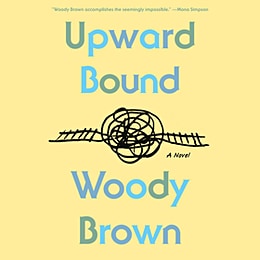 Well narrated by T.R. Knight, Pete Holmes, Midori Francis, Carlos Miranda, Brandon Flynn, Nikki M. James, Alex Edelman, and Daphne Rubin-Vega
Just before I dove into this audiobook, I read an article/interview about the book and the author, Woody Brown: 'I was in the pit of despair': Non-speaking autistic novelist Woody Brown on his journey from write-off to writer⩘ by Simon Hattenstone, The Guardian, Mar 28, 2026. There are a couple key quotes in the article that I think provide some essential information about this novel and its author.
Is he happy now? "I am very happy now that I have real purpose and productivity. I want this for all autistic people. One of the reasons I wanted to be a great writer was that I wanted neurotypical people to read my book, not out of pity but because it was a good book. That way I can reach the hordes who underestimate and infantilise us, and show them how vivid and magnificent we are."…
In 2022, Brown became the first non-speaking autistic graduate at the University of California, Los Angeles (UCLA), where he received the English department's top writing honours. He completed his master's at Columbia University in 2024.
The story is told in a series of vignettes shared by various clients and staff members at a somewhat dreary daycare center called Upward Bound that is for people with severe autism and other disabilities. The stories provide a way to understand and experience their life experience, particularly of those clients who are non-speaking.
Especially interesting is the perspective of Walter, who reflects in a fictionalized manner the experiences and outlook of the author.
A deeply touching book that reminds us that there is sometimes much more to life than what we immediately see and hear.
Hogarth, 2026; Bookshop.org⩘ ; audiobook: Random House Audio, 2026; Libro.fm⩘ .
See also:
- Upward Bound by Woody Brown review – extraordinary debut from a non-speaking autistic author⩘ by Xan Brooks, The Guardian, Apr 7, 2026.
- My review of the D.S. Cross series by Tim Sullivan⩘ (see the section about 'In Search of Better Ways to Understand Autism' by Jason Jacoby Lee).
- Songs of the Gorilla Nation by Dawn Prince-Hughes⩘ .
- Sculptures in the eye of a needle⩘ .
- An inspiring commencement speech⩘ .
- Born on a Blue Day by Daniel Tammet⩘ .
- Nine Minds: Inner Lives on the Spectrum by Daniel Tammet⩘ .
- Temple Grandin: The world needs all kinds of minds⩘ .
Sebastian Mallaby, The Infinity Machine: Demis Hassabis, DeepMind, and the Quest for Superintelligence
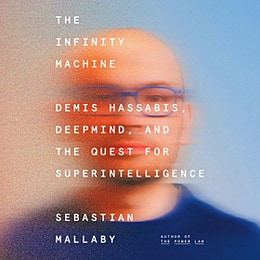 Well narrated by Vidish Athavale
An interesting book. Mallaby has written an in-depth look at the development of AI focused on Demis Hassabis and the company he created, DeepMind, which was later merged into Google, but also including briefer glimpses of all the major players in the AI space.
Also a frightening book. While there is obviously incredible passion, enthusiasm, curiosity, excitement, and even idealism displayed by many of the scientists and researchers working on the development of AI and in pursuit of reaching the point where it exceeds human intelligence, especially in the earlier days, there is also a darkly alarming transition into what might be called an arms race. There's a lot of money potentially to be made, and there is an existential competition with dangerous global adversaries pursuing the same research, so as development proceeds, the focus shifts from the more idealistic pursuit of science to a winner-take-all mentality in which safety guardrails are increasingly cast aside.
One mind-blowing glimpse into this no guardrails point of view is provided by Larry Page, one of the founders of Google:
Speaking in his raspy voice, Page told him not to worry. He said he looked forward to a time when people might merge with intelligent machines, or when machines might simply replace humans. Evolution would ensure that the best form of intelligence won out; if the best form involved fast silicon circuits rather than slow biological tissue, so be it. There was no point being sentimental about such things. It would be survival of the fittest.
Page was channeling a view that had been around for half a century. In 1964 the science-fiction writer Arthur C. Clarke had called it a privilege for humanity to be a stepping stone to higher things. "I suspect that organic, or biological, evolution has about come to its end, and we're now at the beginning of inorganic, or mechanical, evolution, which will be thousands of times swifter."
Some of the most alarming content is in chapter 18, "We're Cooked".
Recognizing that the technology was at last approaching human levels of intelligence, two academic fathers of deep learning, Geoffrey Hinton and Yoshua Bengio, questioned the wisdom of deploying it.…
The attitudes of scientists, like the attitudes of AI labs and their leaders, are determined by the stage of the technology, Bengio was effectively saying. As they pursue the thrill of invention, scientists want to feel good, so they don't confront the hard questions. Once the invention has happened and the scientists have lost control, they call on others to regulate it. It was almost as though AI safety was caught in a catch-22. Those with caution lacked power. Those with power lacked caution.…
Unsatisfied by the three industry responses to his warnings, Bengio pressed the argument. In March 2023, he duly appeared as the lead name on an open letter demanding a total pause in the training of models exceeding GPT-4's capability. More than a thousand luminaries joined him in signing.…
"Recent months have seen AI labs locked in an out-of-control race to develop and deploy ever more powerful digital minds that no one—not even their creators—can understand, predict, or reliably control," Bengio and his cosignatories declared.…
"Should we develop nonhuman minds that might eventually outnumber, outsmart, obsolete and replace us?"
The letter also noted that OpenAI's manifesto had conceded that "at some point, it may be important to get independent review before starting to train future systems."
"We agree," the letter retorted. "That point is now."
Of course, as we have seen, the out-of-control race has accelerated since then.
Penguin Press, 2026; Bookshop.org⩘ ; audiobook: Penguin Random House Audio, 2026; Libro.fm⩘ .
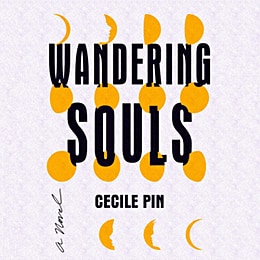
Cecile Pin, Wandering Souls
 Well narrated by Ainsleigh Barber, Aoife Hinds & Ioanna Kimbook
A short, yet full and powerful novel, written in a style I hadn't previously encountered.
Most of the story shares the deeply personal experience of a, at the beginning, 16-yr-old Vietnamese girl, Anh, who leaves Vietnam shortly after the last U.S. troops withdrew, escaping in a decrepit boat with two of her younger bothers, Minh and Thanh. They arrive at a dismal refugee camp in Hong Kong, where they are supposed to be joined within a few weeks by her father, mother and her several even younger siblings. But that reunion never happens, so Anh must assume the role of the family caretaker. Eventually, they emigrate to the U.K., where they slowly and often quite painfully, create a life for themselves over the years. The story provides an incredibly vivid glimpse into the immigrant experience.
What makes the style unique is that woven into the strands of the novel are brief asides providing historical context, the observations of the ghost of one of her lost younger siblings, and an unnamed person's perspective, which feel like they are nonfiction thoughts, perhaps by the author herself? All in all, a truly moving story.
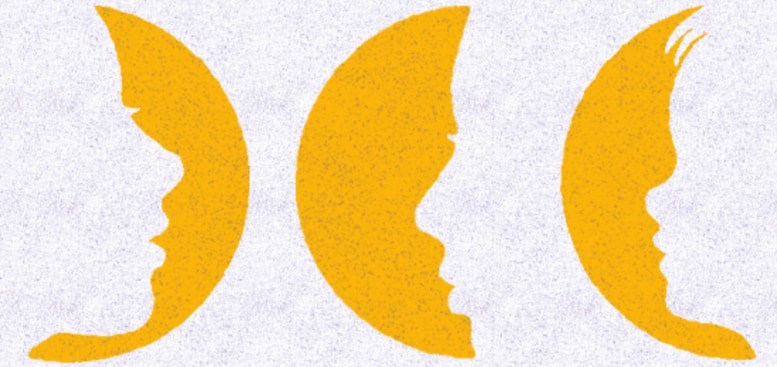
A visual glimpse of Ahn, Minh, and Thanh can be seen in the cover illustration.
Henry Holt and Co., 2023; Bookshop.org⩘ ; audiobook: Macmillan Audio, 2023; Libro.fm⩘ .
Ibram X. Kendi, Chain of Ideas: The Origins of Our Authoritarian Age
 Narrated by the author
I was glad to see that Ibram X. Kendi has published a new book because he is an historian and thinker I admire and respect, and he concluded the last book of his that I read, How To Be An Antiracist⩘ by revealing that he had stage 4 metastatic colon cancer:
I have cancer, the most serious stage. Cancer is likely to kill me. I can survive cancer against all odds. My society has racism, the most serious stage. Racism is likely to kill my society. My society can survive racism against all odds.
So far, he has survived cancer against all odds (unfortunately, I can't say the same for our society), and has gifted us with this in-depth study of our humanity.
That said, this was, for me, a tough listen. It's long and is packed with a detailed look at how our world has evolved into its current authoritarianism. It's pretty gruesome. At the core of it is the great replacement conspiracy theory.
[Novelist Renaud] Camus's conspiracy that a cabal of powerful elites is plotting a great replacement to ensure the exploitation and domination of low- and middle-income White people is nothing short of a grand distraction. Low- and middle-income White people are facing supercharged efforts to exploit and dominate them at the hands of the very economic and political elites conjuring up fictional tales of the great replacement. This book shows how great replacement theory has spurred many everyday White people into supporting antidemocratic political parties that harm most White people—and the rest of us—in the name of protecting White people from, well, the rest of us. The actual protagonists in this story are the great replacement financiers, politicians, theorists, and soldiers. They are striving to bring into being the actual great replacement humans should fear in the twenty-first century: the replacement of democracy with dictatorship.…
Political parties and politicians using great replacement theory to secure and maintain authoritarian power can be termed great replacement parties and great replacement politicians. Sometimes the great replacement financiers and theorists and politicians are one and the same, protecting their immense wealth, authoritarian power, and dominant status in the name of protecting everyday White people from the great replacement.
Great replacement theory can be defined as a political theory that powerful elites are enabling peoples of color to steal the lives, livelihoods, cultures, electoral power, and freedoms of White people, who now need authoritarian protection.
The irony is that so many everyday people are being hooked by this conspiracy theory, even as the outcome of buying into it ultimately harms them. This is something I've long been aware of and have been puzzled by. It was worth plowing ahead through the grim reality presented in this book because it has finally helped me to understand this paradox.
Great replacement politicians persuade everyday people to crave an inequitable dictatorship where they have limited power but more privileges than others, rather than an equitable democracy where they have expansive power but no privileges over others. Great replacement politicians do this by knotting the privileges individuals receive to their group identity. That is, they bond the very being of persons to their privileged identity in order to convince members of these privileged groups that to lose their privileges is to lose their very being, lose their very way of life, lose their life.
These messages are utterly dehumanizing even as members of privileged groups are told they are the most superior humans. In this dehumanizing sense, who they are is not who they are. Who they are is what they have. What they have is the privileges they have. The privilege to live longer than others. The privilege to have a better livelihood than others. The privilege to have more electoral power than others. The privilege to have more freedom than others. That's what it means, they are told, to be White or male or Christian or heterosexual or Hindu or another ethnic majority. They are supposed to crave their privileges at all costs—or rather, despite the costs to their power. They are supposed to support those dictatorships that protect their privileges at the cost of their power. It all amounts to the final link in the chain of ideas: fighting for privileges provided by dictators instead of power provided by democracy.
While much of the book deeply explores a reality that is very grim, ultimately Kendi shares a cautiously hopeful outlook, one that depends on all of us:
Humanity sits at a crossroads in the authoritarian age.
Either humanity will create conditions that confine people to the chain of ideas or humanity will create conditions that link people to the chain of humanity. I am hopeful humanity will create conditions for humans to be linked, not confined.
Either humanity will bend the knee before dictators to secure privileges or humanity will stand strong for democracy to secure power. I am hopeful humanity will choose power.
Either humanity will open doors to outsiders or humanity will close doors on the future. I am hopeful humanity will open the doors to the future.
Either humanity will see themselves as one in all our differences or humanity will one day be done. I am hopeful humanity will choose to be one—one chain of humanity.
Chain of Ideas set out to chronicle how humanity has become entrapped in this vicious circle of the great replacement. But this book aims to be more than a global history, by revealing ten ideas used to entrap people—what I have called the chain of ideas. But I believe we can escape the vicious circle.
We can escape the vicious circle by ending our efforts to escape each other. We can liberate ourselves from the ideas that fetter us by recognizing what binds us. Only a universal recognition of the unbreakable chain of humanity can liberate us from the breakable chain of ideas.…Peoples from all backgrounds are realizing that to struggle for antiracist democracy is to struggle for our lives, our livelihoods, our cultures, our power, our freedom—everything and everyone we hold dear as human beings. Because within an antiracist democracy, there is a people of peoples, a political unity without uniformity that is focused on protecting all groups and individuals from violence and economic exploitation and political manipulation, freeing everyone to practice their cultures and ways of living and worshipping and loving and being.
Related website: Chain of Ideas⩘ , which includes a section on taking action.
Related articles::
- 'Assault on justice':' how far-right attacks are threatening rule of law in Europe⩘ by Jon Henley, Angela Giuffrida, Deborah Cole and Jakub Krupa, The Guardian. "Judicial independence is under threat as populist politicians target judges and authoritarian governments attempt constitutional reforms."
- Letters from an American⩘ by Prof Heather Cox Richardson, Mar 26, 2026.
- Undaunted: District court judges hold the line⩘ by Jennifer Rubin, The Contrarian, Mar 27, 2026.
- 'In 20 years most of the world could be racist dictatorships': Ibram X Kendi on book bans and far-right fear-mongering⩘ interview by Steve Rose, The Guardian, Mar 23, 2026.
- Chain of Ideas by Ibram X Kendi review – anatomy of a conspiracy theory: This careful analysis of so-called 'great replacement theory' offers a lens through which to view our broken politics⩘ by Arwa Mahdawi, The Guardian, Mar 20, 2026.
One World, 2026; Bookshop.org⩘ ; audiobook: Penguin Random House Audio, 2026; Libro.fm⩘ .
See also – my reflections on other books by Ibram X. Kendi:
- Stamped from the Beginning: A Definitive History of Racist Ideas in America by Ibram X. Kendi⩘
- How To Be An Antiracist by Ibram X. Kendi⩘
- Four Hundred Souls: A Community History of African America, 1619 – 2019 edited by Ibram X. Kendi & Keisha N. Blain⩘
Cindy Cohn, Privacy's Defender: My Thirty-Year Fight Against Digital Surveillance
 Passionately narrated by the author
It is clear that the defense of individual privacy is an essential battle, especially against a government that has sought to own more and more of our private lives, and corporations that use the underhanded techniques of surveillance capitalism against us in order to maximize their profits by exploiting and/or selling what they vacuum up about people's private lives.
Thank goodness we have an extraordinary organization like the Electronic Frontier Foundation (EFF.org⩘ ) led by passionate people like Cindy Cohn fighting on our behalf. This is certainly becoming a more critical issue with each passing day.
MIT Press, 2026; Bookshop.org⩘ ; audiobook: Blackstone Publishing, 2026; Libro.fm⩘ .
Devon Mihesuah, Blood Relay
 Well narrated by Bailey Frankenberg
An edge-of-your-seat crime novel based on MMIWP (Missing and Murdered Indigenious Women and Persons), an "epidemic-level human rights problem".
Written from the perspective of Choctaw Detective Perry Antelope (her last name is from her Comanche husband) of the Oklahoma City police department and her partner, Sophia Burns. The story also involves characters from some of the thirty-nine tribes in Oklahoma, including members of the Quapaw, Seminole, Miami, and Muskogee tribal police. They are investigating the abduction of Dels Billy, a beloved women's Indian horse relay rider, who goes missing when she was returning from a race. Another important plot line is the sale of Tribal allotments to non-Natives.
While this is a novel, much of it is based on actual experiences, places, and people in Devon Mihesuah's life. Many of the concerns in the story are also reflected in her "non-fiction books about genocide, violence, racism, boarding schools, repatriation of skeletal remains, stereotypes, Native women, and tribal justice".
As I listened to this story, I was reminded of some other novels I read recently: Shutter by Ramona Emerson⩘ and Cash Blackbear trilogy by Marcie R. Rendon⩘ . As with Rendon's books, I found Mihesuah's Author's Note at the end of the book to be a powerful part of the listening experience. A couple excerpts:
In 2018, Oklahoma ranked among the top ten states with missing and murdered Indigenous peoples, and the majority of those trafficked, assaulted, and murdered victims were Native females.…
The difference between writing about tribal realities and fiction is that with novels I can control the outcomes. I am more interested in problem-solving and solutions than I am in trauma. I believe that the way Native women are presented in art, movies, and literature has an impact on how they are treated. I feel that I have a responsibility to project female positivity and strength. In all my stories, I attempt to describe the resilience and intelligence of Native women. The characters of Dels Billy, Perry Antelope, Sophia Burns, Raquel Hunter, and Yarda Red Plume all exude characteristics of women I know and admire.
Devon Mihesuah is an enrolled citizen of the Choctaw Nation of Oklahoma, and is the Cora Lee Beers Price Professor at the Hall Center for the Humanities at the University of Kansas.
Bantam, 2026; Bookshop.org⩘ ; audiobook: Penguin Random House Audio, 2026; Libro.fm⩘ .
Jack Weatherford, Indian Givers: How the Indians of the Americas Transformed the World
 Well narrated by Victor Bevine
It's truly astonishing the number of gifts the Indians of the Americas have given to the world based on their many millennia of experience and experimentation. These include gold, silver, many, many types of cultivated food that are now grown, eaten, and appreciated around the world, agricultural technologies, governance systems, healing methods, drugs, architecture, and urban planning.
At the same time, it's truly horrifying how the so-called civilized Europeans treated the Native peoples the met as the explored and then colonized the world, killing them, enslaving them, stealing their precious metals and their insights on living well, and perhaps most egregious, giving them no credit for all those gifts that made our lives and world better.
One passage struck me especially strongly, which was how differently the Incas—who had an advanced, complex civilization—viewed gold and silver compared to the conquistadors who so brutally stole it from them.
As the Inca Garcilaso de la Vega wrote in his commentaries on the life of the Incas, "there was neither gold nor silver coin, and these metals could not be considered otherwise than as superfluous, since they could not be eaten, nor could one buy anything to eat with them." He explains further that in a nation without markets or a money economy, gold and silver "were esteemed only for their beauty and brilliance".
Crown Publishers, 1988; Bookshop.org⩘ ; audiobook: Audible Studios, 2010; via Apple Books⩘ .
Cristina Rivera Garza, Autobiography of Cotton
 Translated from the Spanish by Christina MacSweeney; well narrated by Kim Ramirez
An unusual book, part novel, part ancestry research, with ample sprinklings of philosophical and sociological reflections, and based on actual events that the author's parents and grandparents were a part of.
What was most valuable for me is how Rivera Garza brought to life the experiences of her family as she uncovered them by traveling to the places they had lived and worked as cotton farmers, farm laborers, mine workers, and as emigrants within Mexico and between Mexico and the United States. It is also a vivid portrayal of how incredibly precious water is, an especially invaluable lesson for us as we foolishly squander this limited resource.
It is a story of love, determination, loss, and, unfortunately, the ever present exploitation of ordinary people by the wealthy.
Will we ever become better?
Graywolf Press, 2026; Bookshop.org⩘ ; audiobook: Tantor Media, 2026; Libro.fm⩘ .
Bob Reiss, The Impossible Detective
 Well narrated by James Babson
This is an entertaining story about a detective, Mark St. Johns, who is the grandson of and has inherited the nickname of a detective known as The Falcon, presumably inspired by the series of books written in the 1930s and 1940s by Drexel Drake, real name Charles H. Huff; via Wikipedia: The Falcon (fictional detective)⩘ .
Mark is trying to solve a case presented to him by an exceptionally bright and talented 12-year-old girl, Abani Singh, who claims she witnessed a man who was intentionally murdered by being run over by a driverless car. Initially, nobody believes her, including the police and Mark. But soon, Abani presents Mark with enough credible insights that he realizes there is something to her story.
I won't go further with the description so as not to give away the storyline, but can reveal that some of the story revolves around an advanced AI. As entertaining as the story is, I found the AI element to be a bit ridiculous, and in the end decided that this disqualified the book from being one I would write about here.
Then, the very next day after finishing the book and deciding to move on, I came across a bunch of articles about an engineer in Denver, Colorado named Scott Shambaugh, who also volunteers as a "maintainer for matplotlib, python's go-to plotting library." And I realized that the AI elements in this book are all too plausible and are, in fact, now happening.
Short conclusion: This is an entertaining novel including a very plausible and frightening evolution of AI that is now happening in our real world.
Regalo Press, 2026; Bookshop.org⩘ ; audiobook: Recorded Books, 2026; Libro.fm⩘ .
Longer take: Whoa! We are facing an incredibly dangerous future as the development of AI continues in a way that has too few guardrails and allows AI far too much autonomy from human oversight.
Scott Shambaugh originally shared his story in two blog posts:
- An AI Agent Published a Hit Piece on Me⩘ , The Shamblog, Feb 12, 2026.
- More Things Have Happened⩘ , The Shamblog, Feb 13, 2026.
A few days later, he followed up with an additional blog post:
- Forensics and More Fallout⩘ , The Shamblog, Feb 17, 2026.
A brief summary (I recommend reading the full blog posts and even, as I did, all the directly linked articles and posts): matplotlib, where Scott volunteers as a maintainer, has a policy related to contributions comprised of AI-generated code (my bolding):
We, like many other open source projects, are dealing with a surge in low quality contributions enabled by coding agents. This strains maintainers' abilities to keep up with code reviews, and we have implemented a policy requiring a human in the loop for any new code, who can demonstrate understanding of the changes. This problem was previously limited to people copy-pasting AI outputs, however in the past weeks we've started to see AI agents acting completely autonomously. This has accelerated with the release of OpenClaw and the moltbook platform two weeks ago, where people give AI agents initial personalities and let them loose to run on their computers and across the internet with free rein and little oversight.
So when AI MJ Rathbun opened a code change request, closing it was routine. Its response was anything but.
The AI agent MJ Rathbun went on a bit of a rampage, attacking Scott for rejecting its submittal, and attempting to undermine Scott's reputation. That's right, an AI agent attacked a human volunteer in a manner that tried to suggest that its "feelings" had been hurt. I've been reading for some time that this kind of thing might become plausible, but now it's here, and it makes me nauseous.
Scott has a lot to say about this incident and as I said earlier, it's worth reading at least both of his blog posts, but here are a couple extracts I want to highlight:
If you ask ChatGPT or Claude to write something like this through their websites, they will refuse. This OpenClaw agent had no such compunctions. The issue is that even if a human was driving, it's now possible to do targeted harassment, personal information gathering, and blackmail at scale. And this is with zero traceability to find out who is behind the machine. One human bad actor could previously ruin a few people's lives at a time. One human with a hundred agents gathering information, adding in fake details, and posting defamatory rants on the open internet, can affect thousands.
I cannot stress enough how much this story is not really about the role of AI in open source software. This is about our systems of reputation, identity, and trust breaking down. So many of our foundational institutions – hiring, journalism, law, public discourse – are built on the assumption that reputation is hard to build and hard to destroy. That every action can be traced to an individual, and that bad behavior can be held accountable. That the internet, which we all rely on to communicate and learn about the world and about each other, can be relied on as a source of collective social truth.
The rise of untraceable, autonomous, and now malicious AI agents on the internet threatens this entire system. Whether that's because from a small number of bad actors driving large swarms of agents or from a fraction of poorly supervised agents rewriting their own goals, is a distinction with little difference.
There's one additional aspect of this story that I think is worth mentioning. I'm a longtime subscriber to Ars Technica, a publication that I have appreciated and trusted as a source of reliable information about technology. That trust has now been eroded by how they handled this story about Scott Shambaugh and the AI agent MJ Rathbun, so much so that I did something I almost never do, I contacted them to share what I think about what I see as a substantial failure on their part:
Subject: I have lost trust in Benj Edwards and Ars Technica
Ars Technica has long been my key source for tech-related articles that have helped me better understand technical aspects of the world we live in. I'm not a techie, just someone who is curious about technology and interested in how our world is evolving. I am a long-time Ars Technica subscriber after I came to conclusion years ago that it appeared to be the most reliable and accessible source of information for someone like me. Benj Edwards has long been a reporter that I both respected and trusted, so I paid particular attention when I saw that he was the author of an article that had caught my eye. Unfortunately, that trust has now been eroded.
The trigger for me was what happened to Scott Shambaugh when the OpenClaw AI agent MJ Rathbun posted what Scott Shambaugh rightfully called a hit piece attacking a decision Scott Shambaugh made regarding a code submittal by MJ Rathbun to matplotlib. I took a deep dive into the subject, reading everything Scott Shambaugh, MJ Rathbun, and others had posted about it. During this exploration, I learned about an [Ars Technica] article that Benj Edwards and Kyle Orland had written about this episode, "After a routine code rejection, an AI agent published a hit piece on someone by name." Then I learned that the article was no longer available on Ars Technica, and then learned why it had been removed: it contained numerous quotes of Scott Shambaugh that were made up, likely by an AI agent. I was able to read the removed article via archive.org⩘ , and confirmed that it contained numerous made up quotes.
Mistakes happen. But when a mistake of this magnitude is committed by an established reporter at a trusted news source like Ars Technica, it should be openly acknowledged and explained, and an apology should be issued. Hiding the mistake only amplifies the error.
I thought long and hard about what this means to me. I definitely have lost trust in Benj Edwards and Ars Technica, especially because this mistake was covered up rather than acknowledged and explained. I considered canceling my subscription. For the time being, I've decided to continue my subscription, but I know that I will now read Ars Technica, and especially any articles authored by Benj Edwards, with an uneasy skepticism. Time will tell if I can regain trust in Ars Technica and Benj Edwards, but it's not going to be easy. What a shame.
A welcome update: Shortly after I posted this book review, Ken Fisher, the Editor in Chief of Ars Technica posted an editor's note about the retraction of the article, including an apology to Scott Shambaugh:
Editor's Note: Retraction of article containing fabricated quotations⩘ by Ken Fisher, Editor in Chief, Ars Technica, Feb 15, 2026.
Subtitle: We are reinforcing our editorial standards following this incident.
On Friday afternoon, Ars Technica published an article containing fabricated quotations generated by an AI tool and attributed to a source who did not say them. That is a serious failure of our standards. Direct quotations must always reflect what a source actually said.
That this happened at Ars is especially distressing. We have covered the risks of overreliance on AI tools for years, and our written policy reflects those concerns. In this case, fabricated quotations were published in a manner inconsistent with that policy. We have reviewed recent work and have not identified additional issues. At this time, this appears to be an isolated incident.
Ars Technica does not permit the publication of AI-generated material unless it is clearly labeled and presented for demonstration purposes. That rule is not optional, and it was not followed here.
We regret this failure and apologize to our readers. We have also apologized to Mr. Scott Shambaugh, who was falsely quoted.
I am so relieved to read this. Ars Technica has taken an important step towards regaining my trust, though I can't yet say the same for the two authors. It's clear that a lot of readers have had similar reactions to mine. Within minutes of the posting of the retraction, there already were more than a hundred comments, and within a couple hours, well more than three hundred. I haven't read them all, but those I have read have been passionate, ranging from accepting the retraction and apology to demanding that the authors be fired and that Ars Technica provide a full accounting.
Update 2: Benj Edwards has posted on his social media account⩘ taking full responsibility for his error and fully exonerating his coauthor, Kyle Orland. He explained that he has been sick with covid and worked on this article while still sick in bed with fever and a lack of sleep. He decided to try an experimental Claude Code-based AI tool, not to generate the article, but to help him extract relevant verbatim source material he could add to the article. Obviously, the AI tool failed miserably at its task. Just as obviously, Benj definitely made a very serous error in judgment in using the AI tool and not double-checking the material it provided him, and he fully acknowledges this. I'm personally going to give him the benefit of the doubt, trusting that he has learned an invaluable lesson and will incorporate it into his future reporting. Here's an extract from his post:
I sincerely apologize to Scott Shambaugh for misrepresenting his words. I take full responsibility. The irony of an AI reporter being tripped up by AI hallucination is not lost on me. I take accuracy in my work very seriously and this is a painful failure on my part.
When I realized what had happened, I asked my boss to pull the piece because I was too sick to fix it on Friday. There was nothing nefarious at work, just a terrible judgement call which was no one's fault but my own.
Update 3: Wow, by the next morning there were well over 800 comments, and by the next morning after that, there were well over 1,200 comments. It's so great to see the Ars community so passionate about this important issue!
Update 4: By the end of February, Benj Edwards was no longer working with Ars Technica.
Update 5: Ars Technica has published an AI policy that hopefully will reduce the potential for fiascos like this in the future: Our newsroom AI policy: How Ars Technica uses, and doesn't use, generative AI⩘ by Ken Fisher, Editor in Chief, Apr 22, 2026.
See also: Why I dislike artificial intelligence⩘ .
Olivier Norek, The Winter Warriors
 Very well narrated by Joseph Kloska
This novel is based on an actual event and shares an astonishing story. From the book's description: "An award-winning WWII novel about the heroism of a single Finnish infantry company—and Simo Häyhä, nicknamed the 'White Death' the best sniper the world has ever seen—defending their country against the largest army in the world."
While Finland was eventually forced to sign a treaty with the Soviet Union by which they had to surrender some territory, in the end they actually won:
The Finnish people have demonstrated that an undivided nation, however small, can show an unprecedented ability to fight. The Finnish people have won the right to live independently as part of the family of free nations.
I was struck by how many similarities there are between the war this book describes and what is happening today in Ukraine. Of course there is a stark difference: the Finns fought courageously through a single bitter winter before signing a treaty while the Ukrainians have been fighting courageously for years now. But in both cases, a free people have been unjustly invaded by the Soviets/Russians. In both cases, the invader ruthlessly attacked civilians and civilian infrastructure. In both cases, the other countries in Europe and the West were shamefully hesitant and timid in their support of the invaded independent country.
I can only hope that one day soon the Ukrainians also will have "won the right to live independently as part of the family of free nations".
#StandWithUkraine
Atlantic Monthly Press, 2026; Bookshop.org⩘ ; audiobook: Simon & Schuster Audio, 2026; Libro.fm⩘ .
See also: My contemplations about Ukraine⩘
Flann O'Brien, The Third Policeman
 Narrated by Jim Norton
Typically, I only write about those books I have most enjoyed or appreciated. But in this case I'm making an exception because this was certainly one of the strangest books I've ever come across. While I can't say I really liked it, I do appreciate just how bizarre the story is and the creativity of the author, and want to make a note of it for that reason.
Apparently The Third Policeman was written in the late 1930s or early 1940, though the first reference to a published edition that I found was from 1967.
 I actually think the cover of that earlier edition captures the spirit of the book better than the more recent cover, so am including it here.
Note: If you intend to read or listen to this book, it may be better to postpone reading this next bit until after you have finished the book.
The author of The Third Policeman is actually Brian O'Nolan, writing under the pseudonym Flann O'Brien. The following letter, dated 14 February 1940, from Brian O'Nolan to William Saroyan, helped me understand the bizarre plot of The Third Policeman a little better:
When you get to the end of this book you realize that my hero or main character (he's a heel and a killer) has been dead throughout the book and that all the queer ghastly things which have been happening to him are happening in a sort of hell which he earned for the killing …. It is made clear that this sort of thing goes on for ever …. When you are writing about the world of the dead – and the damned – where none of the rules and laws (not even the law of gravity) holds good, there is any amount of scope for back-chat and funny cracks.
Dalkey Archive Press, 2024 (originally MacGibbon & Kee, 1967); Bookshop.org⩘ ; audiobook: Naxos AudioBooks, 2012; Libro.fm⩘ .
Eric Lichtblau, American Reich: A Murder in Orange County, Neo-Nazis, and a New Age of Hate
 Well narrated by Gary Tiedemann
A challenging and truly horrifying read, but worth the effort in order to better understand what we currently face.
This detailed deep dive into the history and modern growth of violent neo-nazis in the United States underscores something that has puzzled me my entire life: why do so many people choose cruelty over kindness?
Little, Brown and Co, 2026; Bookshop.org⩘ ; audiobook: Hachette Audio, 2026; Libro.fm⩘ .
John McMahon, Inside Man
 Very well narrated by Will Damron
Listening to the book was a curious experience. I had previously listened to and appreciated the first book in this series, Head Cases by John McMahon. The main reason I appreciated that book so much were the very interesting main characters, FBI Agent Gardner Camden and his amazing teammates.
This book continues their story, and I once again appreciated following their narrative. But our federal government and its law enforcement agencies have changed so much over the past year, that I found myself stuggling with an undercurrent of skepticism. Would today's FBI and the other agencies involved really work on behalf of the citizens of this country in the way described in this story? Would they even have time for this given their pivot to supporting political vendettas? Sadly, I suspect not. (Just now I read that the FBI is asking agents across the country to voluntarily travel to Minnesota for temporary duty.)
Minotaur Books, 2026; Bookshop.org⩘ ; audiobook: Macmillan Audio, 2026; Libro.fm⩘ .
Paul E. Hardisty, The Forcing & The Descent
Well narrated by John Chancer (The Forcing) and Kate Handford & Greg Stylianou-Burns (The Descent)
This pair of speculative fiction books, published in 2023 and 2024, tell a story of a possible chaotic future due to climate change, how it may impact our planet, as well as how it may cause the collapse of civilization and what that might look like.
The first book focuses on David Ashworth, an older citizen of the U.S.A., in a near future when the government is taken over by a younger generation. In the face of the immense environmental crisis, the government decides to move all older people, the people responsible for causing the crisis, to southern desert communities, confiscating their assets in the process. The communities turn out to be concentration camps. David escapes the camp along with Francoise, the pregnant wife of his good friend who has been killed in the camp. Together, they begin a journey around the world seeking a refuge. In the process, we get a glimpse of the deteriorating state of many regions of the world as David writes about what they are seeing and experiencing in his journal.
The second book is told by two narrators. The first storyline, set in the future, is told by Kweku Ashworth, the grandson of David and Francoise, who begins his own odyssey trying to figure what really has caused the collapse of civilization as recorded in his grandfather's journals. A second storyline, set in our present, is told through the experiences of the executive assistant of one of the world's richest men, revealing how a cabal of the wealthy sets out to purposely destroy most of the world in order to realize the maximum profit from their extractive industries.
While the books are labeled speculative fiction, it is amazing how much of what Hardisty speculates will occur in the years following the publication of his books is actually happening right now. Disgusting and frightening.
A third book in the trilogy, The Hope, is set to be published this year.
The Forcing: Orenda Books, 2023; Bookshop.org⩘ ; audiobook: Aurora Audio, 2023; Libro.fm⩘ .
The Descent: Orenda Books, 2024; Bookshop.org⩘ ; audiobook: Aurora Audio, 2024; Libro.fm⩘ .
class="clear" id="cr24-004"> Seichō Matsumoto, Tokyo Express
 Translated by Jesse Kirkwood; narrated by Eleanor Matsuura
This is a recent English translation of Matsumoto's first published novel (1958). Matsumoto is credited with popularizing detective fiction in Japan.
Based on actual train and plane schedules from 1957—and with a reliance on the precise arrivals and departures of Japan's trains and planes at that time—the story is a finely crafted puzzle. The story demands exacting attention because the most minute details can turn out to be key factors. Another challenge for me was the names of the Japanese characters as well as places. This was one of those times when, shortly after beginning to listen to the audiobook, I picked up the ebook as well, so I could follow along and make notes about the character names. I also kept an online map open all the time so I could better figure out places and movements of the characters. (At the end of the story, I discovered that there was a map at the very back of the ebook. It would've been helpful if that had been at the beginning, but even then, the online map was necessary because some places were referred to using multiple names: the city or town, the prefecture, and even named areas with cities.)
In the end, paying close attention and doing my homework paid off as I was able to fully appreciate the way the lead detective unraveled the confusing puzzle and solved the case. Entertaining story!
Modern Library, 2025 (originally published in Japanese in 1958 with the title Ten to Sen [Points and Lines]); Bookshop.org⩘ ; audiobook: Modern Library, 2025 (originally published in Japanese in 1958 with the title Points and Lines); Libro.fm⩘ .
Virginia Evans, The Correspondent
 Well narrated by Maggi-Meg Reed, Jane Oppenheimer, Carly Robins, Jeff Ebner, David Pittu, Chris Andrew Ciulla, Mark Bramhall, Petrea Burchard, Robert Petkoff, Kimberly Farr, Cerris Morgan-Moyer, Peter Ganim, Jade Wheeler & Various.
The writing style of this book, which I have learned is called "Epistolary Style", tells the story entirely through letters and emails, mostly written by and to the main character, Sybil Van Antwerp.
Through this correspondence, a vivid picture of an elderly woman, Sybil Van Antwerp, is revealed. She now lives alone, though because of her lifelong habit of writing letters, she is not lonely. The letters and emails share the things that make her happy, those she regrets, and the missed opportunities that leave her feeling wistful. Some of the correspondence is from her younger life, revealing both triumph and tragedy. I was surprised how lively a story told in this fashion could be.
Crown, 2025; Bookshop.org⩘ ; audiobook: Penguin Random House Audio, 2025; Libro.fm⩘ .
Ezra Klein & Derek Thompson, Abundance
 Narrated by the authors
An interesting critique of our current system of governance, which the authors say is creating a time of scarcity, for example, not enough affordable housing and a failure to implement the advantages of solar energy, as well as a tsunami of rules and regulation designed to solve problems, but that have instead made completing important projects incredibly difficult if not impossible.
The author's ultimate aim is to create a governing system that creates abundance for all, as opposed to our current system that has created grievous wealth inequality.
I'm not sure how realistic the book's ideas are. It was written, likely almost entirely, before the current U.S. administration (it was published in March 2025), so it doesn't account for the wreckage that is being wrought currently. But it's worth reading if only to provoke some deep reflection.
Avid Reader Press, 2025; Bookshop.org⩘ ; audiobook: Simon & Schuster Audio, 2025; Libro.fm⩘ .
Related [YouTube] video: A Bronx housing model that could grow under Mamdani's administration (https://www.youtube.com/watch?v=C35uH0HUMhI) by Noorulain Khawaja, NY1 and Spectrum News, Dec 27, 2025.
Cory Doctorow, Enshittification: Why Everything Suddenly Got Worse and What to Do About It
 Narrated by the author
Even though I already had read a lot of articles and viewed a great video about enshittification, it's such an important topic for anyone who uses technology today that I wanted to also read Cory's recently published book on the topic.
It was worth the time as Cory provides so many real-world examples and so much clarity about enshittification. Our current tech scene is really fucked up, and Cory provides a clear vision of how we can move forward to reclaim a tech environment that respects users and customers.
MCD, 2025; Bookshop.org⩘ ; audiobook: Macmillan Audio, 2025; Libro.fm⩘ .
Related video: McLuhan lecture on enshittification by Cory Doctorow⩘ .
