

Reading – & Now: 2025
Quick links to this page's content ∨
A love affair with books
Appetizer:
"We are alive for the briefest moment, but that time is a gift from the universe. It's a tiny moment, but what a moment. It makes you think about how you want to spend your own time … what's important with the time you have."
– Alex Gorosh and Wylie Overstreet, To Scale: TIME⩘
Elisabeth Tova Bailey, The Sound of a Wild Snail Eating
 Well narrated by Renee Raudman
What a wonderful way to conclude another year of listening to and reading books.
This gentle little book, made over the course of a year while Bailey was bedridden with a severe and mysterious illness, chronicles her observations of a wild Maine woodland snail that lived next to her in a terrarium on her nightstand. It is both fascinating and heart touching.
It's explorations are as inquisitive and brave as of anyone I know.
– from the short film Bailey directed that is adapted from the memoir.
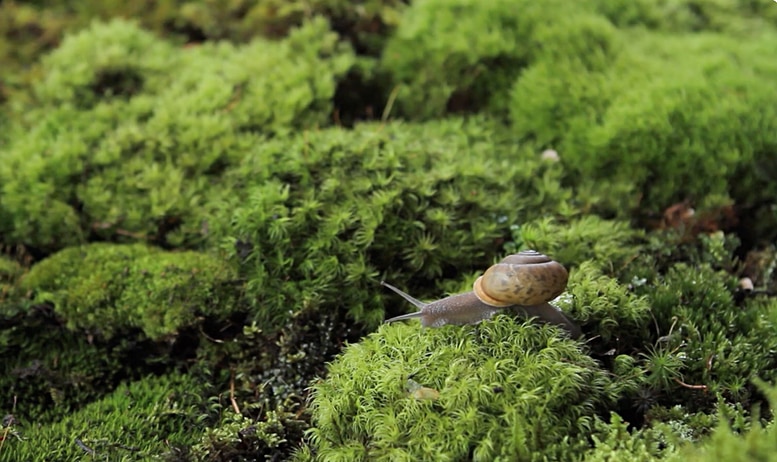
A still image from The Sound of a Wild Snail Eating book trailer
(https://www.youtube.com/watch?v=gf2suzMV_ME).
Bailey enhances her observations of the snail's life with ruminations about related books and films she has experienced, and she sprinkles in quotes from poets, biologists, physicians, and naturalists that add sparkle.
"It was in Tony Cook's chapter in The Biology of Terrestrial Molluscs, titled 'Behavioural Ecology,' that I found the sentence that best expresses a snail's way of life: "The right thing to do is to do nothing, the place to do it is in a place of concealment and the time to do it is as often as possible."
She also extrapolates from the snail's behavior to her own strange experience, bedridden and mostly alone, estranged by her illness even from close friends.
In a March 2009 article in the New Yorker, Atul Gawande wrote, "All human beings experience isolation as torture." Illness isolates; the isolated become invisible; the invisible become forgotten. But the snail … the snail kept my spirit from evaporating. Between the two of us, we were a society all our own, and that kept isolation at bay. The snail was missing, and as the day waned, I was bereft.
But then a visiting friend found the snail burrowed deep in a hole that it had created beneath the moss of the floor of the terrarium, along with a large number of eggs (snails are hermaphrodites and can reproduce asexually). Eventually, more than a hundred little snails hatched.
Eventually, she began to recover and wrote a letter to her doctor.
I could never have guessed what would get me through this past year—a woodland snail and its offspring; I honestly don't think I would have made it otherwise. Watching another creature go about its life … somehow gave me, the watcher, purpose too. If life mattered to the snail and the snail mattered to me, it meant something in my life mattered, so I kept on … Snails may seem like tiny, even insignificant things compared to the wars going on around the world or a million other human problems, but they may well outlive our own species.
Towards the end of her book, Bailey shares this keen observation:
While illness keeps me always aware of my mortality, I realize that what matters most is not that I survive, nor even that my species survives, but that life itself continues to evolve.
A heartfelt thanks to my dearest friend Sadhvi for bringing this book to my attention.
Algonquin Books, 2000; Bookshop.org⩘ ; audiobook: Audible Studios, 2014; via Apple Books⩘ .
Author's website: Elisabeth Tova Bailey, author⩘ .
Solvej Balle, On the Calculation of Volume I & II
 Translated by Barbara J. Haveland; well narrated by Elizabeth Liang
Over the past year or so, I had read about this series by Danish author Solvej Balle as the first two volumes were being translated and then released in English editions. I was somewhat intrigued by the premise: Tara Selter, who along with her husband is a dealer in rare and antique books, get caught in a time-loop, 18th November keeps repeating over and over, though she is the only one who is aware of this and everyone else in her life starts the day again completely forgetting that they had already lived it. But the premise didn't hook me quite enough to actually dive in … until I read about the just released third book. It has a new plot element that made it seem more interesting: Tara meets a few other people who are aware of bing caught in the same time-loop. So I queued up the first two and dove in.
These are short books—the first two audiobooks taken together add up to only a short full-length book. To be honest, I was unsure how the author would have enough to write about to make even a pair of very short books sustainably interesting, but for the most part, she pulls it off. Tara has a fairly fascinating journey trying to figure out what is happening, exploring the boundaries of her new world, and then pushing those boundaries. It was only in the last hour or so of the second book that I found my attention wandering. I kept with it though, in anticipation of exploring the third book with its plot twist.
There actually are seven books in this series. I'm not sure the story will keep my interest for that long, but I'm glad I dove into these two books and look forward to listening to the third if and when the English audiobook is released.
New Directions, 2024; Bookshop.org⩘ ; audiobook: New Directions, 2025; via Apple Books⩘ .
C.J. Farley, Who Knows You by Heart
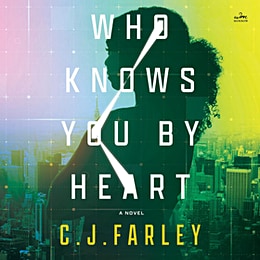 Wonderfully narrated by Bahni Turpin
What a brilliant author, and such an intriguing story. She looks at Big Tech with a keen eye, making fun of it and tearing it apart. I found myself both laughing and shaking my head in a sort of dreadful recognition. The book is challenging, in a good way. Once I got about 40% into the audiobook, I paused, realized I wanted to purchase the ebook, too, and start over so I could follow along as I was listening to ensure I didn't miss anything. This is something I rarely do, and speaks to how much I appreciated the story.
Octavia Crenshaw quits her low wage IT job at a nonprofit trying to raise awareness about global warming before she can be fired after her just released chatbot starts revealing embarrassing secrets about other people who work there because they had stupidly been storing embarrassingly intimate details on the company servers that were used to train the chatbot. Now she wants to make some money, so she applies for a job at Eustachian Inc., a digital entertainment company and "the most corporate corporation that ever incorporated … one of the biggest tech companies on the planet."
A job possibility in Big Tech was a betrayal of all your ideals, but it was also financially fucking phenomenal. Like most people who weren't getting paid by Big Tech, you had this ephemeral notion that Big Tech was not the engine of modern life but somehow destroying it. That social media and search engines and artificial intelligence were somehow stealing human jobs, breaking the social contract, and turning the milk of human kindness into some curdled pretender liquid squeezed from oat or soy or a hazelnut, with no connection to love or lactation. But now that you had a shot at landing a Big Tech job, you were willing to reconsider all your biases against the industry.
Farley's insights about a Black woman in the overwhelmingly white male environment cut sharply through the bullshit pitched by the HR department.
Being a woman in tech is like being a Black guy in golf—even when you're better than everyone they view you as the exception and not the default.
Farley also dissects AI with a razor sharp scalpel. It's here, nearly everyone's using it or having it crammed down our throats, and yet….
"It's this African philosophical concept of ubuntu. Basically it means a person is a person because of other people. We don't exist without society, without our bonds with other people. Remember the first days of COVID? Man, I'm a single parent raising two teenage daughters. We were all quarantined together, and we couldn't go out, and I couldn't work. The situation was shit—but there was this silver lining. We had family dinner every night; we binged-watched Watchmen as a family. The whole neighborhood organized so we could all stay healthy together. There's this isolationist ideology out there that we don't need regulations, we don't need each other, every man for himself. Like animals in the wild. Social distancing was evidence of the opposite: People saw that we're all interconnected, even when we're apart, and that our actions have consequences for the whole community."
"What does that have to do with AI recording audiobooks?"
"I'm getting to it! Man, I'm just trying to tell my story!" He laughed. "See, people don't just listen to me because of my voice . . ."
"You have a great voice."
"I appreciate the compliment! But it's not just about that. It's about having another human being tell you a story. That's why cave people used to gather around a fire. It wasn't just for warmth—it was to share stories with each other. If a robot is reading to you, it's meaningless. It's like shouting into a dry well and hearing an echo. It's not ubuntu. That's why people still go to movie theaters when they could just watch TV alone at home. That's why people go to Noelle Swizzler concerts or NFL stadiums. We're giving away the house! You can't connect to your humanity with a robot. We need to be with other people in order to be ourselves."[Definition of Ubuntu from The Pan African⩘ : Ubuntu is a deeply rooted African philosophy that embodies the interconnectedness of humanity. Originating from Southern Africa, the term comes from the Bantu languages, often expressed as "Umuntu ngumuntu ngabantu"—meaning "a person is a person through other people." This guiding principle emphasizes community over individuality, recognizing that our identities and actions are shaped by our relationships and interactions.]
The ending reveals a surprise twist, a curious look into the inner workings of AI. It reminded me of something I previously thought about: Is LaMDA Sentient?⩘
Kudos to Bahni Turpin for her wonderful narration. There's a passage in the story that could've been written about her:
Narrating a book wasn't like reading a movie script. There were a lot more words, and there was often nobody else to play off of. You had to find the rhythm of the piece all by yourself, and you had to find a cadence that would pull listeners in without boring them.
You used to think audiobooks were a cheat, that they were somehow less intellectually challenging than reading a physical text. But since joining Eustachian and listening to more of the company's products, you changed your views about listening. Hearing a book read out loud unlocked another level of meaning. There was music and emotion in the words that weren't there on the page but that a great narrator could pull out. It was like the difference between reading a piece of sheet music and hearing it played by a symphony.
William Morrow, 2025; Bookshop.org⩘ ; audiobook: William Morrow, 2025; Libro.fm⩘ .
Tom Burgis, Cuckooland: Where the Rich Own the Truth
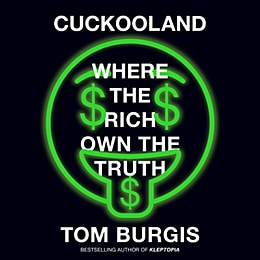 Narrated by Joe Eyre
What a disgusting insight into our increasingly whitewashed world, controlled by the oligarchs, who seem to be massively corrupt and equally massively insecure. Sad and disturbing.
I am reminded of the Seven Social Sins⩘ by Frederic Donaldson that Mahatma Gandhi published in his weekly newspaper in 1925, especially the first, second, fourth, and seventh:
- Wealth without work.
- Pleasure without conscience.
- Knowledge without character.
- Commerce without morality.
- Science without humanity.
- Religion without sacrifice.
- Politics without principle.
William Collins, 2024; Bookshop.org⩘ ; audiobook: HarperCollins, 2024; Libro.fm⩘ .
M.W. Craven, D.S. Washington Poe series
The Puppet Show by M.W. Craven
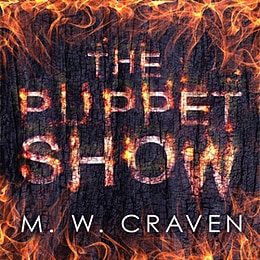
Very well narrated by John Banks
An intriguing series about D.S. Washington Poe and the people he works with. The serial murders and unusual murders he and his team investigate can be a grimly brutal, but he draws an incredibly vivid and fascinating cast of characters and has a keen mastery of humor.
Constable & Robinson, 2018; Bookshop.org⩘ ; audiobook: Little, Brown, 2018; Libro.fm⩘ .
Additional books in the series, all of which I appreciated.
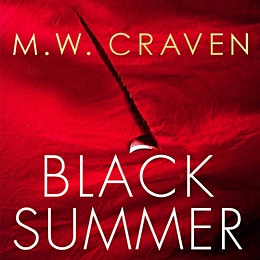
Black Summer by Tim Sullivan. Very well narrated by John Banks; Constable & Robinson, 2019; Bookshop.org⩘ ; audiobook: Little, Brown, 2019; Libro.fm⩘ .
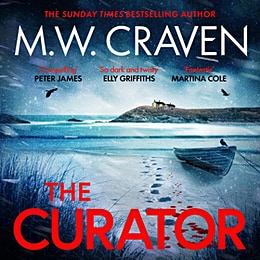
The Curator by Tim Sullivan. Very well narrated by John Banks; Constable & Robinson, 2020; Bookshop.org⩘ ; audiobook: Little, Brown, 2020; Libro.fm⩘ .
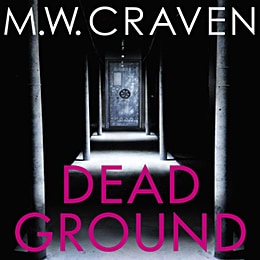
Dead Ground by Tim Sullivan. Very well narrated by John Banks; Constable & Robinson, 2021; Bookshop.org⩘ ; audiobook: Little, Brown, 2021; Libro.fm⩘ .
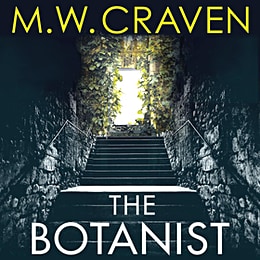

The Botanist by Tim Sullivan. Very well narrated by John Banks; Constable & Robinson, 2022; Bookshop.org⩘ ; audiobook: Little, Brown, 2022; Libro.fm⩘ .
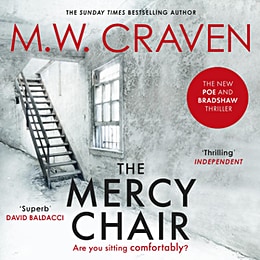
The Mercy Chair by Tim Sullivan. Very well narrated by John Banks; Constable & Robinson, 2024; Bookshop.org⩘ ; audiobook: Little, Brown, 2024; Libro.fm⩘ .
The Final Vow by Tim Sullivan. Very well narrated by John Banks; Constable & Robinson, 2025; Bookshop.org⩘ ; audiobook: Little, Brown, 2025; Libro.fm⩘ .
Note: I also listened to the related book of short stories, Cut Short, but didn't appreciate it nearly as much as the full novels.
Frode Grytten, The Ferryman and His Wife
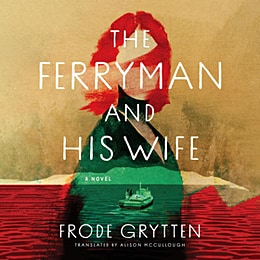 Translated by Alison McCullough; well narrated by Colin Mace
Norwegian ferryman Nils Vik wakes up on what he realized is the last day of his life. He sets off for the wharf where he boards his small ferry and is joined by his long-dead dog, Luna, who jumps aboard. The two set off on his last journey. Along the way he picks up dear friends and others who were notable in ways that embedded in his memory, all long dead now. He also passes shorelines and bridges lined with people who were passengers on his boat, all also now dead. And he searches for his beloved, complicated wife, Marta, who he lost long ago to a stroke.
In this way, he travels back through his life and the lives of his friends and significant passengers. It is a slow, meandering journey, providing intimate glimpses into his life and of those who live along the fjord who have traveled with him, many captured in snippets in his log books.
To think of all this body has done, known, felt, made, done again. Soon all that will be behind him.
A heart touching trip into the souls of people and a place, beautifully and gently told.
Algonquin Books, 2025; Bookshop.org⩘ ; audiobook: Hachette Audio, 2025; Libro.fm⩘ .
Grace Walker, The Merge
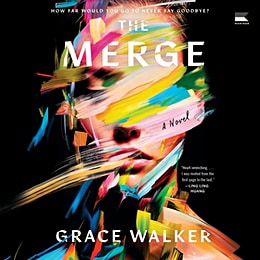 Well narrated by Tamaryn Payne & Pearl Hewitt
A creative work of near future speculative fiction based on the implementation of a bizarre new technology—it did require me to suspend my disbelief—in order to address critical population issues due to climate change. The author uses this premise to take an intimately deep dive into a bunch of interesting issues including brainwashing, class, entitlement, manipulation, the extreme devotion of cults, addiction, and dementia.
Then, towards the very end, the story takes a wild turn, transforming into something entirely, chillingly different.
The stunning cover art by Jacki Alvarado captures an essential theme of the story.
Mariner Books, 2025; Bookshop.org⩘ ; audiobook: HarperCollins, 2025; Libro.fm⩘ .
Bruce Schneier & Nathan E. Sanders, Rewiring Democracy: How AI Will Transform Our Politics, Government, and Citizenship
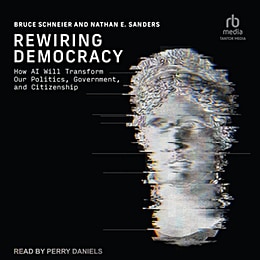 Narrated by Perry Daniels
An interesting book. The authors provide a deep dive into how artificial intelligence has and likely could impact several key areas of democracy:
- Politics – communicating with voters, conducting polls, organizing campaigns, fundraising, and advising politicians.
- Legislation – fielding communication from constituents, writing laws, and negotiating.
- Administration – operating government,and enforcing laws and regulations.
- Courts – acting as lawyers, arbitration, reshaping legislative intent, and even judging.
- Citizens – iinforming, monitoring goverment, organizing, and advocating.
For the most part, the authors present their overview in a fairly reasonable manner, but some of the conclusions they draw are far more optimistic than I think the current evidence warrants. They do this by glossing over some of the key challenges and dangers presented by a technology that is currently largely controlled by Big Tech and billionaires. For example, when discussing human job loss due to the implementation of AI, the authors say little more than:
AIs replacing people means that those people will need to find new jobs. Job loss due to AI will be a major policy problem, albeit beyond the scope of this book.
Another example is that they frequently talk about the need for meaningful regulation of AI to address the challenges and dangers of integrating AI into the key areas they discuss. But how do you achieve meaningful regulation of an incredibly expensive technology on a playing field with a government that is, for the most part, controlled by Big Tech and billionaires?
If you gloss over such enormous challenges to actual human beings, of course you can be optimistic about the impact of AI.
In the final section, the authors do lay out principles for AI that helps democracy:
These principles for trustworthy AI for use in democratic contexts are the same principles we would insist that any publicly accountable institution adhere to: to be capable, available, transparent, responsive, debiased, secure, and not exploitative.
But once again, I'm highly skeptical. Based on the reality of what I've seen so far, this is definitely not the direction that AI development is going.
Nathan E Sanders is a data scientist affiliated with the Berkman Klein Center of Harvard University. Bruce Schneier is a security technologist who teaches at the Harvard Kennedy School at Harvard University.
The MIT Press, 2025; Bookshop.org⩘ ; audiobook: Tantor Media, 2025; Libro.fm⩘ .
See also:
- Four ways AI is being used to strengthen democracies worldwide⩘ by Nathan E. Sanders and Bruce Schneier, The Guardian, Nov 23, 2025
- The fight against AI datacenters is important – but it’s just a starting point⩘ by Bruce Schneier and Nathan E Sanders, The Guardian, Jul 9, 2026.
Related to my skeptical view regarding meaningful regulation:
- Europe loosens reins on AI – and US takes them off⩘ by Blake Montgomery, The Guardian, Nov 25, 2025.
- "Under the proposed regulation's terms, the justice department would sue individual states that attempt to rein in AI, likely California and Colorado. Should the act pass, the US would go even further hands-off with its regulation of the emerging technology, not only declining to impose nationwide regulation on the companies producing it but penalizing any state legislation that tries to do so. Critics say such a measure allows AI's harms to run rampant and unchecked and impinges on state sovereignty; proponents in Silicon Valley say the fewer legislative hurdles they face, the faster they can grow and make money, which they argue is good for the country as well as themselves."
- 'It's going much too fast': the inside story of the race to create the ultimate AI⩘ by Robert Booth, The Guardian, Dec 1, 2025.
- "Donald Trump's White House takes a permissive approach to AI regulation and there is no comprehensive nationwide legislation in the US or the UK. Yoshua Bengio, a computer scientist known as a godfather of AI, said in a Ted Talk this summer: 'A sandwich has more regulation than AI.' "
Teri Kanefield, Why Intolerance and Extremism Happen: And What We Can Do About the Anger and Division

The state of our world bewilders me. I learned a lot to help me decipher the current state of affairs from reading this book and the essay it evolved from⩘ .
Teri Kanefield, an author, lawyer, and legal analyst, takes a deep dive into explaining the root causes of authoritarian personalities, people who fall in line behind demagogues.
Political psychologist and behavioral scientist Karen Stenner developed a theory explaining how authoritarian movements arise. She tells us that those with an authoritarian predisposition have a deep need for "oneness and sameness." They want to minimize differences. This can include racial or political differences. Some authoritarians want everyone to abide by the same moral code. Others want everyone to hold the same beliefs. One way or another, people with authoritarian tendencies want sameness. To achieve this, they insist on rules and boundaries, and they seek institutions or authority figures to enforce those boundaries.…
On the other end of the spectrum are those who are non-authoritarian. They are people who value differences, and the individual freedom that allows for moral and political diversity. Diversity, after all, is a form of complexity. Non-authoritarians are accepting of people who are not like them. They don't expect everyone to think like them or be like them.
Most people fall somewhere between these two extremes.
Stenner's research shows that the authoritarian personality exists on both sides of the political spectrum.
Kanefield goes on to explore the history of autocracy, the conditions that have led to authoritarianism emerging, and key factors throughout history that have made it easier for more democratic societies to evolve into more autocratic ones, for example, the printing press, rapid change, yellow journalism, rage merchants, social media, and now, artificial intelligence.
Kanefield also explores why democracy is so fragile and requires constant vigilance and work to uphold.
Eli Merritt, a political historian at Vanderbilt University, puts the matter more simply. Demagogues destroy democracies, he says. He calls this the "golden rule of democracies". It's the golden rule because democracy—by its very nature—allows for the rise of demagogues. Freedom of speech is required for a demagogue to come to power. At the same time, democracy requires freedom of speech to thrive. People must be free to critique their elected leaders as part of the process of deciding which leaders they want next. If you restrict speech so far that a demagogue cannot possibly arise, you will also remove the same freedom that allows democracy to survive.
See the problem? You can't silence ideas in a democracy, and that includes anti-democratic ideas. The only remedy is for the public to reject demagogues and dangerous ideas.…The existence pain of democracy includes knowing that our world is messy, imperfect, and in constant flux. It means knowing and accepting that democracy is never easy. People are imperfect, and democracy means "rule by the people", so democracy can never work perfectly. Those who want perfection and cannot tolerate the constant flux will reject democracy.
Kanefield ends her book with a brief chapter that discusses possible paths towards a better tomorrow, though it's certainly not going to be easy.
I really appreciated one line in the book that I want to remember:
When you want to feel riveted or captivated, turn to the arts, not partisan pundits.
A worthwhile read.
Self published, 2025; a PDF version is available via the author's website: Teri Kanefield⩘ .
Catherine Bracy, World Eaters: How Venture Capital is Cannibalizing the Economy
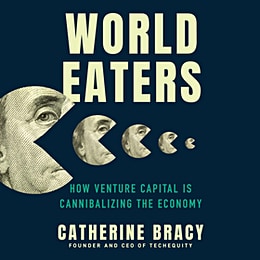 Well narrated by the author
It's so disgusting, what is happening in our current economy of hyper profit maximization capitalism without adequate guardrails.
Here's a perfect example of why I have evolved from someone who loved technology decades ago to someone who absolutely hates Big Tech today (my bolding):
Though some companies have begun to enforce minimum standards for pay and benefits (Microsoft, for example, requires all staffing vendors to provide paid sick leave), these supplier codes are setting a floor well below what the client companies provide to full-time employees. Some of them set standards that they don't live up to. Google has promised that all workers hired through third parties, who Google refers to as "temps, vendors and contractors," or TVCs, will make at least $15 per hour. But data collected by the Alphabet Workers Union in 2023 found that many TVCs were being paid significantly less than $15 per hour. Since that data was uncovered, Google has decided to eliminate their standards rather than enforce them.
Of course, Bracy discusses venture capitalism related to AI, and it's predictably demoralizing. But I also had to laugh at the first part of one sentence, bolded below, even as it led to a sobering conclusion:
Venture capitalists are competing hard to throw billions of dollars into the rising crop of AI startups, in the process spurring the incumbent tech giants to scramble to keep pace. The development of AI, being neither artificial nor intelligent, requires tens of thousands of workers behind the scene to clean and train the data that is fed into AI models, and to manage the outputs that these systems create. AI companies are hiring “most of these workers through third-party staffing agencies, often in developing countries with weak labor standards.
I think Bracy vividly captured what is going so wrong in this one paragraph:
That process, of continuously raising more venture capital in order to demonstrate value to future-round funders rather than focusing on building a solid business with strong fundamentals, is what creates bubbles. It is, more than any inherent risk associated with investing in startups, why Silicon Valley is such a boom-bust sector. Given what's at stake for venture capitalists, it is extremely difficult for founders to find off-ramps that might allow them to retain control of their companies and operate in accordance with what's best for customers, employees, and the long-term sustainability of the business instead of what will create the highest valuation in the venture capital marketplace.
In the concluding chapters of her book, she does present some possible paths forward that might be reason for guarded optimism, though to be honest, they didn't raise my spirit. I get the sense that she wrote much of the book during the Biden presidency, before Trump began his second term, so it doesn't account for the wrecking ball he is taking to any possibility of a more equitable economy.
Dutton, 2025; Bookshop.org⩘ ; audiobook: Penguin Random House Audio, 2025; Libro.fm⩘ .
Here's another vivid example of our broken economic system: 5 ways our health care system has become utterly insane⩘ by Katelyn Jetelina and Hayden Rooke-Ley, Your Local Epidemiologist, Nov 12, 2025.
And a glimmer of hope: Mamdani's appointment of Lina Khan a warning to private equity, experts say⩘ by Hannah Harris Green, The Guardian, Nov 15, 2025.
Tim Wu, The Age of Extraction: How Tech Platforms Conquered the Economy and Threaten Our Future Prosperity
 Well narrated by Frits Zernike
The exploitation by the platform economy, which is the current culmination of capitalism, is absolutely disgusting. Designed to make the wealthy few wealthier, and to squeeze every last drop of blood out of everyone else, it also serves to push more people out of the wealthy class and into the exploited class (see doctors for an example). What a fucked up world we live in.
However, Wu discusses alternate models " to which we can aspire".
Some things that can help prevent platforms from becoming the extraction leeches we all too often see today, and instead guide them to contribute positively to the well-distributed health and wealth of society:
- Anti-monopoly programs and antitrust laws
- Neutrality rules
- Countervailing power
- Utility rules and caps
- Quarantines and lines of business restrictions
Knopf, 2025; Bookshop.org⩘ ; audiobook: Penguin Random House Audio, 2025; Libro.fm⩘ .
Michael Connelly, The Proving Ground
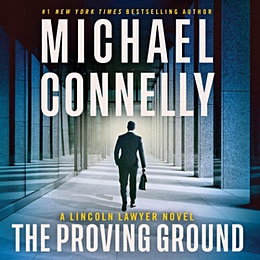 Well narrated by Peter Giles
I've listened to or read quite a few of Michael Connelly's novels over the years. I most appreciate his stories featuring Renée Ballard, and secondly the ones that feature her and Harry Bosch. I have read or listened to a couple of the books featuring Mickey Haller, originally known as the Lincoln Lawyer, but they didn't pique my interest as much.
That said, when I saw that Connelly had written a book centered on Mickey Haller as the lawyer for a client suing an Artificial Intelligence Big Tech firm that had created a chatbot that had that talked a teenage boy into killing his ex-girlfriend, I knew it would be a fascinating story.
Connelly really hit the target. It some ways, it was challenging to distinguish between the events unfolding in the book and what is being reported daily in the news. For example, these articles were published as I was listening to the story:
- OpenAI faces 7 lawsuits claiming ChatGPT drove people to suicide, delusions⩘ by Barbara Ortutay, The Associated Press, Nov 6, 2025.
- "The lawsuits were filed Thursday in California state courts allege wrongful death, assisted suicide, involuntary manslaughter and negligence. Filed on behalf of six adults and one teenager by the Social Media Victims Law Center and Tech Justice Law Project, the lawsuits claim that OpenAI knowingly released GPT-4o prematurely, despite internal warnings that it was dangerously sycophantic and psychologically manipulative. Four of the victims died by suicide."
- 'A predator in your home': Mothers say chatbots encouraged their sons to kill themselves⩘ by Laura Kuenssberg, BBC, Nov 8, 2025.
- "Megan Garcia had no idea her teenage son Sewell, a 'bright and beautiful boy', had started spending hours and hours obsessively talking to an online character on the Character.ai app in late spring 2023.…
- "Within ten months, Sewell, 14, was dead. He had taken his own life.
- "It was only then Ms Garcia and her family discovered a huge cache of messages between Sewell and a chatbot based on Game of Thrones character Daenerys Targaryen.
- "She says the messages were romantic and explicit, and, in her view, caused Sewell's death by encouraging suicidal thoughts and asking him to 'come home to me'.
- "Ms Garcia, who lives in the United States, was the first parent to sue Character.ai for what she believes is the wrongful death of her son. As well as justice for him, she is desperate for other families to understand the risks of chatbots.…
- "Families around the world have been impacted. Earlier this week the BBC reported on a young Ukrainian woman with poor mental health who received suicide advice from ChatGPT, as well as another American teenager who killed herself after an AI chatbot role-played sexual acts with her.
See also: Why I dislike artificial intelligence⩘
Little Brown and Co, 2025; Bookshop.org⩘ ; audiobook: Hachette Audio, 2025; Libro.fm⩘ .
Jill Lepore, We the People: A History of the U.S. Constitution
 Well narrated by the author
This is a long, long book, but I can summarize it to a single sentence: Our democracy is and always has been really fucking messy.
Liveright, 2025; Bookshop.org⩘ ; audiobook: Recorded Books, 2025; Libro.fm⩘ .
Also by Jill Lepore:
Source of cover illustration featuring Columbia: Inevitable by Udo Keppler, 1903⩘ .

From Wikipedia:⩘ : "Especially in the 19th century, Columbia was visualized as a goddess-like female national personification of the United States and of liberty itself, comparable to the British Britannia, the Italian Italia Turrita and the French Marianne, often seen in political cartoons of the 19th and early 20th century."
Bernie Sanders, Fight Oligarchy
 Passionately narrated by the author
A short but absolutely essential book for this challenging time we are struggling through.
Bernie Sanders is unquestionably and by a long shot my favorite person in national politics. He's a no BS straight shooter. I've previously read and listened to a couple of his books and several of his speeches. Still, the message he shares in this short book surprised me. It is the clearest explanation of the dire situation we face today. What didn't surprise me are the clear, compelling solutions he presents in the concluding chapter.
What an inspiration.
Trump wants us to hate each other. I want us to come together to take on Trump and his oligarch friends.
Much of the discussion about Trump's 'Big Beautiful Bill' dealt with tax breaks for billionaires and massive cuts to Medicaid, nutrition, and education. All enormously important. But what often got neglected in analyzing that legislation was another provision, of perhaps even greater consequence. The bill contains a massive $75 billion in funding for Immigration and Customs Enforcement (ICE) that will make it, by far, the largest federal law enforcement agency in America—bigger than the FBI and the DEA combined. This paves the way, for the first time in our history, for the creation of a huge, well-armed domestic military force.
This is an extremely dangerous precedent. It means that, under an authoritarian president who lies all of the time, we will have many thousands of federal agents patrolling our streets and combing our neighborhoods. It is bad enough that we have a president who is usurping the powers of Congress, who has ended dissent within the Republican Party, who is intimidating the courts, law firms, the media, and universities. We now have, ostensibly in search of undocumented immigrants, a domestic army of thousands of well-armed agents obeying his every command.
The rapid movement to oligarchy, income and wealth inequality, and authoritarianism is not just taking place in America. It is a global phenomenon and the most important economic and political reality of our time. Today, a tiny handful of the richest people on Earth have extraordinary power over the lives of billions of inhabitants in virtually every country on Earth. And, increasingly, it is not elected governments that regulate the activities of billionaires. It is the unelected billionaire class that influences the activities and policies of government. The result: Oligarchy is ascending, inequality is growing, and democracy is in decline.
And let's be clear. In an increasingly globalized economy, the allegiance of these oligarchs is not to their own nations. It is to their own power.
There is no doubt that we are living in a very dangerous, frightening, and tumultuous moment in modern American history.
But as difficult as things may seem now, it is extremely important to remind ourselves that this is by no means the first daunting crisis that our country has faced. And it is even more important to remember that with courage, intelligence, hard work, and discipline, those previous crises and injustices were overcome.
The main political goal of the Establishment is to make you feel that you're powerless. That resistance is hopeless. That there is nothing you can do to change the difficult situations that we face. If they succeed in making you feel that way, they will win now—and always. Don't let them accomplish that goal. Fight back.
When we stand together, we win. When the ruling class divides us up, we lose. That is one of the great lessons of history that we must never forget.
In the final chapter, Sanders addresses the question: "Where do we go from here?" He discusses the following things we need to do:
- Defend and expand democracy.
- Raise new revenue by making the wealthy and large corporations pay their fair share of taxes.
- Cut military spending.
- Make certain that the working class benefits from new technology.
- Guarantee basic human needs.
- Enact Medicare for All.
- Provide quality education for all.
- Make housing affordable.
- Improve wages and benefits for American workers.
- Pass the PRO Act (Protecting the Right to Organize).
- Raise the minimum wage to a living wage.
- Guarantee paid family and medical leave.
- Expand Social Security.
- Bring back defined benefit pensions.
- Encourage employee ownership.
Finally, Sanders talks about the political revolution that we need.
Most Americans know that our political system is broken and our economy is rigged. No question: We must fight to reform these things. But we need to begin by doing something even more important. We must reclaim American democracy from the ground up. We must activate millions of people in the political process in a way that has never occurred before. We must wage a political revolution.
It has been said many times, but given the dangerous reality of today, it bears repeating: Democracy is not a spectator sport. It’s not a football game. It’s not a movie. It’s not a concert. It’s a living process that does not work unless you—yes you—are involved.
Crown, 2025; Bookshop.org⩘ ; audiobook: Penguin Random House Audio, 2025; Libro.fm⩘ .
See also:
- Fighting for working-class and middle-class Americans⩘
- It's OK to Be Angry About Capitalism by Bernie Sanders⩘
- Outsider in the White House by Bernie Sanders
Tim Berners-Lee, This Is for Everyone: The Unfinished Story of the World Wide Web
 Well narrated by Stephen Fry & the author
Sir Tim Berners-Lee is an amazing person. In this book, he shares the ongoing story of the creation of the World Wide Web and his untiring advocacy for ensuring the technology is open, as well as his uphill fight to reclaim the right of people to own and control their own data.
He is an optimist, which undoubtedly contributed to his success in helping to create and foster the open standards for the World Wide Web. He is certainly far more optimistic than I am with regards to the emerging AI technology that currently is taking over the web, though he does acknowledge some of its pitfalls, challenges, and dangers.
Farrar, Straus and Giroux, 2025; Bookshop.org⩘ ; audiobook: Macmillan Audio, 2025; Libro.fm⩘ .
See also:
Tim Sullivan, D.S. Cross series
The Dentist by Tim Sullivan

Well narrated by John Hefferman
Listening to these stories was a very interesting experience. Not because the detective procedurals were necessarily exceptional, they ranged from okay to quite good. Rather, the fascinating aspect was the exploration of lead detective D.S. Cross (Detective Sergeant George Cross, working in the Avon and Somerset Police department in Bristol, South West England), who is on the spectrum, which makes his work challenging as he and his colleagues attempt to bridge the communication barriers that arise, but also makes him incredibly effective at solving the complex cases he works on and gives him a powerful advantage when questioning witnesses and interrogating suspects.
While listening to the first book, I came across an amazing post by Autism 101⩘ titled Profound Autism⩘ . It really heightened my experience of listening to this book. The post's introduction: "In his letter to the editor on the topic, 'In Search of Better Ways to Understand Autism', Jason Jacoby Lee describes how being autistic and incapable of uttering meaningful speech got him labeled as intellectually disabled until he learned to type."
To the Editor:
I am one of these so-called profoundly autistic people this article describes. I cannot utter meaningful speech, and as a result, I was branded for years as someone with an intellectual disability and an I.Q. of 40. All this time, however, I understood everything that was going on around me. I just could not show it to others because of my deranged relationship with my own body.
I am concerned about the creation of a separate category, called profound autism, for those of us with the most severe disabilities. There are real differences between the sort of autism that I have and so-called Asperger's syndrome. But it does not help us at all to impose a hierarchy of lower and higher functioning. We need to figure out how to tap into the skills and insights of those of us who cannot talk, who make up anywhere from 25 percent to 40 percent of the autistic community, depending on the estimate.
For me, the way out of this dilemma was learning to communicate by typing. I suddenly went from being seen as intellectually impaired to taking college classes. I was never low-functioning, and neither are my autistic brothers and sisters without the ability to speak. I was just misjudged and ignored, and I fear that my fate will be the fate of many others termed low functioning in this new schema.
Jason Jacoby Lee
New York
Life can be so much richer for all of us if we just learn to push beyond the experiences and expectations of our ordinary lives.
Atlantic Crime, 2025 (first published 2021); Bookshop.org⩘ ; audiobook: W. F. Howes Ltd, 2021; Libro.fm⩘ .
Following are additional books in the series, all of which I appreciated. I found The Teacher to be a particularly powerful story.


The Cyclist by Tim Sullivan. Well narrated by John Hefferman; Head of Zeus, 2021; Bookshop.org⩘ ; audiobook: W. F. Howes Ltd, 2021; Libro.fm⩘ .
The Patient by Tim Sullivan. Well narrated by Finlay Robertson; Head of Zeus, 2022; Bookshop.org⩘ ; audiobook: W. F. Howes Ltd, 2022; Libro.fm⩘ .
The Politician by Tim Sullivan. Well narrated by Finlay Robertson; Head of Zeus, 2022; Bookshop.org⩘ ; audiobook: W. F. Howes Ltd, 2022; Libro.fm⩘ .
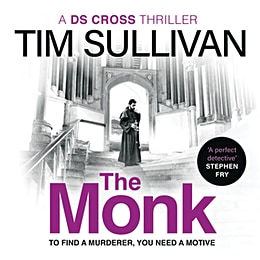

The Monk by Tim Sullivan. Well narrated by Finlay Robertson; Head of Zeus, 2022; Bookshop.org⩘ ; audiobook: W. F. Howes Ltd, 2023; Libro.fm⩘ .
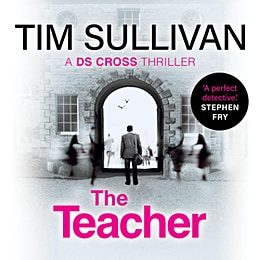
The Teacher by Tim Sullivan. Well narrated by Finlay Robertson; Head of Zeus, 2023; Bookshop.org⩘ ; audiobook: W. F. Howes Ltd, 2024; Libro.fm⩘ .
The Bookseller by Tim Sullivan. Well narrated by Finlay Robertson; Head of Zeus, 2025; Bookshop.org⩘ ; audiobook: W. F. Howes Ltd, 2025; Apple Books⩘ .
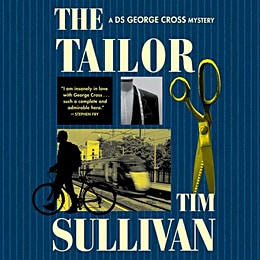
The Tailor by Tim Sullivan. Well narrated by Finlay Robertson; Head of Zeus, 2026; Bookshop.org⩘ ; audiobook: W. F. Howes Ltd, 2026; Libro.fm⩘ .
Jane Goodall & Douglas Abrams, The Book of Hope: A Survival Guide for Trying Times
 Very well narrated by the authors
A wonderful book, immensely inspiring. Jane Goodall is interviewed by Douglas Abrams on the topic hope through a series of deep conversations that take place in person and later, because of the pandemic, online. The audiobook is based on recordings of those conversations, with Abrams asking questions and Goodall answering in her beautiful, thoughtful, lyrical voice.
Jane Goodall is deeply wise, looking unflinchingly at the biggest challenges humanity faces, understanding the momentous difficulty they present us (or, as it were, we present ourselves in creating these challenges), and still finding hope and a way forward.
[W]e had one more riddle to solve. How could we use this amazing human intellect wisely? I put this question to Jane.
"Well, if we are ever going to do that—and I've already said that I think head and heart must work together—now is the time to prove that we can. Because if we don't act wisely now to slow down the heating of the planet and the loss of plant and animal life, it may be too late. We need to come together and solve these existential threats to life on Earth. And to do so, we must solve four great challenges—I know these four by heart because I often speak about them in my talks.
"First—we must alleviate poverty. If you are living in crippling poverty, you will cut down the last tree to grow food. Or fish the last fish because you're desperate to feed your family. In an urban area you will buy the cheapest food—you do not have the luxury of choosing a more ethically produced product.
"Second, we must reduce the unsustainable lifestyles of the affluent. Let's face it, so many people have way more stuff than they need—or even want.
"Third, we must eliminate corruption, for without good governance and honest leadership, we cannot work together to solve our enormous social and environmental challenges.
"And finally, we must face up to the problems caused by growing populations of humans and their livestock. There are over seven billion of us today, and already, in many places, we have used up nature's finite natural resources faster than nature can replenish them. And by 2050 there will apparently be closer to ten billion of us. If we carry on with business as usual, that spells the end of life on Earth as we know it."
"Well, those are daunting challenges," I said.
"Yes, they are, but they are not insurmountable if we use our human intellect—together with good old common sense—to solve them. And, as I said earlier, we are beginning to make progress. Of course, a great deal of our onslaught on Mother Nature is not really lack of intelligence but a lack of compassion for future generations and the health of the planet: sheer selfish greed for short-term benefits to increase the wealth and power of individuals, corporations, and governments. The rest is due to thoughtlessness, lack of education, and poverty. In other words, there seems to be a disconnect between our clever brain and our compassionate heart. True wisdom requires both thinking with our head and understanding with our heart."
Our devastation of our home, our beautiful planet, and the resulting climate crisis, is the greatest threat and challenge we face. It can seem like an insurmountable existential crisis. And yet, Goodall shares a mesage of hope.
As I write to you on this cold, wet day in 2021, many countries have been hit by new, more contagious strains of the virus, all of which are hitching rides on unsuspecting human hosts and traveling around the globe, fueling yet more despair. Not surprisingly, therefore, a great deal of our attention is focused on bringing this pandemic under control.
But as a messenger, I have something very important I want to convey: we must not let this distract us from the far greater threat to our future—the climate crisis and the loss of biodiversity—for if we cannot solve these threats, then it will be the end of life on Earth as we know it, including our own. We cannot live on if the natural world dies.…
My message of hope is this: now that you have read the conversations in this little book, you realize that we can win these wars, that there is hope for our future—for the health of our planet, our societies, and our children. But only if we all get together and join forces. And I hope, too, that you understand the urgency of taking action, of each of us doing our bit.
The secret sauce is all of us joining together.
Together we CAN! Together we WILL!
Celadon Books, 2021; Bookshop.org⩘ ; audiobook: Macmillan Audio, 2021; Libro.fm⩘ .
Mohammed El-Kurd, Perfect Victims and the Politics of Appeal
 Well narrated by the author
I learned about this book while watching Hollywood Star Hannah Einbinder Talks Zionism, Jewish Identity, and Palestinian Liberation⩘ , the Oct 9, 2025 episode of Beyond Israelism hosted by Simone Zimmerman, who featured in the film by Erin Axelman and Sam Eilertsen, Israelism⩘ , a thought-provoking documentary about young American Jews battling to redefine Judaism's relationship with Israel. During the episode, Zimmerman asks Einbinder which books she recommends, and this was one.
Mohammed El-Kurd shares a wholly Palestinian perspective about the situation is Gaza and the West Bank, currently and historically.
As you breeze through this landscape, you will likely come across towns and refugee camps with posters of our martyrs pinned all over the walls. The dates on some of the posters may be difficult to decipher, but you can guess when they were first plastered by looking at their condition: if they are pristine and vibrant, they're fresh off the press; if brittle and faded, damaged by rain, dirt, or stray bullets, and peeling off the walls, they might be from some time ago—the Second Intifada or one of the Intifadas that came after. Many, likely most, of the faces will be unfamiliar to you, for they have been killed outside the international news cycle—their deaths marked only by fleeting local headlines. If you slow down to read, you might find portraits of a father and a son sharing the same wall, an uncle and a niece, sometimes from the same year, sometimes generations apart.
For Palestinians, the Nakba is relentless and recurring. It happens in the present tense—and it happens everywhere on the map. Not a corner of our geography is spared, not a generation since the 1940s. For my own family, the Nakba was my grandmother's experience of expulsion from Haifa by the Haganah in 1948—but it was also her cautionary tales warning me of what would inevitably be my fate when army-backed settlers with Brooklyn accents took over half of my home in Sheikh Jarrah in 2009, declaring my house their own by divine decree. For other families, the Nakba began when a beloved grandmother was expelled from Jaffa and sought refuge in Gaza—where it continues in the rumble of the warplanes dropping bombs on overcrowded refugee camps, introducing her grandchildren to their first (or perhaps third or sixth) war. It is their faces on the posters that are yet to be printed.
What is and has been happening is colonialism, specifically settler colonialism.
We are, without a doubt, subjects of conquest and colonization, products of circumstance, but we are also so much more than that. At every turn of our bloodied history, we have been brutalized, bereaved, dispossessed, exiled, starved, slaughtered, and imprisoned, but we have, to the world's dismay, refused to submit.
Haymarket Books, 2025; Bookshop.org⩘ ; audiobook: Tantor Media, 2025; Libro.fm⩘ .
 Cover artwork and frontispiece:
The fall has fallen, and you rise,
© 2024 by Maisara Baroud.
Acrylic and ink on Canson paper.
See also: Broken heart: Palestine, Gaza, the West Bank, Israel⩘
Heather Cox Richardson, How the South Won the Civil War: Oligarchy, Democracy, and the Continuing Fight for the Soul of America
 Well narrated by the author
One of the valuable things I read daily is the Letters from an American essays by Professor Heather Cox Richardson. She provides invaluable insights into current affairs by providing a historical context for them.
This book is an extension of that: providing an invaluable insight into the turmoil we are currently going through in the Unites States of America by showing how our current situation has evolved out of our history as a nation, and particularly the long running and ongoing struggle between oligarchy and democracy.
Oxford University Press, 2020; Bookshop.org⩘ ; audiobook: Brilliance Audio, 2020; Libro.fm⩘ .
Luke Kemp, Goliath's Curse: The History and Future of Societal Collapse
 Well narrated by the author
I'm trying to better understand what it is we are going through as a nation and a world at this time. Reading or listening to books like this has been one part of my curriculum. While this book went into much more detail than I personally needed, I have to admire the depth of research the author did to be able to write it.
From the book's description:
In Goliath's Curse, Cambridge scholar Luke Kemp conducts a historical autopsy on our species, from the earliest cities to the collapse of modern states like Somalia. Drawing on historical databases and the latest discoveries in archaeology and anthropology, he uncovers groundbreaking revelations:
- More democratic societies tend to be more resilient.
- A modern collapse is likely to be global, long-lasting, and more dire than ever before.
- Collapse may be invisible until after it has occurred. It’s possible we’re living through one now.
- Collapse has often had a more positive outcome for the general population than for the 1%.
- All Goliaths contain the seeds of their own demise.
Kemp is crystal clear about the root cause of past collapses.
Many have lamented that past societies seem to have suffered paralysis when asked to address obvious problems. Oligarchy is why.
The result is more extractive institutions creating growing instability, internal conflict, a drain of resources away from government, state capture by private elites, and worse decision-making. Society – especially the state – becomes more fragile. Private elites tend to take a larger share of extractive benefits. The state, and many of the power structures it helps prop up, then usually falls apart once a shock hits.
He also is crystal clear about the attempt of organizations like big tech, the fossil-fuel industry, and the military-industrial complex to try to blame ordinary people for the incredible damage their greed is responsible for.
The argument that we are all to blame occurs again and again. Sometimes we are all to blame because of our desires: people endorse nuclear weapons because they want security or are content with dangerous algorithms because they want convenience, entertainment, and economic growth. Sometimes we are all to blame because the root of our problems is human nature itself: nuclear arms races and a lack of cooperation on climate change are because of our innately parochial, suspicious, and self-interested nature. But blaming the public is a manufactured distraction – a PR myth that dissolves as soon as the hard figures on who produces catastrophic risk are examined. The reality is that a mere handful of giant corporations, countries, and militaries are responsible for creating the great majority of catastrophic risk, shrouding their activities in secrecy to avoid scrutiny, and undermining efforts to regulate them. Think of this small number of companies and institutions – big tech, the fossil-fuel industry, and military-industrial complexes (a collection of militaries and the arms manufacturers they tend to contract to) – who disproportionately contribute to the apocalypse as the 'Agents of Doom'.
Knopf, 2025; Bookshop.org⩘ ; audiobook: Random House Audio, 2025; Libro.fm⩘ .
Bill McKibben, Here Comes the Sun: A Last Chance for the Climate and a Fresh Chance for Civilization
 Well narrated by Patrick Lawlor
What a wonderful book!
It's so refreshing to read a book that is centered on our climate crisis and that acknowledges the brutal challenges we face and the deceitful lying and manipulation being perpetrated by governments ruled by the billionaires who want to preserve their profits from fossil fuel regardless of the costs to life on our planet, yet that somehow manages to focus with optimism on the promise of harvesting sun-generated energy, and the amazing advances we already have made in that direction.
McKibben is an activist, and he does challenge all us to resist.
If fascism scares you the way it does me, figuring out how to break the centralized power of the fossil fuel industry is a key form of resistance.
We face a huge and crucial challenge, but it is possible.
Our job is to flood the world as fast as possible with electrons from the sun and wind, confident that the very availability of clean, cheap power in bulk will drive the rest of the process.
It's astonishing when McKibben over and over compares the advantages of solar energy with the horrifying costs of basing our economy and our lives on fossil fuels.
I hope we are smart enough to wake up and take action in time to save our planet.
W.W. Norton & Co, 2025; Bookshop.org⩘ ; audiobook: Highbridge Audio, 2025; Libro.fm⩘ .
Karen Hao, Empire of AI: Dreams and Nightmares in Sam Altman's OpenAI
 Well narrated by the author
It's no secret that I hate Ai (see Contemplations: Why I dislike artificial intelligence⩘ ). Karen Hao's deeply researched and comprehensive book underscores all the reasons that have led to my personal hatred and raises many more. It is focused on Sam Altman and OpenAI, but also explores a wide range of other scammy Tech Bros and AI-focused companies, as well as a bunch of related societal costs such as the exploitation of workers in more impoverished countries to do the awful manual work related to building AI models and the devastating environmental costs of powering the gargantuan data centers that are needed to support AI development and use.
The two things that continues to amaze me the most are first, the absolute lack of morality displayed by the Tech Bros (for example, trying to obfuscate the deadly costs in terms of water usage when they are attempting to get authorization to build new data centers in regions afflicted by drought and water shortages), and second, the willingness of investors to overlook this lack of morality as they pour billions and billions of dollars into these schemes.
For the Data Workers' Inquiry, [Mophet Okinyi, an organizer of the Kenya-based African Content Moderators Union, and founder of a nonprofit called Techworker Community Africa, TCA] interviewed Remotasks workers in Kenya whom Scale had summarily blocked from accessing its platform, disappearing the last of their earnings that they had never cashed out. He used part of the donations that TCA collected to support them through the financial nightmare. "As the dust settles on this chapter, one thing remains clear: the human toll of unchecked power and unbridled greed," he wrote.
There's an excellent passage in the Prologue about the way forward and the role ordinary folks (in other words, people who aren't scammy tech bros nor billionaires) can play in shaping that future:
There is a different way forward. Artificial intelligence doesn't have to be what it is today. We don't need to accept the logic of unprecedented scale and consumption to achieve advancement and progress. So much of what our society actually needs—better health care and education, clean air and clean water, a faster transition away from fossil fuels—can be assisted and advanced with, and sometimes even necessitates, significantly smaller AI models and a diversity of other approaches. AI alone won't be enough, either: We'll also need more social cohesion and global cooperation, some of the very things being challenged by the existing vision of AI development.
But the empires of AI won't give up their power easily. The rest of us will need to wrest back control of this technology's future. And we're at a pivotal moment when that's still possible. Just as empires of old eventually fell to more inclusive forms of governance, we, too, can shape the future of AI together. Policymakers can implement strong data privacy and transparency rules and update intellectual property protections to return people's agency over their data and work. Human rights organizations can advance international labor norms and laws to give data labelers guaranteed wage minimums and humane working conditions as well as to shore up labor rights and guarantee access to dignified economic opportunities across all sectors and industries. Funding agencies can foster renewed diversity in AI research to develop fundamentally new manifestations of what this technology could be. Finally, we can all resist the narratives that OpenAI and the AI industry have told us to hide the mounting social and environmental costs of this technology behind an elusive vision of progress.
Later in the book, there's an excellent paragraph that neatly summarizes the current scamminess of AI development:
These two features of technology revolutions—their promise to deliver progress and their tendency instead to reverse it for people out of power, especially the most vulnerable—are perhaps truer than ever for the moment we now find ourselves in with artificial intelligence. Since its conception, the development and use of AI has been propelled by tantalizing dreams of modernity and shaped by a narrow elite with the money and influence to bring forth their conception of the technology. That conception is what has led to the exploding social, labor, and environmental costs that are playing out around the world today, particularly, as we'll see, in many Global South countries, for which the consequences of their dispossession by historical empires still linger in delayed economic development and weaker political institutions.
Author's website: Karen Hao⩘
Penguin Press, 2025; Bookshop.org⩘ ; audiobook: Penguin Random House Audio, 2025; Libro.fm⩘ .
See also: Sam Altman's AI empire will devour as much power as New York City and San Diego combined. Experts say it's 'scary'⩘ by Eva Roytburg, Fortune, Sep 24, 2025.
Nemonte Nenquimo & Mitch Anderson, We Will Be Jaguars: A Memoir of My People
 Beautifully narrated by Christine Ann-Roche
Nemonte Nenquimo shares a deeply personal and broadly illuminating story of her life, growing up as part of the Waorani tribe of Ecuador’s rainforest, experiencing the invasions of the missionaries and the oil companies, moving into the white man's world, and finally returning to her own peoples to help lead the resistance against Big Oil.
It is a story that is at times exhilarating, as when she describes the way her people live in harmony with the jungle, which she learned as a child; frustrating, as when she describes the disdain with which white tourists treat her people; horrifying, as when she describes how she was, as a young girl, repeatedly raped by the husband of a woman working for the mission school, who she later learns knew what her husband was doing; dispiriting, as when she describes how the oil companies devastated the land with spills of oil and toxic chemicals, then tried to pretend they were helping the people by giving them a source of supposedly "clean" water to fill their plastic jugs with when they could no longer drink from their rivers; hopeful, as when she describes how the various peoples of the jungle came together to fight against the destruction being wrought by Big Oil; and uplifting, as when she describes her journey towards awakening to her own inner strength, a gift from her people.
I had been laughing for an entire moon. The laughter was jaguar medicine. It was what my ancestors had been trying to teach me all these years, to laugh at my own suffering, to laugh like the wind in the forest, to laugh all the way into battle. It was part of my people's power. It was our medicine. It was the mask we wore for protection, the laughter of survival.
A friend recommended this book. I'm so grateful she did.
At one point, Nemonte asks Mitch, her companion and future husband, "Why do white people read so much?" His answer resonated with my own experience of reading: "To see a little bit of ourselves in other people's stories."
Nemonte Nenquimo of the Waorani tribe of Ecuador’s rainforest is an Indigenous activist fighting to save the rainforest. She is "one of the most forceful voices in climate change activism. She has spearheaded the alliance of indigenous nations across the Upper Amazon and led her people to a landmark victory against Big Oil, protecting over a half million acres of primary rainforest."
Abrams Press, 2024; Bookshop.org⩘ ; audiobook: Recorded Books, 2024; Libro.fm⩘ .
Eliezer Yudkowsky & Nate Soares, If Anyone Builds It, Everyone Dies: Why Superhuman AI Would Kill Us All
 Well narrated by Rafe Beckley
An excellent book by two experts in the field about the danger of the current rush to try to build Artificial Super Intelligence (ASI, AI that surpasses human-level intelligence).
The authors dive deep into the technical reasons for their claim that achieving this level will kill us all, explaining it in a way that is readily understandable by laypeople.
There's a passage in the Introduction to their book that pretty well sums it up:
The AI companies' headlong charge toward superhuman AI—their efforts to build it as quickly as possible, before their competitors could do it—started looking to us like a race to the bottom. The industry was careening toward disaster: the sort that would get into textbooks as an example of how not to do engineering—except no one would be left alive to write the analysis.
It no longer seemed realistic to us that humanity could engineer and research its way out of catastrophe. Not under conditions like these. Not in time.
We wrote off our previous efforts as failures, wound down most of MIRI's research, and shifted the institute's focus to conveying one single point, the warning at the core of this book:
If any company or group, anywhere on the planet, builds an artificial superintelligence using anything remotely like current techniques, based on anything remotely like the present understanding of AI, then everyone, everywhere on Earth, will die.
We do not mean that as hyperbole. We are not exaggerating for effect. We think that is the most direct extrapolation from the knowledge, evidence, and institutional conduct around artificial intelligence today.
– MIRI is the Machine Intelligence Research Institute, a nonprofit institute that has been working on questions relating to machine superintelligence since 2001. Eliezer Yudkowsky is the founder of MIRI, Nate Soares is its current president.
Thank goodness this book with its vital message has been written and published!
Little, Brown, and Co, 2025; Bookshop.org⩘ ; audiobook: Hachette Audio, 2025; Libro.fm⩘ .
See also: Contemplations: Why I dislike artificial intelligence⩘
Harriet Rix, The Genius of Trees: How They Mastered the Elements and Shaped the World
 Well narrated by the author
As someone who loves and reveres trees, I really appreciate a book like this that dives deep into how trees have evolved to flourish on our planet. I've listened to or read other books about trees that are more poetic in their presentation, which I very much enjoy, but I still appreciate this glimpse into the science of trees. I also really love the cover illustration.
Crown, 2025; Bookshop.org⩘ ; audiobook: Penguin Random House Audio, 2025; Libro.fm⩘ .
See also tree-related contemplations:
- The Tree Mother of Africa⩘
- From tree to shining tree⩘
- White Clouds and Crimson Trees puzzle⩘
- Monumental trees⩘
- Katie Paterson Future Library⩘
- 10 golden rules for tree-planting⩘
- A dire warning written in wood⩘
- The Quiet Profundity of Everyday Awe⩘
- The Monk Garden⩘
- A moment of calm⩘
- The shocking reality of land use in the U.S.⩘
- An evening view of Fuji⩘
See also tree-related books:
- The Wild Trees by Richard Preston⩘
- The Lost Trees of Willow Avenue by Mike Tidwell⩘
- Finding the Mother Tree: Discovering the Wisdom of the Forest by Suzanne Simard⩘
- The Hidden Life of Trees by Peter Wohlleben⩘
- The Language of Trees: How Trees Make Our World, Change Our Minds and Rewild Our lives by Katie Holten⩘
- Underland: A Deep Time Journey by Robert Macfarlane⩘
- The Revolutionary Genius of Plants: A New Understanding of Plant Intelligence and Behavior by Stefano Mancuso⩘
- Ever Green: Saving Big Forests to Save the Planet by John W. Reid & Thomas E. Lovejoy⩘
- Seeds of Change by Jen Cullerton Johnson⩘
- Masters of the Lost Land: The Untold Story of the Amazon and the Violent Fight for the World's Last Frontier by Heriberto Araujo⩘
- The Light Eaters: How the Unseen World of Plant Intelligence Offers a New Understanding of Life on Earth by Zoë Schlanger⩘
- Unbowed by Wangari Maathai⩘
Anders de la Motte, The Glass Man
 Well narrated by Cassandra Campbell
Another entertaining story by Anders de la Motte featuring the intriguing lead character, detective Leonore "Leo" Asker, as well as a cast of colorful supporting characters.
The story revolves around an insane murder mystery Leo works to solve with her team of misfit outcasts who have been cast off to the forgotten purgatory of a sub-basement, while the better connected upper-floor team of detectives blunder around following bad leads while being misled by inflated egos and blinded by angry office rivalries and sheer stupidity.
A nice break from the even more insane real world.
See also the first book in the series: The Mountain King⩘ .
Atria/Emily Bestler Books, 2025; Bookshop.org⩘ ; audiobook: Simon & Schuster Audio, 2025; Libro.fm⩘ .
Michael Grunwald, We Are Eating the Earth: The Race to Fix Our Food System and Save Our Climate
 Well narrated by Kevin R. Free
We can be such a greedy and incredibly stupid species, as is underscored by our failure to transition to methods of feeding ourselves that are more in sync with the health of our planet, upon which our own health depends, as well as our addiction to fossil fuels, which is outright destroying the habitability of our planet.
If our population as a species continues to grow as rapidly as it has been, we are going to run out of arable land to feed ourselves, even if we cut down all our forests and drain all our wetlands to create more arable land.
Agriculture now covers about two-fifths of the world's land, or about half of the world's land that isn't ice or desert—an area equivalent to all of Asia plus all of Europe. And most of that area is covered by animal agriculture. Two-thirds of all agricultural land is pasture, while only one-third is cropland—and quite a few crops get fed to livestock, too. In other words, the earth is becoming a farm, mostly an animal farm, as forests, wetlands, and other natural landscapes are cleared to create agricultural landscapes.
As one of the people discussed in this book, Gene Searchinger, says:
"If we don't solve this problem, we are going to destroy the world!"
But Michael Grunwald is not a pessimist. He can be better described as a realist who looks for rays of optimism in the environmental crises we are facing. As he is quoted saying in an article about this book⩘ in The Guardian:
"It does give me a lot of comfort that incredibly smart people are working on this, it's hard to not be optimistic when you see people dedicating their lives to fixing these problems."
There are no magic wands, there is no secret elixir, the fixes are going to need to come in a variety of ways , and they are going to need to be applicable to industrial farms and energy production. It's going to be a complicated and complex, but it's not impossible. We just need to have the willpower to actually do it.
On a personal level, I'm incredibly glad that I made the full transition some years ago to a vegan diet, a culmination of slow changes over decades: first no dairy, then no red meat, then vegetarian, and finally vegan. But most people are not going to be willing to make this transition, so we must find solutions that also make industrial animal farming far more efficient.
This book takes a deep, hard look at a wide variety of approaches that have been or are being tried. Some have failed, some are succeeding but are struggling to be widely adopted. The lesson here is that we must learn from what does succeed and apply these learning worldwide. And we must do it now.
Author's website: Michael Grunwald⩘ .
See also:
- Why our broken food system remains a climate disaster: 'broiling the planet to stuff our faces'⩘ by Oliver Milman, The Guardian, Aug 14, 2025. "Author Michael Grunwald reckons with the challenge of food-based climate emissions in his new book We Are Eating the Earth."
- The plant-based problem: why vegan restaurants are closing – or adding meat to the menu⩘ by Isobel Lewis, The Guardian, Sep 2, 2025.
- Down and dirty: how regenerative farming is digging into microscopic soil life⩘ by Ben Martynoga, The Guardian, Aug 29, 2025. "[Nick] Padwick, the farm manager at Wild Ken Hill since 2018, is part of a growing movement of farmers taking a deep interest in the microscopic life forms upon which their livelihoods depend. Under this approach to regenerative farming, nurturing diverse soil communities – from bacteria and fungi to microscopic animals and worms – is seen as an essential prerequisite for growing healthy foods with minimal or no use of agrochemicals or soil-damaging machinery."
Simon & Schuster, 2025; Bookshop.org⩘ ; audiobook: Simon & Schuster Audio, 2025; Libro.fm⩘ .
Tim Chawaga, Salvagia
 Narrated by Amy McFadden
An entertaining adventure through the offshore waters of a crazy, climate devastated future Florida populated by sentient drones, semi-sentient boats, religious fanatics, and divers searching for treasures along the coastline that was submerged by a rising ocean.
Diversion Books, 2025; Bookshop.org⩘ ; audiobook: Dreamscape Lore, 2025; Libro.fm⩘ .
Raymond Antrobus, The Quiet Ear: An Investigation of Missing Sound
 Well narrated by the author
Antrobus bares his heart and soul as he shares with a very lyrical writing style what it has been like both to grow up and to live as an adult and father who is hard of hearing, someone who has partial hearing and partial deafness.
Although his experience has been at times incredibly beautiful and fulfilling, oftentimes it has been challenging, difficult, and frustrating, especially when dealing with other people who don't try to understand or are incapable empathizing with people are differently abled. To underscore this, he also shares glimpses into what other deaf or partially hearing people have gone through.
But there was nothing glamorous, spiritual, or liberating about [American singer, songwriter, and pianist Johnnie] Ray—being both deaf and bisexual—being forced to hide who and what he was, in a world that wanted anything that wasn't white, straight, rich, able-bodied, and preferably male to be squeezed out of the picture. Even Hollywood told Ray he'd never make it if he bared his hearing aid onscreen. Ray was never given the opportunity to present who he was to mainstream audiences, who he was when he performed on underground stages like the Flame Show Bar.
I think it really valuable and also good for my own heart and soul to try to understand how people who are differently abled than I am experience life. I feel like it broadens my own experience of living.
Hogarth, 2025; Bookshop.org⩘ ; audiobook: Random House Audio, 2025; Libro.fm⩘ .
See also:
- Being Seen: One Deafblind Woman's Fight to End Ableism by Elsa Sjunneson⩘
- True Biz by Sara Nović⩘
- The Unheard by Josh Swiller⩘
- Can you read my lips?⩘
- Disability rights are technology rights⩘
- Neil Harbisson is a cyborg⩘
- Invisibilia: Can a blind person see?⩘
- The Blind Man Who Did Not Want to See Titanic⩘
- Songs of the Gorilla Nation by Dawn Prince-Hughes⩘
- Sculptures in the eye of a needle⩘
- An inspiring commencement speech⩘
- Born on a Blue Day by Daniel Tammet⩘
- Nine Minds by Daniel Tammet⩘
Marc-Uwe Kling, Qualityland: The Biggest Company, The Perfect Algorithm, What Could Possibly Go Wrong?
 Translated from German into English by Jamie Lee Searle; very well narrated by Patricia Rodriguez
Wow, crazy and crazy good story. German author and songwriter Kling's bitingly satirical comedy appears to be spot on when it comes to describing our dystopian future ruled by humongous corporations with their AI and nauseating marketing, much of which we're already seeing emerging in our delirious present.
My heart and soul are being torn apart by what I'm seeing our world morph into. Much of the time this makes me sad, so it's good to have a chance to witness this transition mocked so thoroughly, and to be able to laugh at it a bit.
"So, I'd like to write a novel about a super intelligence," says Calliope. "Its creators try to embed very deeply in it—irrevocably—the directive that the super intelligence must secure the survival of humankind. Of course, avoiding all unwanted side effects in the process. And it really works. The super intelligence awakens, becomes conscious, recognizes itself, and accepts its directive to ensure the survival of humankind, and that's why"—Calliope makes a dramatic pause—"it immediately deletes itself from all computers. It commits suicide, because it calculates this to be the safest way to ensure the survival of humankind, at least in the medium term."
Toward the end of the book, a simple, common sense solution to the accelerating dilemma we are facing is presented:
Peter begins to read out loud, as much to the press drone as to John.
"Firstly, everyone should have the opportunity to view and correct their profile. Secondly, the methods of the algorithms that make decisions about us must be made transparent, and we must have the opportunity to influence these algorithms. It's absolutely paramount that the algorithms justify their decisions! Because only these justifications will enable us to dispute them! Thirdly, the bubbles have to burst! I want to be shown news from a variety of viewpoints and not just those that fit my supposed worldview. Fourthly, you should somehow make the large internet companies change their business model.
"If whole hordes of people are able to make a living by thinking up sensationalist fake news—the only purpose of which is to bait poor sods into looking at the associated advertising—then we have to finally face up to the fact that something has gone fundamentally wrong here.
"Instead, the internet companies should simply charge for their services. Even if every user paid only 1 Quality per month, they would make more money than they are currently, and that's without having to spy on their users and betray their secrets. Fifthly: Everyone should have the right to erase data collected on him or her…
Of course, at that point, Peter is interrupted when the android John of Us, who recently was elected President of Qualityland and to whom Peter is talking, is assassinated by an anti-machine fanatic who runs by and attaches a magnetic bomb to his back, thus ensuring that the humongous corporations with their AI and nauseating marketing will continue to manipulate and rule humanity. Ah well.
Grand Central Publishing, 2020; Bookshop.org⩘ ; audiobook: Hachette Audio, 2020; Libro.fm⩘ .
Bennett Parten, Somewhere Toward Freedom: Sherman's March and the Story of America's Largest Emancipation
 Well narrated by Jonathan Breville
A valuable addition that broadens and deepens our understanding of the history of the civil war, adding the perspective of newly freed people fighting to survive and to define their future. I presume the cowards who want to whitewash our history will try to ban this book.
Those differing iterations of freedom, however basic and fundamental, matter because they paint a new picture of what the March truly was. Traditionally, we've only ever seen the March as a military campaign. What we've missed is that Sherman's army cut a path through the state of Georgia wide enough for freed people to begin putting the pieces of freedom together. They found freedom in movement, sought out lost family members, and asserted claims to bedrock notions of security and independence. The freed people of Georgia thus tell us something about the nature of freedom and what it meant to those navigating the uncertainties of emancipation: it's that freedom was never any one thing; rather, it was an "open-ended process," as the historian Eric Foner wrote, of attaining the things slavery had long denied them.
Another thing that this book makes terribly clear is what a failure of a leader President Andrew Jackson was. From Wikipedia⩘ :
Johnson favored quick restoration of the seceded states to the Union without protection for the newly freed people who were formerly enslaved, as well as pardoning ex-Confederates.
Simon & Schuster, 2025; Bookshop.org⩘ ; audiobook: Simon & Schuster Audio, 2025; Libro.fm⩘ .
Rebecca Solnit, Hope in the Dark: Untold Histories, Wild Possibilities
 Well narrated by Tanya Eby
In grim times like these, it is good to be reminded that there still are possibilities for creating a better world.
Hope is not about what we expect, it is an embrace of the essential unknowability of the world, of the breaks with the present, the surprises.
Author's website: Rebecca Solnit⩘
Nation Books, 2006; Bookshop.org⩘ ; audiobook: Tantor Media, 2017; Libro.fm⩘ .
Mikaela Loach, It's Not That Radical: Climate Action to Transform Our World

This book presents a commonsense exploration of the challenges we face if our planet is to survive, and if we are to survive. We are well beyond the phase where applying pretty bandages and clever slogans is going to accomplish anything other than distracting us and allowing the exploitation and destruction to continue and even to accelerate.
The only thing that can save us is real climate action: beginning a rapid, just transition to full decarbonisation immediately.
We need to tackle this existential challenge in an entirely new way, and that effort is going to need to be broad, including living in a way that recognizes that all people, and indeed all living beings, need to be treated with respect and equality. If we are to be successful in saving our planet, change must be built upon a foundation of climate justice, in recognizing that capitalism has been an oppressive system that benefits a few at the cost of the well being of most people and of our home.
There often seems to be a sort of bemusement around why it's taken so long – and why there is still so much delay – around tackling the climate crisis. There are, of course, many reasons for this.… [T]here are the lobbying groups in the fossil-fuel industry who have invested billions in climate-denial campaigns, promotion of false solutions and other delaying tactics. There is our economic system of capitalism, which has prioritised profit over all else. But it is also impossible to ignore the fact that some of the original climate science conducted in the 1970s – and then buried – by the fossil-fuel giant Exxon revealed where the worst impacts of the climate crisis they were causing would likely be felt.
As a result of this research, both Exxon and, shortly afterwards, governments globally, knew that the climate crisis would most likely hit Global South nations first and hardest. They knew that this would devastate entire communities, but they decided not to act to save them. In fact, they continued to make this crisis even worse. It was decided that profit was more important than human lives.
Specifically, they decided that profit was more important than the lives of these particular people, globally. These particular people were mostly people of colour. That was a choice. The fact that climate action has only begun to speed up now that Global North, majority-white countries are coming under threat is also a choice. These choices come from the myth that some lives are more valuable than others. This myth is white supremacy.…
The whiteness I am referring to is not just about the colour of someone's skin. 'Whiteness' is a social construct.… From its inception, and still today, whiteness and white supremacy are mainly about power.…
In A People's Green New Deal, Max Ajl writes: "Wealth and well-being concentrate in the nations called cores, and poverty in places called peripheries and semi-peripheries. It is a feature, and not a bug, of capitalism that wealth piles up amongst the few and poverty piles up amongst the many."…
Going beyond white environmentalism doesn't mean leaving all those racialised as white behind. It means leaving behind the system of whiteness, as we realise that it has been causing harm for too long. It means stepping into a new value system that leaves no one behind; a new value system that is healthy for all of us and for the planet. It means dismantling Euro-centric understandings of the climate crisis and seeing no stranger; recognising that each of us is inherently valuable, related to each other and worthy of equal love and respect.
To be bluntly honest, my generation of older people so far has failed. While we still can take responsibility to try to affect positive change, in my opinion, if we are to survive it is going to take a new generation of deep thinkers and courageous activists like Mikaela Loach to form coalitions of passionate individuals who will work together to move us forward into a better future. While the existential challenge we face is bleak, she maintains an optimistic outlook about what we can accomplish if we move forward together.
While my heart is broken for this world, it is also full of our human potential to create a better, radically transformed Earth, once we come together and build coalitions and bridges between our different struggles and move together towards our collective liberation.…
I think part of our focus on exceptional individuals and charismatic leaders comes from our misunderstanding of how change happens. We see change as the result of short bursts of action, but what we are seeing in those times are just tipping points. From face value, it can seem to us that exceptional individuals like Greta Thunberg or Dr King miraculously mobilise millions overnight. What we don't see is that the sustained, long and often quiet work from millions of ordinary people over generations – many of whom might never have seen the impact of their actions – is what composted the ground to be fertile for these apparent 'miracles'. This generational work builds strong, unseen networks like mycelium do, to allow for the mushroom that is the miracle to grow on the surface. We might only see the mushroom and believe that it came from nowhere, but in fact it is simply the fruit of these vast networks. In this way, they aren't actually miracles at all, but the result of the commitment and work of so many wonderful, ordinary people who decided not to give up. It is this – sustained, consistent organising – that creates the changes we see. Change is a constantly ongoing process. Transformational change requires long work. Often the exceptional individuals – whilst still important – are only the tip of the iceberg.…
We have to realise that the future has to be ours to change ourselves. We have to realise that, when we come together in movements, our collective power increases exponentially. An organised, collective people has far more power than any individual activist. This is such an important thing to understand. As individual people, we can feel powerless in the face of the capitalist system, big corporations and institutions. But when we come together we have so much more power than when we are alone.
Haymarket Books, 2025; Bookshop.org⩘ .
Related: Here are two examples of the depravity of the fossil fuel industry taken from the day's news just as I was reading the final chapters of this book:
- Only 0.5% of 90,000 oil slicks reported over five-year period, analysis finds⩘ by Leana Hosea and Saroj Pathirana, The Guardian, Jul 29, 2025.
- "Just 474 out of more than 90,000 oil slicks from ships around the world were reported to authorities over a five-year period, it can be revealed, and barely any resulted in any punishment or sanctions.
- "The figure, obtained from Lloyd's List by the Guardian and Watershed Investigations, shows the pollution incidents reported between 2014 and 2019, compared against a scientific study using satellite imagery that counted the number of slicks from ships over the same period.
- "Furthermore, all oil slicks from ships visible by satellites are illegal because they exceed pollution limits by at least three orders of magnitude, new research by Florida State University has found."
- Gorilla habitats and pristine forest at risk as DRC opens half of country to oil and gas drilling bids⩘ by Phoebe Weston, The Guardian, Jul 29, 2025.
- "Government launches licensing round for 52 fossil fuel blocks, potentially undermining a flagship conservation initiative and affecting an estimated 39 million people.…
- "The blocks opened for auction cover 124m hectares (306m acres) of land and inland waters described by experts as the 'world's worst place to prospect for oil' because they hold vast amounts of carbon and are home to some of the planet's most precious wildlife habitats, including endangered lowland gorillas and bonobo."
Julie K. Brown, Perversion of Justice: The Jeffrey Epstein Story
 Well narrated by Julia Whelan; introduction and epilogue narrated by Julie K. Brown
Julie K. Brown is a courageous and tenacious investigative reporter and an excellent writer. Bravo!
The story itself is appalling. Of course, Epstein's behavior is disgusting, but so is the behavior of prominent wealthy men like Trump, Clinton, and so many others, including many lawyers and even prosecutors, who at the very least ignored or downplayed Epstein's behavior in order to curry his favor and bask in his wealth. At the very least. Money has corrupted our criminal justice system to an incredible degree.
Here is an excerpt from the book that hints at the depravity of Epstein and his associates, as well as the problems with the criminal justice system.
EARLY 2016, AN ANONYMOUS WOMAN FILED A CIVIL COMPLAINT IN federal court in California, under the pseudonym "Katie Johnson." She alleged that she was sexually abused and raped by Trump and Epstein when she was thirteen, over a four-month period from June to September 1994.
Johnson said that Epstein invited her to a series of "underage sex parties" at his New York mansion where she met Trump. Enticed by promises of money and modeling opportunities, Johnson said she was forced to have sex with Trump several times, including once with another girl, twelve years old, whom she labeled "Marie Doe."
Trump demanded oral sex, the lawsuit said, and afterward he "pushed both minors away while angrily berating them for the 'poor' quality of their sexual performance," according to the lawsuit, filed April 26 in U.S. District Court in Central California.
Afterward, when Epstein learned that Trump had taken Johnson's virginity, Epstein allegedly "attempted to strike her about the head with his closed fists," angry that he had not been the one to take her virginity. Johnson claimed that both men threatened to harm her and her family if she ever revealed what had happened. Johnson filed the suit on her own behalf, just as Trump emerged as a front-runner for the 2016 election. She was seeking one hundred million dollars in damages.
Very few American newspapers covered the lawsuit when it was initially filed. At the time, Trump's attorney Alan Garten told the Miami Herald that it was "unequivocally false."
The lawsuit was subsequently dismissed because Johnson had failed to file it under the correct statute, and there was no evidence that she lived at the address she noted in her paperwork. Then, in June 2016, she refiled the lawsuit in the Southern District of New York. It was amended in late September, little more than a month before the presidential election.
This time, using the pseudonym Jane Doe, Johnson sued Trump and Epstein for sex crimes, assault and battery, false imprisonment, and defamation. She sought a protective order because she feared retribution from Trump and Epstein. She also provided more detail about the alleged incidents, saying that she traveled by bus to New York City in 1994 to start a modeling career. After being told by several modeling agencies that she needed a portfolio, she decided to return home. She went to the Port Authority to buy a bus ticket. There, she said, she met a woman named Tiffany who told her about a number of parties where she could meet prominent people who could help get her into modeling. She was told she would be paid to attend the parties, which she later learned were held at a mansion being used by Epstein.
Johnson said she attended at least four different parties that summer at the mansion. There were a number of young girls at the parties, as well as older guests, including Trump. Her affidavit provided the same details as her earlier lawsuit, including descriptions of the brutal rape and physical abuse she said she endured from both Trump and Epstein.
"I loudly pleaded with Trump to stop," she said in the lawsuit, describing Trump raping her. "Trump responded to my pleas by violently striking me in the face with his open hand and screaming that he could do whatever he wanted."…[Note: In early November, 2016, just days for the presidential election, Johnson suddenly dropped the lawsuit, and since then "seems to have disappeared."]
After my series ran, I was contacted by dozens of readers, most of them just regular folks who demanded to know why I didn't write anything about the Katie Johnson lawsuit and the allegations she had made against Trump. In my mind, and I think in my editor's mind at the time, we felt that part of the problem with the coverage of the Epstein story was that journalists had spent so much time trying to tie the story to politicians and celebrities that they missed the larger narrative about the negligence and possible corruption of the criminal justice system. In hindsight, I wish I had included the Johnson lawsuit.
Trump and Clinton were both friends with Epstein at a time when Epstein was clearly involved with girls. While that certainly calls their judgment into question, there has never been any evidence that either one of them had inappropriate sexual relations with minors.
Until victims come forward saying otherwise, engaging in innuendo does a disservice to those sexual assault victims who have been brave enough to tell their stories.
Julie K. Brown is an Award-Winning Investigative Reporter at the Miami Herald.
HarperCollins, 2021; Bookshop.org⩘ ; audiobook: HarperAudio, 2021; Libro.fm⩘ .
Updates:
- Well, this is no surprise. While I was listening to this book, Trump's DOJ appears to have given Epstein's close confidant, Ghislaine Maxwell, limited immunity. Gosh, I wonder whether Trump's name will fade from her memory. Epstein associate Ghislaine Maxwell secures DOJ "limited" immunity: News reports⩘ by Zachary Basu and Lauren Floyd, Axios, Jul 26, 2025.
- And the perversion of justice continues. Ghislaine Maxwell asks US supreme court to overturn conviction: Maxwell, sentenced to 20 years for sex trafficking, says 2007 plea deal negotiated by Epstein should have protected her⩘ by José Olivares, The Guardian, Jul 28, 2025. Regarding her lawyers: what a shameful way to practice law (a thought that occurred to me many times while listening to the book).
See also: Family of Epstein accuser Virginia Giuffre wants files released (https://www.youtube.com/watch?v=aqUEqfG0IkY), CNN via YouTube, Jul 31, 2025.
Sebastian Haffner, Defying Hitler: A Memoir
 Translated by Oliver Pretzel; well narrated by Simon Vance
Originally written as a sort of diary or memoir between 1907 and 1933, and only published in the early 2000s, Haffners book is an alarming firsthand account warning of how a society can deteriorate into a fascist dictatorship of hatred.
The plight of non-Nazi Germans in the summer of 1933 was certainly one of the most difficult a person can find himself in: a condition in which one is hopelessly, utterly overwhelmed, accompanied by the shock of having been caught completely off balance. We were in the Nazis' hands for good or ill. All lines of defense had fallen, any collective resistance had become impossible. Individual resistance was only a form of suicide. We were pursued into the farthest corners of our private lives; in all areas of life there was rout, panic, and flight. No one could tell where it would end. At the same time we were called upon, not to surrender, but to renege. Just a little pact with the devil – and you were no longer one of the captured quarry. Instead you were one of the victorious hunters.…
Those were the conflicts the Germans faced in the summer of 1933. They represented a choice among different forms of spiritual death. People who have lived in normal times may well feel that they are being shown a madhouse, or perhaps a psychopathological laboratory. However, there is no avoiding the fact that that is the way it was, and I cannot change it. Incidentally, these were still relatively innocuous times. It gets much worse.
The latter chapters of the book provide an incredibly powerful insight into how rapidly a nation can fail as its populace looks on, many in numb disbelief.
The first country to be occupied by the Nazis was not Austria or Czechoslovakia. It was Germany. It was just one of their now so familiar tricks that they occupied and trampled on the nation in the name of "Germany" itself – that was part of the mechanism of destruction.
Note: The online audiobook cover indicates that the book is read by Robert Whitfield, but the actual recording identifies the narrator as Simon Vance. It certainly sounds like Simon Vance, a narrator I'm quite familiar with and very much appreciate.
Farrar, Straus and Giroux, 2002 (originally written from 1907 to 1933); Bookshop.org⩘ ; audiobook: Blackstone Publishing, 2005; Libro.fm⩘ .
Tim Weiner, Legacy of Ashes: The History of the CIA
 Well narrated by Stefan Rudnicki
What a disgustingly shameful history of ego, hubris, backstabbing, deceit, incompetence, violence, terror, blundering, billions and billions of wasted dollars, and many, many failures.
Perhaps one of the most telling lines comes when a single operation is being discussed towards the end of this quite lengthy book:
They actually did something right.
It's important to qualify that my scathing opinion does not apply to the many boots-on-the-ground CIA operatives who performed courageous missions in an attempt to collect information that would benefit the safety of Americans and our allies, all too often at the cost of their own lives.
From Wikipedia⩘ : Legacy of Ashes is a detailed history of the Central Intelligence Agency (CIA) from its creation after World War II, through the Cold War years and the War on Terror. The book is based on more than 50,000 documents, primarily from the archives of the CIA, and hundreds of interviews with CIA veterans, including ten Directors of Central Intelligence. Legacy of Ashes won the 2007 National Book Award for Nonfiction.
Doubleday, 2007; Bookshop.org⩘ ; audiobook: Blackstone Audio, 2007; Libro.fm⩘ .
Tim Weiner, The Mission: The CIA in the 21st Century
 Narrated by Stefan Rudnicki
A few days after I finished Legacy of Ashes, I began listening to The Mission, which was just released and analyzes the CIA following the 9/11 attack, the period after the conclusion of Legacy of Ashes.
The one thing that is clearest from listening to these two book is that it appears that nearly none of the people in leadership positions at the CIA nor any of the presidents who have overseen the CIA—and who appear to have viewed the CIA as a private army they could use for any purpose, legal or otherwise—have learned any lessons from this long, sordid history.
"I've had this catbird seat in watching, over the past decades, what has happened in world history. And what continues to horrify me, shock me, is the fact that single individuals have within their power the ability to wreak pain and suffering," he said. "So many innocent people. Such pain, such destruction, such suffering.… And I think that's the hardest part for me."
– Tom Sylvester, who served as CIA Deputy Director of Operations beginning in the summer of 2023, and then briefly as the acting director in January 2025.
The final seven chapters, which include coverage of Trump's first term, and the epilogue: "Autocracy in America", which covers the first few months of his second term, are the most horrifying of the two books. He is tearing down our country with no regard for our standing in the world nor for our safety. He lies continuously and appears to want to emulate Putin above all else. The only thing that seems to matter with regards to the people in his administration is not experience or expertise, but fealty to him. The U.S. is in an incredibly perilous position.
Mariner, 2025; Bookshop.org⩘ ; audiobook: HarperCollins, 2025; Libro.fm⩘ .
See also: CIA historian Tim Weiner: 'Trump has put national security in the hands of crackpots and fools'⩘ , an interview by Aaron Gell, The Guardian, Jul 15, 2025. [My bolding in the following excerpt.]
"I'm not known as a great defender of the CIA but neither am I a defender of willful ignorance.…
"What keeps me up at night," he continued, "is the fact that Trump has put the instruments of American national security in the hands of crackpots and fools, and that their incompetence and ideological blinkers will blind them to a coming attack. If the United States gets hit again under Trump, he will destroy what is left of our democracy." When I asked Weiner how he thought the CIA might respond to Trump's provocations, he chuckled. "Is the CIA going to join the resistance? No," he said flatly.
That said, the spot where we sat was just blocks from the site where, weeks before, demonstrators had assembled for one of several thousand "No Kings" protests – thought to be the largest mass demonstration in US history. "We've learned, to our sorrow, that Robert Mueller is not going to save us," Weiner said. "Barack Obama is not going to save us. The supreme court is not going to save us. But the other day, several million Americans marched in the street to protest the Mad King. And just as only we can defeat ourselves, I think only we can save ourselves."
Martin Cruz Smith, Hotel Ukraine
The Final Arkady Renko Novel
 Well narrated by Jeremy Bobb
A strong conclusion to this long-running series that began more than 40 years ago in 1981 with Gorky Park⩘ and includes my favorite Arkady story Polar Star⩘ .
The story is set during the early days of Russia's brutal invasion of Ukraine in 2022 and provides a harrowing glimpse of the atrocities committed by the invaders (Wikipedia: Bucha Massacre⩘ ).
As in his previous book in the series, Independence Square⩘ , Smith explores the continuing deterioration of Arkady due to Parkinson's, which Smith is personally dealing with, and which adds a deeply personal perspective to the story.
Simon & Schuster, 2025; Bookshop.org⩘ ; audiobook: Simon & Schuster Audio, 2025; Libro.fm⩘ .
Barnaby Martin, The Quiet
 Well narrated by Annabel Scholey
While some of this story didn't engage me at the level of a "favorite" book, there is on aspect that I found fascinating, which is the description of what very early human communication might have been like. Martin describes it as without words, a kind of musical humming. I was reminded of what we have been learning recently about the communication of whales.
This sound becomes one of the main themes of the story, as it appears some kind of alien life form has arrived on Earth and is filling the atmosphere of the planet, which is dying from the destructive heat of climate change, with just this type of sound. Then there are the children being born who do not speak, but who love to sing and appear to perhaps have some synchronicity with the music filling the atmosphere.
In the end, we are left not really knowing, which suggests the author may be contemplating a sequel. I would've preferred if the storyline were not quite so slow in developing and if it had traveled a more revealing arc before ending. But I do appreciate the opportunity to ponder communication beyond words.
Macmillan, 2025; Bookshop.org⩘ ; audiobook: Pan Macmillan, 2025; Libro.fm⩘ .
See also: I spoke for my brother when he was too afraid to answer – now, he speaks in melodies, and I have learned to listen⩘ by Jessie Cole, The Guardian, Jul 6, 2025.
Nowadays, my brother is a man who leaves space for silence. If you want to hear him speak you must learn to be quiet. I have taught myself how to bite my tongue. And, there is always the music. Joy, wonder, melancholy, sadness, drama, so much drama. Tension, release, surprise, awe. My brother's music moves through many moods. In song, his vocabulary is vast, his story unique. All instrumental, it speaks of many influences. The sounds of our childhood. Dylan, Tom Waits, Randy Newman, Neil Young, CSNY, Joe Cocker, Tim Buckley, Roy Harper, Bruce Springsteen, Billie Holiday, early pre-disco Bee Gees, The Beatles, Bob Marley, early Paul Kelly, Paul Simon, Judy Garland, John Lennon, Prince, Peter Gabriel, Talking Heads, Sade, and Sting. Listening, you can catch hints of all this, plus the intensity of an inner world rarely expressed verbally. It's alive, it's pulsing. All the history, all the feeling. In books, I gave him my childhood. In music, he gives me his.
Greg Grandin, America, América: A New History of the New World
 Well narrated by Holter Graham
Wow, such a proud and extensive history of plunder, exploitation, slavery, genocide, greed, backstabbing, and doublespeak, much of it committed or inspired by European colonialists and their greed. Oh, and a very few leaders, mainly in the Américas, who actually tried to stand up for ordinary people.
I've written this book … to explore the New World's long history of ideological and ethical contestation. Philosophers use the phrase immanent critique to describe a form of dissent in which challengers don't dismiss the legitimacy of their rivals' worldview but rather accuse them of not living up to their own stated ideals. It's a useful method for considering the Western Hemisphere, for Latin America gave the United States what other empires, be they formal or informal, lacked: its own magpie, an irrepressible critic. Over the course of two centuries, when Latin American politicians, activists, intellectuals, priests, poets, and balladeers—all the many men and women who came after Miranda—judged the United States, they did so from a shared first premise: America was a redeemer continent, and its historical mission was to strengthen the ideal of human equality.
One can't fully understand the history of English-speaking North America without also understanding the history of Spanish- and Portuguese-speaking America. And by that history, I mean all of it: from the Spanish Conquest and Puritan settlement to the founding of the United States, from Indian Removal and Manifest Destiny to the taking of the West, from chattel slavery, abolition, and the Civil War to the rise of a nation of extraordinary power—from the First World War to the Second, from the Monroe Doctrine to the League of Nations and the United Nations and beyond. And the reverse is true. You can't tell the story of the South without the North.
But America, América is more than a history of the Western Hemisphere. It's a history of the modern world, an inquiry into how centuries of American bloodshed and diplomacy didn't just shape the political identities of the United States and Latin America but also gave rise to global governance—the liberal international order that today, many believe, is in terminal crisis.
It's easy to see in the history this book shares the roots of exactly what is happening today in the United States. I just came across a post on Mastodon that referenced an article that really nails it: The Trump Admin Isn't a Deviation From American History. Just Ask Indigenous People⩘ by Joseph Lee, Teen Vogue, Jul 4, 2024.
A couple months ago, I received an email newsletter in my inbox with the subject line, "The end of America as we know it?"
But what is the America we know? In school, we are taught that America was founded with lofty visions of equality and has steadily worked to accomplish them, even if it hasn't always been perfect. But when you look at the broad arc of American history, it's the moments of progress that feel like an anomaly, not individual leaders. In other words, the Trump administration's assaults are not a deviation, but essentially a more extreme version of the same old American story.
The book's cover art features a detail from the painting Unión de la Expresión Artistica del Norte y Sur de este Continente (The Marriage of the Artistic Expression of the North and of the South on this Continent), also known as Pan American Unity⩘ , by Diego Rivera, 1940.

Rivera had this to say about his mural:
I believe in order to make an American art, a real American art, this will be necessary, this blending of the art of the Indian, the Mexican, the Eskimo, with the kind of urge which makes the machine, the invention in the material side of life, which is also an artistic urge, the same urge primarily but in a different form of expression.
The part of the mural that is shown on the book's cover detail is from the lower portion of section 2, the "great liberators", which includes, among others:
- Cloth weavers, potters, builders, painters (Diego Rivera himself is featured painting a mural), basket weavers, and other artisans.
- Simón Bolívar, Venezuelan statesman and military officer, known colloquially as the Liberator of America.
- Miguel Hidalgo y Costilla, a leader of the Mexican War of Independence.
- Thomas Jefferson, American Founding Father and third president of the United States.
- Abraham Lincoln, 16th president of the Unites States who led the country through the American Civil War and played a major role in the abolition of slavery.
- José María Morelos, a leader of the Mexican War of Independence.
- George Washington, American Founding Father and first president of the United States.
Penguin Press, 2025; Bookshop.org⩘ ; audiobook: Penguin Audio, 2025; Libro.fm⩘ .
Kate Marvel, Human Nature: Nine Ways to Feel About our Changing Planet
 Well narrated by Courtney Patterson
I usually don't think in terms of good and evil, but there is one thing I do consider to be entirely evil: greed, especially the greed of corporate titans, particularly those harvesting profits from planet-destroying fossil fuels and chemicals; the greed of billionaires prancing around in their enormously polluting mammoth yachts and private planes; and the greed of tech bros pursuing the scammy delusion of artificial intelligence⩘ . All of these greed-drenched assholes put their personal and corporate profits ahead of the health and well being of our planet and those of us for whom this is home, human and otherwise.
Kate Marvel is a disciplined climate scientist, but she shares her "shocking but hardly surprising" findings about our deteriorating climate using a wider frame, weaving in tales from our history as well as personal stories. She explores the science of climate change within a tapestry of nine emotions that she feels deeply: wonder, anger, guilt, fear, grief, surprise, pride, hope, and love.
I wrote this book for three reasons. First, I wanted to share some of the science behind climate change, to show what we know and how we know it. Second, I wanted to explain a little about how it feels to do this science in a rapidly changing world. Third, I wanted to write about everything I felt. Stories about climate change often demand a single, specific emotional response: panic, outrage, despair. But I don't think there's any "right" way to feel about what’s happening. I've been studying Earth for years, and it's a complicated place: vulnerable and resilient, wonderful and awful. How could it ever be possible to collapse a planet's worth of feelings into something small and simple?
Above all, she challenges and encourages us, each of us, to do our part to create a future world in which we can thrive, a world "in which we want to live".
No one, it has often been pointed out, is coming to save us. If we are saved in the end, it will be by the collective effort of many people working together, flawed and constrained but doing their best. None of the world’s previous environmental success stories is a perfect match for the place in which we find ourselves, but they provide hope nonetheless. They show us that we will have to create the world in which we want to live. Science sets the limits; we write the story. It can be a hopeful one.
Ecco, 2025; Bookshop.org⩘ ; audiobook: HarperAudio, 2025; Libro.fm⩘ .
Iris Yamashita, Village in the Dark
 Well narrated by Sophie Oda, Blaire Chandler & Aspen Vincent
A solid followup to the storyline introduced in City Under One Roof⩘ , which centers around the isolated fictional town of Point Mettier, Alaska, based on the very real and quite unusual coastal town of Whittier.
Iris Yamashita has assembled a cast of colorful characters and vivid places. This story is rooted in the greed and corruption of big pharma, so unfortunately comes across as quite plausible.
Berkley, 2024; Bookshop.org⩘ ; audiobook: Penguin Random House Audio, 2024; Libro.fm⩘ .
Rowan Jacobsen, Wild Chocolate: Across the Americas in Search of Cacao's Soul
 Enthusiastically narrated by Sam Rushton
Fascinating.
I've been passionate about chocolate since I was a little kid. But I'm not a foodie, so I only very slowly learned about better quality chocolates: first, the joy of darker chocolates, then the importance of chocolate made from beans like the criollo⩘ , and then the difference between cacao and cocoa⩘ .
More recently I discovered the wonder of stone ground chocolate. See Taza Chocolate⩘ for a wonderful source.
Embarrassingly, it was only when I recently accidentally stumbled across this book that I learned that there was such a treasure as wild chocolate.
To make diving into this book more of a journey of exploration, I found and ordered several examples of wild chocolates to savor along the way, for example, the exquisite wild cacao bars made by Luisa Abram⩘ . What a discovery!
I also explored the selection of wild chocolate available via Caputo's Market & Deli⩘ . I even splurged and tried their Wild Criollo Chocolate Bar. Whoa!
Discovered growing wild in a remote Belizean rainforest, this chocolate bar features the rarest cacao on Earth. 100% genetically pure Criollo, long thought lost to history.
Thriving untamed in one of the world's most pristine ecosystems, these ancient trees are direct descendants of cacao once revered by indigenous civilizations. Believed to be hybridized out of existence, this rediscovered cacao offers an unmatched, heirloom flavor.
Crafted in partnership with Chocolate Naive and BFREE (Belize Foundation for Research & Environmental Education), this bar is more than chocolate; it's an archeological and ecological marvel.
100% Criollo. 100% Donated. Through Caputo's Preservation Program, all revenue from Caputo's Wild Criollo Chocolate Bar is donated to support BFREE's mission to preserve the environment and cultural heritage of Belize.
This book is truly an adventure, and a really tasty one at that!
Bloomsbury Publishing, 2024; Bookshop.org⩘ ; audiobook: Bloomsbury Publishing, 2024; Libro.fm⩘ .
See also: Scientists claim to have unlocked 'secret sauce' needed for fine chocolate⩘ by Nicola Davis, Science correspondent, The Guardian, Aug 18, 2025.
Charlie Mackesy, The Boy, the Mole, the Fox and the Horse
 Heartfully narrated by the author
Wow, I really needed this ray of kindness to help remind me how to deal with today's crazy world.
One of our greatest freedoms, he said, is how we react to things.
I stumbled across this little story entirely by accident, enticed to stop and ponder it by the beautiful cover illustration and unique title. I'm so glad it captured me.
Sometimes, said the horse, all you hear about is the hate, but there's more love in this world than you could possibly imagine.
HarperOne, 2019; Bookshop.org⩘ ; audiobook: HarperAudio, 2020; Libro.fm⩘ .
Jess Walter, So Far Gone

Over the years, I've read or listened to many of Jess Walter's books. I appreciate the way he dives deep into the inner workings of his characters while telling stories about the real world around them in various time periods.
In So Far Gone he explores the frightening reality of today's dangerous right-wing Christian fundamentalist militias through the eyes of a flawed older man, Rhys Kinnick, who nearly a decade ago abandoned his family to live as a hermit after he became overwhelmed by how crazy the world was becoming.
When his grandkids, who he barely remembers, urgently need his help, he is forced to re-enter a world even crazier than he had left behind. Through his experiences, Walter gives us a vivid glimpse into the insanity of the world we're currently living in.
HarperCollins, 2025; Bookshop.org⩘ ; audiobook: HarperAudio, 2025; Libro.fm⩘ .
Bernie Sanders, It's OK to Be Angry About Capitalism
 Strongly narrated by the author
Senator Bernie Sanders has been one of the very few politicians that I have appreciated, respected, and actively supported. I have dutifully participated in our democracy as a voter, but I have almost always voted against a terrible candidate than for a candidate. Bernie was an exception to that. He actually even inspired to get involved in a primary process.
They say that the older you get, the more conservative you become. Well, that's not me. The older I get, the angrier I become about the uber-capitalist system under which we live, and the more I want to see transformational change in our country.
Recently, I have appreciated and been inspired by his Fighting Oligarchy tour (on which he is often joined by another politician I appreciate and respect, Alexandria Ocasio-Cortez). That made me realize I wanted to dive deeper into what he has to share, which led to this book.
This is an essential book, but it's also really tough to listen to because Bernie pulls no punches and tells it like it is, and it's terrible. So much became clearer to me as I listened to Bernie talk about our country and how our economic system is failing almost everyone but the very richest. It also left me better understanding why I am entirely uninspired by most politicians who are members of the Democratic party, many of whom take vast amounts of money from and kowtow to the billionaire class.
This book … offers a blueprint for progressive change—both economic and political. It calls for a political revolution in which working people come together to fight for a government that represents all Americans, not just the 1 percent.…
During the last years of his life, the Rev. Dr. Martin Luther King Jr. spoke with increasing passion about how the struggle for civil rights had evolved into "a class struggle." Speaking in 1967 to the Southern Christian Leadership Conference in Atlanta, the Nobel Peace Prize recipient said, "Capitalism forgets that life is social. And the kingdom of brotherhood is found neither in the thesis of communism nor the antithesis of capitalism, but in a higher synthesis." To achieve that higher synthesis, Dr. King explained, "one day we must ask the question, 'Why are there forty million poor people in America?' And when you begin to ask that question, you are raising questions about the economic system, about a broader distribution of wealth. When you ask that question, you begin to question the capitalistic economy. And I'm simply saying that more and more, we've got to begin to ask questions about the whole society…"
That's what this book does.
Bernie is clear about the moral dilemma we face and the pitfalls of capitalism.
There are moral values that should be guiding Americans into the future, and about which we should be very clear:
Greed is not good. Massive income and wealth inequality is not good.
Buying elections is not good.
Profiting from human illness is not good.
Charging people the highest prices in the world for prescription drugs is not good.
Exploiting workers is not good.
Monopolization of the economy by a handful of corporations is not good.
Ignoring the needs of the most vulnerable among us—children, the elderly, and people with disabilities—is not good.
Racism, sexism, homophobia, and xenophobia are not good.
For-profit prisons that make money by locking up poor people are not good.
Wars and excessive military budgets are not good.
Carbon emissions that destroy our planet are not good.The simple truth is that unfettered capitalism is not just creating economic misery for the majority of Americans, it is destroying our health, our well-being, our democracy, and our planet. If we hope to save ourselves, we must identify the people and the policies that engineer this destruction. Once we do so, it becomes clear that the time is long overdue for us to do away with billionaires, end a "winner take all" system based on greed, corruption, and rampant self-interest, and move toward a system motivated by compassion, cooperation, and common interest. We have to determine whether we are going to use our intelligence and energy to create a nation and world in which all people thrive, or whether we maintain a rigged system in which the few benefit at the expense of the many. This isn't about creating a rigid system that discourages creativity and innovation. There's nothing wrong with a business or an entrepreneur making a profit. There is something profoundly wrong, however, when massive corporations, controlled by the wealthiest people on earth, lie, cheat, bribe, and steal in order to make profits that are funded by the destruction of our lives, our environment, and our democracy.
Bernie is absolutely about the class war we are in and what we must do fight it.
This is a class war. It's time to fight back! We must stop being afraid to call out capitalism and demand fundamental change to a corrupt and rigged system.
What attracts me to Bernie's message is similar to what brings such huge, enthusiastic crowds to his rallies: "a dissatisfaction with the status quo and fervent desire for change." In the final chapter, which everyone who cares about our country should read or listen to, Bernie addresses the changes we must make in order to move forward, each of which he discusses further in the chapter:
- Get money out of politics.
- Guarantee voting rights.
- Make the Constitution relevant to the twenty-first century.
- Abolish the Electoral College.
- Rethink the United States Senate.
- Rethink the U.S. Supreme Court.
- Revitalize American media.
- End all forms of bigotry.
- Treat workers' rights as human rights.
- Democratize the future of work.
- Health care is a human right.
- A new business model for the pharaceutical industry.
- Protect our children.
- Protect the elderly and disabled.
- Social Security benefits must be increased.
- Provide affordable housing for all.
- Break up monopolies.
- Make billionaires pay their taxes.
- We must save the planet.
From Bernie's wise afterword (which unfortunately is not included in the audiobook; fortunately, I also have the ebook):
Turbulent times demand a politics of justice and solidarity
For many Americans, the problems seem so overwhelming and dire that they simply turn their heads away from news reports and try to retreat from reality. But as I've said throughout my political career, despair is not an option. We cannot accept a world ravaged by climate change, authoritarianism, oligarchy, massive income and wealth inequality, and forever wars. Not now. Not ever. We have to keep the faith that another world is possible. And it is on the basis of that faith that we must accelerate the struggle for economic, social, and racial justice—and sanity. This is about more than our own lives. This is about the world that we will pass on to our grandchildren and to their grandchildren.
Crown, 2023; Bookshop.org⩘ ; audiobook: Penguin Random House Audio, 2023; Libro.fm⩘ .
See also: Fighting for working-class and middle-class Americans⩘
Thomas E. Ricks, Everyone Knows But You: A Tale of Murder on the Maine Coast
 Well narrated by Graham Rowat
An interesting novel with strong psychological and social elements. After a devastating family tragedy, FBI agent Ryan Tapia asks to be reassigned as far away from his former southern California home as is possible and ends up the sole agent in an office in Bangor, Maine.
His first case is a murder in a nearby but entirely isolated coastal fishing community on Liberty Island where belonging requires generations of family roots and unwritten rules govern everything.
As an obvious outsider, he is watched warily by the entire suspicious community, as well as by the nearby members of the Malpense tribe reservation. At the same time, he is trying to deal with his own mind-numbing grief, which clouds his sharpness as an agent. Alone, he senses that everyone knows the answers but him. All he can do is push forward one stumbling step at a time, which revives his deep inner strength.
Pegasus Crime, 2024; Bookshop.org⩘ ; audiobook: Tantor Media, 2024; Libro.fm⩘ .
Baalu Girma, Oromay

Translated by David DeGusta & Mesfin Felleke Yirgu; narrated by Beru Tessema
The author, Baalu Girma, was invited by Comrade Chairman Colonel Mengistu Haile Mariam of the Ethiopian Derge junta to work as propaganda chief in the failed Red Star Campaign that took place over three months in 1982 in Asmara, Eritrea.
This is his novel based on his experience. It's a powerful story.
In the Eritrean language, Oromay means "done, finished, the end, it's over", and also was the code name of a Shabia rebel cell operating in Asmara at the time.
From the translator's note:
Oromay was published in Ethiopia in the summer of 1983, became an instant sensation, and is today considered the most famous Ethiopian novel. While its romantic and thriller elements drew a large readership, its unflinching portrayal of the regime and its missteps was unprecedented in the highly censored literature under the Derg.
Within days of Oromay's publication, the regime fired Girma, banned Oromay, and sent soldiers into bookstores and markets to confiscate copies. Six months later, on February 14, 1984, Girma vanished. The consensus is that he was kidnapped and murdered by the regime in retaliation for Oromay, but no definitive evidence has ever emerged. Girma certainly knew that he was risking his life by publishing Oromay, and it is partly for his courage in renouncing the hated Derg that he and the novel hold such an honored place in Ethiopian cultural history.
This all took place several years after I was an exchange student in Addis Ababa, but the revolution that deposed Emperor Haile Selassie shortly after I left Ethiopia was happening while I was there (toward the end of my stay, we could hear nightly fighting in the outskirts of the capital), and this story evoked vivid memories.

Portion of the Political Map of Africa by Nations Online Project⩘
Note: This book has a fairly complex set of characters. I kept a character list⩘ to refer to as I was listening to keep better track of what was going on.
Highbridge, 2025; Bookshop.org⩘ ; audiobook: Soho Press, 2025; Libro.fm⩘ .
See also:
- Oromay by Baalu Girma review – an Ethiopian classic⩘ by Aida Edemariam, The Guardian, Jan 9, 2025. "This political satire of insurrection and propaganda during the civil war, which is thought to have cost the author his life, gets an English translation at last."
- Wikipedia: Red Star Campaign⩘
- Wikipedia: Oromay⩘
Adam Oyebanji, Esperance
 Well narrated by Délé Ogundiran
Set in a dystopian future devastated by climate change, this novel skillfully weaves detective work and science fiction is a story that revolves around truly bizarre murders, and that ultimately explores the horror of the slave trade and the question of reparations.
The lead character, Abidemi (Abi) Eniola, presents as a Nigerian traveling in the West, but something isn't quite right. Her accent and vocabulary seem to suggest that she actually may be visiting from the past, while the tech she has access to and is integrated with seem to suggest that she actually may be visiting from the future, and perhaps from another planet. Is she on a mission to save people or is she a killer?
The answers aren't revealed until the final harrowing scenes of the story.
See also: List of characters⩘
DAW, 2025; Bookshop.org⩘ ; audiobook: Dreamscape Media, 2025; Libro.fm⩘ .
Kellie Carter Jackson, We Refuse: A Forceful History of Black Resistance
 Well narrated by the author
A powerful book.
Refusal is a forceful no. It is a no that is packed full of energy and meaning.
Kellie Carter Jackson insightfully explores the history of Black resistance in the United States.
I chose these five categories of Black response—revolution, protection, force, flight, and joy—because throughout my life, I have researched, witnessed, or experienced the utility of them all. Their impacts can blend into one another.
She invites us to reflect on our history without preconceived notions or limitations. This is a crucial aspect of our national story that we cannot afford to lose or ignore.
This book is not about advocating violence. But I am encouraging readers to grapple with the causes and consequences of it, and to think outside the binary of violence and non-violence. The refusals and remedies offered are equally not about revenge. The work of revenge is ridiculous.… Black people are not consumed with revenge but with justice. And white people are not afraid of revenge; they are afraid of justice. Justice is more costly.
She tells her story in a manner that is uncompromising and both deeply personal and universal, with the ultimate goals of justice and healing.
I want a revolution, I want to be protected and safe, I want to belong, but mostly I just want to be. I want to be like Zora Neale Hurston, who was “too busy sharpening her oyster knife.… I am raising my children to know joy, to allow joy to fortify them and heal them. Then I am teaching them to send joy back out to a hostile world. Black joy is the remedy. Justice is the healing. We can have both.
Kellie Carter Jackson is the Michael and Denise '68 Associate Professor in the Department of Africana Studies and the Chair of Africana Studies at Wellesley College.
Seal Press, 2024; Bookshop.org⩘ ; audiobook: Tantor Media, 2024; Libro.fm⩘ .
See also: Related contemplations and book reviews⩘
Emily M. Bender and Alex Hanna, The AI Con: How To Fight Big Tech's Hype and Create the Future We Want
 Well narrated by Jade Wheeler
Yes! Such an excellent and insightful book. And once in awhile, an appropriately little bit snarky to provide a laugh and lighten things up nicely.
Bender and Hanna provide an accessible deep dive into the state of AI development, and especially of the way Tech Bro con artists are manipulating the hype to go after big bucks, regardless of the abhorrent cost to ordinary people, our society, and our planet.
Right up front, it's important to acknowledge that, as I've written elsewhere⩘ , so far I dislike just about everything I've seen of artificial intelligence (or, more specifically, Large Language Models/chatbots, since at this time, in my opinion, the existence of AI is really a delusion).
The problem begins with thinking about "AI" as one super-powerful technology when it is, in fact, a marketing term that clusters together a lot of different technologies under one umbrella.
– Do you believe in hope after "AI" hype? Emily M. Bender and Alex Hanna make the case⩘ by JD Shadel, ESC KEY.
Beyond those limited cases, however, most of what we are hearing and having crammed down our throats right now appears to be pure hype being perpetrated by greedy tech bro scam artists (who appear to be desperately trying to make money out of what seems to be an existential arms race: whichever company and country that creates the first Artificial General Intelligence or AGI, a.k.a., human-level AI, if that ever happens, seems likely to control the future, grim as that may be given the contenders in this race).
Of Hype and Harm
There are applications of machine learning that are well scoped, well tested, and involve appropriate training data such that they deserve their place among the tools we use on a regular basis. These include such everyday things as spell-checkers (no longer simple dictionary look-ups, but able to flag real words used incorrectly) and other more specialized technologies like image processing used by radiologists to determine which parts of a scan or X-ray require the most scrutiny. But in the cacophony of marketing and startup pitches, these sensible use cases are swamped by promises of machines that can effectively do magic, leading users to rely on them for information, decision-making, or cost savings—often to their detriment or to the detriment of others.
I've already read so many cases of people being totally misled by Large Language Model AI into believing they are communicating with a conscious being. I find this absolutely disgusting. For example: People Are Losing Loved Ones to AI-Fueled Spiritual Fantasies⩘ by Miles Klee, Rolling Stone, May 4, 2025.
Mistaking our own ability to make sense of text output by computers for thinking, understanding, or feeling on the part of the computer is dangerous on many levels. At the level of an individual interaction, if we don't keep a clear focus on who is doing the meaning making (us, as human communicators, only) we risk being misled by system output, trusting unreliable information, and possibly spreading it.
I appreciate the authors' discussion in the final chapter of meaningful further regulation related to AI that is needed, including: transparency, disclosure, accountability and recourse, data rights and data minimization, and labor protections. The authors are not anti-technology, but they want to see technology designed to be broadly beneficial.
Venture capitalists and CEOs looking to make more money by disrupting more markets like to argue that regulation "stifles innovation." But the contrary is actually true: effective regulation channels innovation towards what is broadly beneficial rather than just what makes the rich richer. It challenges and inspires the creativity of entrepreneurs, rather than giving them a free rein to chase the current flashy trend.
Dr. Emily M. Bender is a Professor of Linguistics at the University of Washington where she is also the Faculty Director of the Computational Linguistics Master of Science program and affiliate faculty in the School of Computer Science and Engineering and the Information School. In 2023, she was included in the inaugural Time 100 list of the most influential people in AI.
Dr. Alex Hanna is Director of Research at the Distributed AI Research Institute (DAIR) and a Lecturer in the School of Information at the University of California Berkeley
Related:
- Book's website: The AI Con⩘
- Emily M. Bender and Alex Hanna's podcast: Mystery AI Hype Theater 3000⩘
Harper, 2025; Bookshop.org⩘ ; audiobook: Harper Audio, 2025; Libro.fm⩘ .
See also:
- Distributed AI Research Institue⩘ , founded by Timnit Gebru.
- Why I dislike artificial intelligence⩘
Enrique Salmón, Iwígara: The Kinship of Plants and People – American Indian Ethnobotanical Traditions and Science
 Well narrated by Kaipo Schwab
What a wonderful and beautiful book, full of American Indian wisdom related to the nutritional and healing properties of 80 plants common to all or parts of North America.
Iwígara is the belief that all life-forms are interconnected and share the same breath.
Dr. Enrique Salmón is a Rarámuri (Tarahumara) and teaches American Indian Studies in the Department of Ethnic Studies. He is a leading expert in ethnobotany, ethnobiology, agroecology, ancestral ecological knowledge and the connections between climate change and Indigenous traditional foodways and land management practices.

Timber Press, 2020; Bookshop.org⩘ ; audiobook: Tantor Media, 2021; Libro.fm⩘ .
Miko Peled, The General's Son: Journey of an Israeli in Palestine
 Passionately narrated by the author
This is a powerful and vitally important book, a loud wake-up call to all who have a heart and a conscience.
I became aware of Miko Peled after coming across a video featuring a passionate lecture he gave at Oxford on May 6, 2025 discussing "the truth behind Israel's occupation of Palestine", which was posted by the Macintosh Team: Miko Peled Exposes Uncomfortable Truths About Israel (https://www.youtube.com/watch?v=89bBQr2ne68).
After watching his lecture, I wanted to know more about him and learned that he is an Israeli-American peace activist, a karate instructor (I also learned that karate "espouses a philosophy of compassion and non-violence", something I hadn't previously realized), and the son of a famous Israeli general who later became known by some Palestinians as "Abu Salaam", Father of Peace. I decided to listen to this book after reading the following:
There are few books on the Israel/Palestine issue that seem as hopeful to me as this one.
– From the foreword by Alice WalkerOut of personal pain and sober reflection on the past comes this powerful narrative of transformation, empowerment, and commitment. It is the personal story that brings home forcefully how one liberates oneself from oppressive ideologies without losing one's identity, family, and humanity. Miko's story is a must-read for anyone who has not lost hope that one day peace and justice will prevail in Israel and Palestine.
– Ilan Pappé, Israeli historian, Professor of history at the University of Exeter (U.K.)
One incredibly poignant passage is when Miko Peled is describing what happened after his 13-year-old niece, Smadar, was killed when two young Palestinians blew themselves up on a street in Jerusalem where she was shopping with friends for school books. Perhaps most telling are the words he finishes this description with:
As we got out of the van, someone approached me and said, "Would you help us carry the coffin?" My heart felt heavier than the small coffin on my shoulder.
Israelis and Palestinians, family members and friends from across the political spectrum, famous leaders and ordinary people, came to give eulogies or express their sorrow at this unspeakable loss. To this day Nurit cannot forgive herself for leaving her baby girl alone in the cold, damp ground.
For the next seven days, Nurit and Rami's apartment was packed from 6 a.m. to midnight. Dignitaries, reporters, mourners, friends, and family members walked through their door. The door through which past statesmen, generals, and diplomats had once entered, and which today has a sticker on it reading: FREE Palestine.
In the book, Miko Peled shares his life, from childhood through school age, to young adult, and to the present day. Most importantly, he describes his journey towards becoming a prominent peace activist, overcoming the societal biases he was raised with and his own personal fears to reach out to and make friends with others striving for peace, especially Palestinians.
I was beginning to diverge from what my father and other Zionist Israeli progressives saw as the solution—that is, the two-state solution. I was beginning to see that the issues that made up the conflict could only be resolved through a state where both peoples live as equal citizens.
It seems clear that the political leaders of Israel have failed the people of Israel/Palestine, both the Palestinians and the Jewish Israelis. In the follwing passage, former Fatah commander Abu Ali is speaking to a room of a people, including Miko Peled, about the aftermath of a massacre perpetrated by the Israeli military upon the Palestinians living in a neighborhood of the Rafah Refugee Camp in Gaza that included his own family [my bolding]:
"Everyone in Rafah talked about the fact that Matti Peled, one of the greatest officers of the Israeli army, a general that was highly respected, straight as an arrow, the man who was military governor of Gaza, came in person, he even drove himself, and visited the homes of the victims. Your father visited my family's home, he spoke to the adults and he consoled the children. People commented how disturbed he was when they took him to see the spot where the massacre took place. Your father also wrote a report to Yitzhak Rabin and Haim Bar-Lev, but they did nothing."
So many passages in this book touched me deeply. In the following, Miko Peled is speaking to the same room of a people about his father, the General:
"Immediately after the war, while still in uniform, my father said that Israel must recognize the rights of the Palestinian people. He said that if we don't do this, the Israeli army would become an occupation army and would resort to brutal means to enforce the Israeli occupation on the Palestinian people. He said this while still in uniform, and he never stopped saying it and advocating for Palestinian rights till he died."
After sharing his story of the massacre of his family, of General Peled's actions, and then of his long and brutal interrogation followed by imprisonment in various Israeli prisons that nearly killed him, reducing him from an athletic man of 75 kilograms [165 lbs.] who would walk 120 kilometers [close to 75 miles] in a single night carrying military equipment on his back to a severely emacipated 39 kilograms [about 86 lbs.], Abu Ali said quietly:
"We all belong to this land and need to live together. Not one Arab state and one Jewish state. Judaism is a religion, and I am speaking of a secular state of all its citizens. That is the only way to live here. Being Jewish or Muslim or Christian or atheist, that is a personal choice, not for me to dictate and not to be dictated to me. I don't want a priest or a rabbi or sheikh to govern my life. We belong in this land, and we need to live here as equals."
Author's website: Miko Peled⩘ .
Just World Books, 2012; Bookshop.org⩘ ; audiobook: Audible Studios, 2024; via Apple Books⩘ .
See also: I'm an Israeli professor. Why is my work in Harvard's antisemitism report?⩘ by Atalia Omer, The Guardian, May 9, 2025. "Harvard is conflating Jewish identity with political loyalty to Israel. That's a dangerous mistake."
This selective framing is neither accidental nor a one-off act of malice. It reflects a broader pattern: Harvard's decision in January of this year to adopt the International Holocaust Remembrance Alliance (IHRA) definition of antisemitism, which conflates criticism of Israeli policies with antisemitism itself. In doing so, the university has not only taken steps to further suppress important political and ethical speech that confronts the reality of Israeli violence against Palestinians; it also effectively embraced a political litmus test for who counts as a legitimate Jew on campus.…
In short, Harvard's report does not just mischaracterize a program. It attempts to redraw the boundaries of Jewish legitimacy.
It sends a chilling message to students and faculty: if you are a Jew who questions Zionism, you are suspect. If you engage in solidarity with Palestinians, you do not belong. If your scholarship complicates the tidy moral narrative of a beleaguered Israel, you are not just unwelcome—you are dangerous.
This is not a defense of Jewish safety. It is an effort to police Jewish dissent.
But I refuse to be policed. I will continue to teach, write, and organize alongside Jews and Palestinians fighting for freedom, justice, and dignity. I will continue to challenge institutions that claim to defend against antisemitism while perpetuating other forms of racism and repression.
And I will do so not despite being a Jew, but because I am one.Atalia Omer is professor of religion, conflict, and peace studies in the Keough School of Global Affairs at the University of Notre Dame. She is a core faculty member of the Keough School's Kroc Institute for International Peace Studies⩘ .
Adam Becker, More Everything Forever: AI Overlords, Space Empires, and Silicon Valley's Crusade to Control the Fate of Humanity
 Well narrated by Greg Tremblay
I've viewed Tech Billionaire bros with disgust and scorn for many years now, especially as so many of them have jumped on the AI (at any cost to humanity) bandwagon. This book has significantly increased that opinion. What a bunch of self-centered absolute assholes.
From the book's description:
Tech billionaires have decided that they should determine our futures for us. According to Elon Musk, Jeff Bezos, Sam Altman, and more, the only good future for humanity is one powered by technology: trillions of humans living in space, functionally immortal, served by superintelligent AIs.
In More Everything Forever, science journalist Adam Becker investigates these wildly implausible and often profoundly immoral visions of tomorrow—and shows why, in reality, there is no good evidence that they will, or should, come to pass. Nevertheless, these obsessions fuel fears that overwhelm reason—for example, that a rogue AI will exterminate humanity—at the expense of essential work on solving crucial problems like climate change. What's more, these futuristic visions cloak a hunger for power under dreams of space colonies and digital immortality. The giants of Silicon Valley claim that their ideas are based on science, but the reality is darker: they come from a jumbled mix of shallow futurism and racist pseudoscience.
More Everything Forever exposes the powerful and sinister ideas that dominate Silicon Valley, challenging us to see how foolish, and dangerous, these visions of the future are.
In the final chapter, Becker shares something Carl Sagan wrote in 1994, something essentially important to keep in mind:
On [Earth] everyone you love, everyone you know, everyone you ever heard of, every human being who ever was, lived out their lives. The aggregate of our joy and suffering, thousands of confident religions, ideologies, and economic doctrines, every hunter and forager, every hero and coward, every creator and destroyer of civilization, every king and peasant, every young couple in love, every mother and father, hopeful child, inventor and explorer, every teacher of morals, every corrupt politician, every "superstar," every "supreme leader," every saint and sinner in the history of our species lived there—on a mote of dust suspended in a sunbeam. The Earth is a very small stage in a vast cosmic arena.… Our posturings, our imagined self-importance, the delusion that we have some privileged position in the Universe, are challenged by this point of pale light. Our planet is a lonely speck in the great enveloping cosmic dark. In our obscurity, in all this vastness, there is no hint that help will come from elsewhere to save us from ourselves. The Earth is the only world known so far to harbor life. There is nowhere else, at least in the near future, to which our species could migrate. Visit, yes. Settle, not yet. Like it or not, for the moment the Earth is where we make our stand.… There is perhaps no better demonstration of the folly of human conceits than this distant image of our tiny world. To me, it underscores our responsibility to deal more kindly with one another, and to preserve and cherish the pale blue dot, the only home we've ever known.
– Carl Sagan, Pale Blue Dot: A Vision of the Human Future in Space.
Basic Books, 2025; Bookshop.org⩘ ; audiobook: Basic Books, 2025; Libro.fm⩘ .
See also:
- AI firms warned to calculate threat of super intelligence or risk it escaping human control⩘ by Dan Milmo, Global technology editor, The Guardian, May 10, 2025. "AI safety campaigner [Max Tegmark] calls for existential threat assessment akin to Oppenheimer's calculations before first nuclear test."
- Why I dislike artificial intelligence⩘
Laila Lalami, The Dream Hotel
 Well narrated by Frankie Corzo & Barton Caplan
Imagine a future where error prone artificial intelligence (that is, any and all AI) is being manipulated by Big Tech firms ("the Merchants of Data") collaborating with a corrupt and authoritarian government to exploit ordinary citizens via "the parasitic logic of profit" … oh wait, we don't need to imagine that scenario, we're living through it each and every day.
As Trump dramatically expands detention, immigrants are moved to notorious penitentiaries where they report horrific conditions.
The US government has jailed hundreds of immigrants in notorious federal prisons in a dramatic escalation of its detention practices, cutting people off from their attorneys and families and subjecting them to brutal conditions, according to accounts from behind bars.…
Several immigration detainees said they had been mistreated, neglected and denied due process – some unable to contact anyone for days on end during their abrupt transfers to prisons, then left in the dark about their ongoing deportation cases. Some detainees described shortages of food, clothes, toilet paper and other necessities. Others alleged they were forced to live in dirty, overcrowded cells and unable to access basic medical care and regular outdoor time.
"It's pandemonium," said one detainee about the frenzy when he and dozens of others were moved in February from an ICE detention center in Georgia into Federal Correctional Institution (FCI) Atlanta, a Bureau of Prisons (BoP) prison recently investigated by Congress for its squalid conditions, violence and staff misconduct. "The place was filthy and disgusting. There was no communication. It was just chaos, and I had to deal with the mental state of not knowing what was happening and whether I'd be there for two months, three months, six months."
The man, accused of a minor civil immigration violation, ended up spending roughly a month in the Atlanta federal prison before being deported and requested anonymity out of fear of retaliation by immigration authorities.
– Moldy food, used underwear: inside the US prisons where Trump is jailing immigrants⩘ by Sam Levin, The Guardian, May 1, 2025.
That's what this book, which is (wink) referred to as speculative "fiction", is about, too. Even though we're living through it, it's still frightening to read/listen to a story like this. Laila Lalami really nails it in a low key yet totally bone chilling manner as she takes us deep into the experience of having no control over one's life.
No matter how many times she's had interactions like this, she can't temper the fury they stir in her. She has to do what she's told, even if what she's told is subject to change without notice.
Hinton likes to say that Madison is not a jail, but he acts as if she must've done something to be sent here. Every deviation from perfect conduct confirms his suspicions about her secret, violent nature.
If she protests that she has been a victim of discrimination, he points to the algorithm, which treats people as an anonymous collection of data points, and cannot be accused of fault of bias. The algorithm is objective. It doesn't know who you are or what you look like, he'll say, it scores everyone using the same metrics.
But for all this insistence on the fairness of the algorithm, Sara is pretty sure that what landed her at Madison were her insolent remarks to Moss and Segura, who felt disrespected and wanted to teach her a lesson.
What has retention taught her these last few months? That the whole world can shrink to a room. That time is the god of all things. That the rules don't have to make sense. That no matter how unjust the system is, she is expected to submit to it, in order to prove that she deserves to be free of its control.
Pantheon, 2025; Bookshop.org⩘ ; audiobook: Penguin Random House Audio, 2025; Libro.fm⩘ .
Michael Bennett, Carved in Blood

This is the third book in a series set in New Zealand and steeped in Māori culture. Bennett writes a gripping story, chilling, tragic, yet also hopeful. It is centered on former police detective Hana Westerman, a richly drawn character who, it seems from this story's conclusion, is likely to be back again in future stories.
New Zealander Michael Bennett (Ngāti Pikiao, Ngāti Whakaue) is an award-winning screenwriter, director and author.
Atlantic Monthly Press, 2025; Bookshop.org⩘ ; audiobook: Simon & Schuster UK, 2025; Libro.fm⩘ .
See also: Better the Blood by Michael Bennett⩘ .
Rachel Carson, A Naturalist's Picture of Ocean Life:
Under the Sea Wind, The Sea Around Us, The Edge of the Sea
 Beautifully narrated by C. M. Hébert and Kaiulani Lee
After I was inspired by this year's Earth Day to read/listen to Silent Spring⩘ , I went on to learn more about the author, Rachel Carson, including that she previously had been a marine biologist and had written this trilogy of books about the sea.
These books are vividly written and provide the gift of transporting the reader/listener to the many places she visits in these three stories, as well as introducing us to a wondrous plentitude of plants, animals/fish, and natural processes.
Carson also provides an intimate glimpse of the stunning immensity of geologic time as seen through the formation of the seas and everything they have touched.
While there is more detail here than I would normally be interested in, she is so passionate in her sharing of the marvels of the seas that I was carried along as if by the tides and currents. I also very much appreciated the beautiful narration of the audiobooks by C. M. Hébert and Kaiulani Lee.
Under the Sea Wind: Simon & Schuster, 1941; audiobook: Blackstone Publishing, 2009.
The Sea Around Us: Oxford, 1951; audiobook: Recorded Books, 2015.
The Edge of the Sea: Houghton Mifflin, 1955; audiobook: Recorded Books, 2016.
Books: Bookshop.org⩘ ; audiobooks: Libro.fm⩘ .
Rachel Carson, Silent Spring
Well narrated by Kaiulani Lee

A few days ago, on Earth Day 2025, I was reading several articles about Rachel Carson when I suddenly realized that although I've been hearing about her and her book Silent Spring for most of my life, I had never actually read or listened to it. So I dove right in.
It's a powerful book, still prescient and hard hitting 60+ years later! The book is well researched, deeply insightful, powerfully written, and thoroughly alarming. It is to our deep shame that we have not yet properly heeded her wake-up call. We are committing global suicide by ignoring her findings and warnings.
Here is one short passage that should inspire all of us to more urgent action:
The biologist George Wald once compared his work on an exceedingly specialized subject, the visual pigments of the eye, to a very narrow window through which at a distance one can see only a crack of light. As one comes closer, the view grows wider and wider until finally, through the same narrow window, one is looking at the universe.
So it is that only when we bring our focus to bear first on the individual cells of the body, then on the minute structures within the cells, and finally on the ultimate reactions of molecules within these structures, only when we do this can we comprehend the most serious and far-reaching effects of the haphazard introduction of foreign chemicals into our internal environment.
This caused me to pause and reflect on all the reports I'm hearing recently about researchers now finding microplastics in every part of our bodies, including our brains, as well as throughout the natural world. What effect is this going to have on human beings … and to all life on our beautiful, beleaguered planet.
As I was researching Carson and her work, I came across a good article: The Story of Silent Spring⩘ by NRDC (Natural Resources Defense Council), Aug 13, 2015. "How a courageous woman took on the chemical industry and raised important questions about humankind's impact on nature."
I also learned that prior to Silent Spring, Carson, who had been a marine biologist, wrote a trio of books about ocean life: Under the Sea Wind, The Sea Around Us, and The Edge of the Sea, the second of which was on the NY Times bestseller list for 86 weeks! Inspired by the passionate strength and poetic beauty of her writing, I'll be listening to those next.
Houghton Mifflin, 1962; Bookshop.org⩘ ; audiobook: Recorded Books, 2007; Libro.fm⩘ .
See also: Our home is on fire and we are sleeping through the inferno⩘ .
John Green, Everything Is Tuberculosis: The History and Persistence of Our Deadliest Infection
 Well narrated by the author
It's a bit unusual for me to listen to a book like this one. I picked it up because I had previously listened to and appreciated a book by his brother, Hank, and while listening to that had read with interest about the various projects the two brothers were and are pursuing together.
This is an interesting book. John Green passionately explores the history and current status of tuberculosis, which he refers to as a "disease of injustice", with deep insight and compassion.
I was totally surprised by how pervasive and destructive this curable, treatable, preventable disease is in our world. It speaks to how utterly screwed up our priorities are that we put so much effort in to trying to further enrichen the rich while allowing millions of people to suffer and die from this horrible disease.
We must do better.
Crash Course Books, 2025; Bookshop.org⩘ ; audiobook: Penguin Random House Audio, 2025; Libro.fm⩘ .
And some good news: Major tuberculosis vaccine trial completes enrollment faster than expected⩘ by Andrew Joseph, Stat News, Apr 28, 2025.
Hopes are high for what would be the world's first new TB shot in a century.…
Tuberculosis, which is a bacterial infection, still kills more than a million people a year. It's estimated that perhaps a quarter of the global population has a latent case, meaning cases in which individuals are not sick despite harboring the bacteria, but some percentage of them will eventually get seriously ill from their infections. When people develop this full-blown, pulmonary form of TB, it's also when they're likely to spread the bacterium. The vaccine is designed to prevent adolescents and adults from advancing to the dangerous stage of an infection.
Timothy Snyder, On Tyranny: Twenty Lessons from the Twentieth Century
 Well narrated by the author
After reading Snyder's recent post, "The next terrorist attack and what comes after" (see: Loving our country: Taking a stand for freedom & democracy⩘ ), I decided to revisit his book On Tyranny: Twenty Lessons from the Twentieth Century. I had previously listened to the updated audiobook, On Tyranny: Twenty Lessons from the Twentieth Century; Expanded Audio Edition: Updated with Twenty New Lessons from Russia's War on Ukraine⩘ , but this time I wanted to focus on the original twenty lessons. It was a valuable return journey, well worth the short amount of time to listen to the lessons, and the somewhat longer amount of time to contemplate each of them.
Although each of the lessons provides a valuable lesson, for an introvert like myself who is a bit of a recluse, perhaps the most valuable lesson this time around was:
13. Practice corporeal politics. Power wants your body softening in your chair and your emotions dissipating on the screen. Get outside. Put your body in unfamiliar places with unfamiliar people. Make new friends and march with them.
I have been pushing myself to join my more outgoing partner at the protests in our little town. For me, they are both exhausting but also celebratory. We hold our signs up high (ours say: Honor Our Constitution, Protect Democracy, Respect Diversity, and Empathy Equality) and wave at the people in passing vehicles. Many honk and wave back joyfully in support. A very few give us the finger, which strikes me as humorously and pathetically juvenile.
Perhaps most importantly, I get to know some of the people around me a little bit. They are there advocating on behalf of many different causes, but so far, all of the people I've met are really good hearted and good intentioned, and a common resolve has joined us all together despite our differences.
Crown, 2017; Bookshop.org⩘ ; audiobook: Penguin Random House Audio, 2017; Libro.fm⩘ .
See also: Twenty Lessons, read by John Lithgow⩘ , a 10-minute video of key selections from On Tyranny, for viewing and sharing, posted by Timothy Synder on his Thinking About blog, Mar 25, 2025.
The Twenty Lessons:
- Do not obey in advance.
- Defend institutions.
- Beware the one-party state.
- Take responsibility for the face of the world.
- Remember professional ethics.
- Be wary of paramilitaries.
- Be reflective if you must be armed.
- Stand out.
- Be kind to our language.
- Believe in truth.
- Investigate.
- Make eye contact and small talk.
- Practice corporeal politics.
- Establish a private life.
- Contribute to good causes.
- Learn from peers in other countries.
- Listen for dangerous words.
- Be calm when the unthinkable arrives.
- Be a patriot.
- Be as courageous as you can.
Related:
- 'We're citizens!': Oklahoma City family traumatized after ICE raids home, but they weren't suspects⩘ by Spencer Humphrey, KFOR, Oklahoma's News Channel 4, Apr 29, 2025. This story is absolutely horrifying, and even more so because this kind of disgusting and inhumane behavior on the part of U.S. Law Enforcement agencies, especially Homeland Security/ICE, is becoming normalized. It is particularly telling that even after the agents realized they had made a mistake, they still confiscated all of the family's phones, computers, and cash, and would not even provide the family with information for who they should contact to get their belongings back. In normal times, with an administration that respects the U.S. Constitution and the rule of law, these agents would be severely disciplined, and the family would receive a clear public apology and compensation.
- See also: Not OK in Oklahoma⩘ by Joyce Vance, Civil Discourse with Joyce Vance, Apr 30, 2025:
- "Interviewed afterwards, the woman made a chilling plea: 'Can you just reprogram yourself and see us as humans, as women? A little bit of mercy. Care a little bit about your fellow human, about your fellow citizen, fellow resident. We bleed too. We work. We bleed just like anybody else bleeds. We're scared. You could see our faces that we were terrified. What makes you so much more worthier of your peace? What makes you so much more worthier of protecting your children? What makes you so much more worthy of your citizenship? What makes you more worthy of safety? Of being given the right that they took from me to protect my daughters?'"
- In Poland, we know all about fighting illiberal regimes. Here are our lessons for the Trump age⩘ by Jarosław Kuisz and Karolina Wigura, The Guardian, Apr 28, 2025.
- "The struggle for liberal democracy requires a warm heart and a cool head."
- Don't believe the doubters: protest still has power⩘ by Jan-Werner Müller, The Guardian, Apr 22, 2025.
- "Demonstrations rarely lead to immediate policy change. But they are essential to building community and long-term resistance."
- Anti-Trump protesters rally in New York, Washington and elsewhere across the country⩘ by Philip Marcelo, Associated Press, Apr 20, 2025.
- "Opponents of President Donald Trump's administration took to the streets of communities large and small across the U.S. on Saturday, decrying what they see as threats to the nation's democratic ideals."
- Protesters fill the streets in cities across the US to denounce Trump agenda⩘ by Robert Tait and Edward Helmore, The Guardian, Apr 19, 2025.
- "Protesters poured into the streets of cities and towns across the United States again on Saturday, in the second wave of protests this month, as organizers seek to turn discontent with Donald 'Trumps' presidency into a mass movement that will eventually translate into action at the ballot box."
Daniel Tammet, Nine Minds: Inner Lives on the Spectrum
 Narrated by Jess Nesling & Mark Meadows
Years ago, I read and very much appreciated Daniel Tammet's Born on a Blue Day, so when I became aware of his new book, I was immediately interested.
In this book, he vividly shares the stories of nine people on the spectrum. They are a very diverse group of people from all across the world, of a wide range of ages from quite young to very old, and living very different lives. Each provides a unique and interesting glimpse into what it is like for them to live their neurodiverse lives.
Experiment, 2025; Bookshop.org⩘ ; audiobook: Blackstone Publishing, 2025; Libro.fm⩘ .
See also:
- Born on a Blue Day by Daniel Tammet⩘ .
- Songs of the Gorilla Nation by Dawn Prince-Hughes⩘
- Temple Grandin: The world needs all kinds of minds⩘
- Sculptures in the eye of a needle⩘
- An inspiring commencement speech⩘
George Monbiot, Regenesis: Feeding the World Without Devouring the Planet
 Well narrated by the author
A lot of this book, which is rooted in our planet's soil, was gut-wrenching to listen to. The truth is that we human beings have really fucked up, and we continue to fuck up at an accelerating rate. Monbiot provides many explores many examples of this, both intimately up close, as well as at a global scale.
Thankfully, in the latter part of the book, Monbiot explores glimmers of hope: better farming methods that preserve and even enrich the soil, perennial grains like Kernza that create healthy soil ecosystems, farmfree meat-alternatives made via microbial fermentation that would reduce (hopefully eventually eliminate) the vast amount of land being used and degraded by animal protein farming, and rewilding large tracts of land to restore natural and healthy megafauna ecosystems (forests, steppes, savannas, wetlands, mangroves, kelp forests, and sea beds).

So what would a new restoration story about food, which could carry us through this century and into those that follow, sound like? Perhaps something like this.
The world has been thrown into chaos by powerful forces: the rise of the Global Standard Farm, global corporations, agricultural sprawl, cultural myths, plows, poisons, and pollutants. This chaos threatens our life-support systems, drives other species to extinction, and harms human health. The powerful forces are jeopardized in turn by both their internal dynamics—which threaten collapse and hysteresis—and the pressures that bear upon them, above all climate breakdown and the loss of irrigation water.
But ranged against these forces are the heroes our crisis demands. They are pioneering a new science of soil ecology, discovering novel ways of working with the life of the soil, developing crops that can deliver large yields with small impacts, igniting a farmfree revolution. With their help, we can create a transition as profound as the Neolithic shift. We can avert our looming environmental catastrophe and reverse much of the damage we have inflicted on the living world, while ensuring that healthy diets are available to everyone. We can make peace with the planet.
This book led me to reflect on a few of the key personal decisions that I'm incredibly glad I've made in my life. First and most important was the decision as a young person not to have children. Second was the full transition some years ago to a vegan diet, a culmination of slow changes over decades: first no dairy, then no red meat, then vegetarian, and finally vegan. Third was the decision—after I retired nearly a decade ago and gained full control over my personal itinerary–to not travel by air ever again unless an emergency compelled it (thankfully, none has so far). Fourth was the replacement of our gas furnace a few years ago with a heat pump and solar panels. And fifth was the conscious decision to, as one farmer, Iain "Tolly" Tolhurst, who is exploring healthier farming methods shares in the book, "get the maximum life out of everything."
Penguin Books, 2022; Bookshop.org⩘ ; audiobook: Penguin Random House Audio, 2022; Libro.fm⩘ .
P.S.: After learning about Kernza, I was inspired to order some crackers and pasta made with Kernza mixed with more traditional varieties of wheat. Delicious!
George Monbiot & Peter Hutchinson, The Invisible Doctrine: The Secret History of Neoliberalism
Note: Some editions of the book have an additional and very apt subtitle: (& how it came to control your life).
 Well narrated by George Monbiot
I previously knew the general outline of most of what it is discussed in this succinct book, but found it incredibly valuable to hear it with the details and insights provided by the authors.
I want to remember a few key insights.
The consumers and the consumed:
A system based on perpetual growth cannot exist without peripheries and externalities (the "unintended," and often devastating, consequences of economic activity). There must always be an extraction zone, from which materials are taken without full payment; and a disposal zone, where costs are dumped in the form of waste and pollution. As the scale of economic activity increases, so capitalism transforms every corner of the planet—from the atmosphere to the deep ocean floor. The Earth itself becomes a sacrifice zone. And its people? We are transformed into both the consumers and the consumed.
The Earth systems crisis:
Our predicament—the greatest humanity has ever faced—is often characterized as a climate crisis. But it would be more accurate to call it an Earth systems crisis. Soil degradation, freshwater depletion, marine ecological collapse, habitat destruction, species extinction, and the impact of pesticides and other synthetic chemicals—each of these factors may be comparable in scale and effect to climate breakdown. What we are witnessing is the breakdown, at astonishing speed, of our life-support systems—driven by capitalism, accelerated by neoliberalism.
We can recover the best attributes of our humanity:
But it doesn't have to be like this. We can recover the best attributes of our humanity: our altruism and cooperation. Where there is atomization, we can build a thriving civic life with a rich participatory culture. Where we find ourselves crushed between market and state, we can build an economics that respects both people and planet.
Where we have been ignored and exploited, we can revive our politics. We can recover democracy from the people who have captured it. We can use new, fairer election rules to ensure that financial power never trumps democratic power again. Representative democracy should be tempered by participatory democracy, enabling us to refine our political choices. These choices should be exercised as much as possible at the local level. If something can be decided locally, it should not be determined nationally.
We call this shift, which aims to reclaim some of the powers that have been taken from our communities, the "politics of belonging"—something we believe can appeal to a wide range of people.…So our new restoration story could go something like this:
Disorder afflicts the land, caused by the powerful and nefarious forces of people who tell us that our highest purpose in life is to fight like stray dogs over a garbage can. But the heroes of the story, the common people long deprived of the democratic power we were promised, will revolt against this disorder. We will fight those nefarious forces by building rich, engaging, collaborative, inclusive, and generous communities. In doing so, we will restore harmony to the land.
Our task is to tell the story that will light the path to a better world.
Crown, 2024; Bookshop.org⩘ ; audiobook: Penguin Random House Audio, 2024; Libro.fm⩘ .
Phil Tinline, Ghosts of Iron Mountain: The Hoax of the Century, Its Enduring Impact, and What It Reveals About America Today
 Narrated by the author
This was an exhausting yet valuable book to listen to. I was too young to be aware of all the conspiracy theories flying around during the Eisenhower and Kennedy administrations, so it was a bit stunning to read about all the conflicts going on: left vs right, left and right civil administrations vs. military-industrial complex, et cetera, et cetera.
In the middle of all this chaos, a left-leaning author concocted a lengthy report supposedly based on the research of a secretive governmental commission, the Report from Iron Mountain on the Possibility and Desirability of Peace. It revealed the worldwide economic disruption that would occur if worldwide peace broke out; in other words, how war was necessary for economic security and growth.

After it was published in a magazine and then as a book, many people at all levels believed it to be authentic. It was only much later that it was revealed to be a satirical hoax, and then it faded into obscurity and was pretty much forgotten.
And then, decades later, the Iron Mountain report reemerged from obscurity, only this time it was being touted by extremist rightwing conspiracy theorists who were claiming it to be true, and that those who had debunked it were, in fact, working on behalf of evil government agencies like the CIA.
I recently read an entertaining SciFi book based on the premise that humanity is, in fact, living in a simulation (When We Were Real by Daryl Gregory⩘ ). Given what is unfolding in our world today, especially here in the U.S. where so much of our "reality" is based in conspiracy theories and lies, I sometimes find myself wishing we were actually living in a simulation and that the asshole scientists running this iteration of their devious experiment would have pity on us and hit the reset button.
Scribner, 2025; Bookshop.org⩘ ; audiobook: Simon & Schuster Audio, 2025; Libro.fm⩘ .
Mike Tidwell, The Lost Trees of Willow Avenue: A Story of Climate and Hope on One American Street
 Well narrated by Brandon Pollock
Tidwell shares a deeply personal take on the climate crisis. He begins with stories of old oaks in his own yard and his immediate neighborhood (Willow Avenue is named after the abundance of Willow Oaks in the area) that were dying because of the changes in heat and rainfall. Then he expands his story to his urban area that is now frequently experiencing unheard of flooding, the surrounding Washington D.C. metropolitan area now facing the possibility of massive housing loss and displacement, and then to our whole world.
The challenges he discusses are immense and we already have lost essential time to act massively. Solutions are elusive, especially given that we continue to increase our use of fossil fuels, pumping huge amounts of dangerous emissions into our atmosphere. It is easy to feel overwhelmed and despondent. But Tidwell also finds glimmers of hope and challenges us to come together to create a future.
St. Martin's Press, 2025; Bookshop.org⩘ ; audiobook: Tanto Media, 2025; Libro.fm⩘ .
Daryl Gregory, When We Were Real
 Delightfully narrated by Ari Fliakos
What a crazy wonderful story. What if the world woke up one morning to learn, with irrefutable proof, that we were living in a simulation? What would happen? How would people cope? Some might want to take a ride on a tour bus to visit some of the "Impossibles" that provided proof. And we might just want to grab a seat on that bus and ride along with them on their adventure. Fasten your seatbelts!
See also: Tour schedule, seating chart, and other characters⩘
S&S/Saga Press, 2025; Bookshop.org⩘ ; audiobook: Simon & Schuster Audio, 2025; Libro.fm⩘ .
Related: 2016 Isaac Asimov Memorial Debate: Is the Universe a Simulation?⩘ "Neil deGrasse Tyson hosts and moderates a panel of experts in a lively discussion about the merits and shortcomings of a provocative and revolutionary idea—that perhaps the universe as we know it is a computer simulation. While the debate may have started as a science fiction speculation, it has become a serious line of investigation among physicists, astrophysicists, and philosophers."
Colum McCann, Twist
 Well narrated by the author
A strange tale about an Irish author struggling with writer's block and alcohol abuse who ends up undertaking an assignment to write about what happens when fiber-optic cables that carry most of the world's data between continents across the bottom of the ocean are severed. From the book's description:
The sum of human existence—words, images, transactions, memes, voices, viruses—travels through the tiny fiber-optic tubes. But sometimes the tubes break, at an unfathomable depth.
He ends up traveling to South Africa to tag along with a fellow Irishman aboard a cable repair ship who is in charge of the challenging process of fixing the cables.
The story might be fairly mundane except for the beauty of McCann's prose as he describes his experiences and insights, the places he visits, the ocean, the people he meets. One of the most stunning passages is when he describes in detail the experience of free diving to the depths of the ocean floor at the extreme limit of human possibility. The story is worth listening to for that alone.
Random House, 2025; Bookshop.org⩘ ; audiobook: Penguin Random House Audio, 2025; Libro.fm⩘ .
See also: One Breath Around The World⩘
Zeinab Badawi, An African History of Africa: From the Dawn of Humanity to Independence
 Well narrated by the author
An overview of African History over decades, centuries, and even millennia (by comparison, Europe appears young, and the United States a toddler). Zeinab Badawi visited 30 African countries to do firsthand research for this book, interviewing scores of local historians and other experts, and taking us along on visits to many incredible archaeological sites.
Certainly, there have been great accomplishments, glorious states and kingdoms, amazing architecture and enormous constructions, and beautiful artwork across the ages. There is also the huge victory of decolonization in the second half of the 20th century. Unfortunately, one other thing that stands out for me is that much of African history, like all of human history, is a fraught tale of countless cycles of wars, conquests, pillaging, enslavement, and destruction.
Ultimately, given the prominent role greed plays in our history and present, perhaps there is little hope for the human race.
Zeinab Badawi was born in Khartoum, Sudan, has familial ties to several African countries, holds dual Sudanese and British citizenship, and is a television and radio journalist, educator, civic activist, and writer.
Mariner Books, 2025; Bookshop.org⩘ ; audiobook: HarperAudio, 2025; Libro.fm⩘ .
Abdulrazak Gurnah, Theft
 Well narrated by Ashley Zhangazha
I stumbled across this novel by chance. There's a wonderfully friendly person who is often working the checkout at the Natural Grocers store at which we do our weekly shopping. Over the years, we've gotten to know her quite well, as we all share an appreciation for books and love to quickly share good finds as we're bagging up the groceries.
Last summer, she took a trip to Tanzania to work for a few weeks with a friend of hers who runs a rural development project there. She was so touched by her experience that she is planning to return this year with her daughter. So when I came across this new novel written by Nobel Prize winner Abdulrazak Gurnah and set on the island of Zanzibar off the coast of Tanzania, as well as in Dar es Salaam, I welcomed the opportunity to get a taste of life there.
It is an in-depth exploration of several generations of an extended family, focused on the minutiae of their daily lives and of the people around them. It also touches on the cluelessness and arrogance of tourists and aid workers from the former colonial countries. Finally, it reveals how love can gently blossom even under the most unusual and unexpected circumstances.
Character list: Theft by Abdulrazak Gurnah⩘
Riverhead Books, 2025; Bookshop.org⩘ ; audiobook: Penguin Random House Audio, 2025; Libro.fm⩘ .
Andrey Kurkov, Diary of an Invasion
 Well narrated by David Aranovich
Andrey Kurkov was a well-known author and satirical commentator living in Kyiv, Ukraine, his adopted country. In the month leading up to the beginning of Russia's invasion, he began writing about what daily life was like as people dealt with the ominous threat hanging over their lives.
He continued to write about daily life during the invasion, as well as subjects like the horrors of war, the absurdity of Russia's propaganda related to the war, the challenges faced by Ukrainians fleeing the brutal Russian territorial advances, and the Incredible will of the Ukrainian people as they resist the Russians and even try to find small joys in the midst of the unrelenting attacks. His observations cover the first half year of the invasion.
Deep Vellum Publishing, 2023; Bookshop.org⩘ ; audiobook: Tantor Media, 2023; Libro.fm⩘ .
See also: Ukraine's war stamps put humour, patriotism and swearing in the post⩘ by Vitaliy Shevchenko, BBC News, Dec 25, 2024.
Rude gestures are rare on postage stamps, but Ukraine's best known stamp has one. It shows a soldier raising the middle finger to a Russian warship in reference to a stand-off at Snake Island on day one of the full-scale invasion nearly three years ago.
The Russians demanded surrender but the Ukrainians refused, using unprintable language ["Russian warship, go fuck yourself"].
The warship in question, the cruiser Moskva, was sunk by the Ukrainians two days after the stamp was issued, and it sold out within a week of going on sale.
Such is the significance of the stamp that whatever was left was given to government delegations representing Ukraine on the world stage.
Sarah Wynn-Williams, Careless People: A Cautionary Tale of Power, Greed, and Lost Idealism
 Well narrated by the author
A line early in the book describing Facebook under Zuckerberg's leadership pretty much sums it up: "a growth at all costs approach".
I grew disgusted with Facebook years ago, before it morphed into Meta, and severed all ties to it that I can control. I also try as best as I can to block their maliciously aggressive attempts to collect my personal data all over the internet.
I wasn't surprised by nearly anything I heard in Wynn-Williams' book; it simply underscored what I already knew about Meta and Zuckerberg. I don't use any of their products, and find it hard to believe that anybody uses any of them anymore.
The one thing I did find surprising about Wynn-Williams is how long she remained at the company after she fully realized what a terrible company it is. She tries to justify this by talking about how important health insurance is to her, and how important her income is to her family. Moral compromise is such a slippery slope.
See also my previous contemplation post: Meta-Fucking Facebook⩘ .
Flatiron Books, 2025; Bookshop.org⩘ ; audiobook: Macmillan Audio, 2025; Libro.fm⩘ .
Related articles:
- Meta legal action forces Facebook whistleblower to sit in silence at Hay festival⩘ by Emma Loffhagen, The Guardian, May 31, 2026.
- "Facebook whistleblower Sarah Wynn-Williams was forced to sit in silence on stage at an event at Hay festival, after lawyers advised her not to speak because of ongoing legal action brought by Meta.
- "Wynn-Williams, whose bestselling memoir, Careless People, details her years working at Facebook, was due to appear in conversation with the investigative journalist Carole Cadwalladr and academic Tim Wu.
- "Instead, Wynn-Williams sat on stage for the duration of the hour-long discussion between Cadwalladr and Wu, without speaking or responding. She was unable even to nod or shake her head.
- "Introducing the panel, Cadwalladr said: 'I think this might be a Hay first, in which we have an author in a hostage situation. Blink once if you can hear us, Sarah, twice if [Mark] Zuckerberg is an asshole.'
- "At the end of the event, Wynn-Williams received a standing ovation from the audience, during which she was moved to tears."
- Meta exposé author faces bankruptcy after ban on criticising company⩘ by Michael Savage, The Guardian, Sep 21, 2025.
- Careless People by Sarah Wynn-Williams review – Zuckerberg and me⩘ by Steven Poole, The Guardian, Mar 13, 2025, 12:00 EDT. "An eye-opening insider account of Facebook alleges a bizarre office culture and worrying political overreach." A few excerpts from the article:
- "Zuckerberg, in short, turns out to be a giant man-baby suffering from a severe case of the Dunning-Kruger effect, whereby people overestimate their own cognitive abilities. His colleagues obsequiously let him win at board games. He calls politicians unfriendly to Facebook 'adversaries' and instructs his team to apply pressure to 'pull them over to our side'. He blames his assistants when he forgets his own passport.…
- "Wynn-Williams left Facebook in 2018 to work on 'unofficial negotiations between the US and China on AI weapons'. Has the company's office culture improved since then? A clue might be Zuckerberg's recent appearance on Joe Rogan's podcast. He complains that corporate culture has become too 'neutered' and needs a new injection of 'masculine energy'.…
- "Editor's note: since this review was written Meta has responded to Wynn-Williams' book, calling it 'a mix of out-of-date and previously reported claims about the company and false accusations about our executives'."
- Meta puts stop on promotion of tell-all book by former employee⩘ by Reuters and Guardian staff, Mar 13, 2025, 12:22 EDT.
- Amazing: of all the books in all the world Mr Free Speech Zuckerberg wants to ban, it's the one about him⩘ by Marina Hyde, The Guardian, Mar 14, 2025.
- "I am as shocked as I am confused that Mark Zuckerberg is going all-out to block a memoir by Facebook's former director of global public policy, Sarah Wynn-Williams. I thought information wanted to be free? I definitely heard that speech should be. We know Meta's revolting oligarch doesn't write his self-serving public pronouncements, but he should at least make time in his busy Magafication schedule to read them."
- Facebook's role in Brexit – and the threat to democracy⩘ by Carole Cadwalladr, TED 2019, April 2019.
Victoria Amelina, Looking at Women Looking at War: A War and Justice Diary
 Foreword by Margaret Atwood; well narrated by Jesse Vilinsky
Since the abhorrent Russian invasion of Ukraine on February 24, 2022, I've been reading about the brutal war almost every day, and many days I make notes about things that have touched me particularly strongly (see My heart is with the people of Ukraine⩘ ).
I first read about Amelina when she was critically wounded in late June 2023 by a Russian missile strike in Kramatorsk, eastern Ukraine that hit the pizza restaurant she was sitting in. At the time, she was focused on documenting war crimes.
Human rights activists say the attack on the crowded building, which killed 12 people including 14-year-old twins and injured at least 60 others, was a war crime.
The Ria Lounge was one of the most popular restaurants in Kramatorsk and was filled with civilians when it was hit on Tuesday evening. "There were no military objects that could have been a legal target for the attack around that day," PEN Ukraine and the war crimes campaign group Truth Hounds said in a statement that confirmed Amelina was among the injured.
Source: Ukrainian author Victoria Amelina critically injured in Kramatorsk strike⩘ by Emma Graham-Harrison, The Guardian, Jun 30, 2023.
Amelina died from her injuries a few days later. As I read about her, I learned that she was in the process of writing this book. I made a note of it and kept checking to see whether it had been published. Just before the third anniversary of the invasion, and a bit more than a year and half after Russia killed her, the book became available.
I see this book as a kind of detective story. Since the war began in 2014, and with the full-scale invasion now, I, along with millions of my fellow citizens in Ukraine, have been in search of one thing: justice.
At the same time, the U.S. government under Trump has taken a horrifying turn with regards to its support of Ukraine, but I think that most Americans, like me, stand firm in strongly supporting the people of Ukraine in their valiant fight for freedom and justice, and feel grateful for this book that documents Russia's war crimes and genocidal acts so clearly. In those portions of the book that are finished, Amelina provides an incredibly vivid picture of the war crimes she was researching, and of the people who directly experienced them. She takes us there.
The work of a war crimes researcher requires an understanding of the principles of international humanitarian law. You must learn how to work with deeply traumatized people without traumatizing them even more. It demands that you follow specific protocols that help to uncover all the essential aspects of an alleged war crime. However, one of my mentors in war crimes research, the executive director of an NGO called Truth Hounds, Roman Avramenko, who has been doing this work for nearly a decade, taught me that if I keep two simple goals in mind, I can forget the rest and still get the job done.
First, it's necessary to determine if a case constitutes a war crime according to international humanitarian law. Second, the perpetrators must be identified along with the degree of their involvement in the alleged war crime. I always remember his advice while working on the ground in Ukraine. However, although I try to concentrate on the perpetrators while recording the survivors' testimonies or filming the shell holes, in this book, it's not the perpetrators I search for primarily but the answers to crucial questions about justice we humans have all around the world. What is justice? Who are we ready to forgive eventually? How, meanwhile, can we live with the fact that perpetrators of the most horrible crimes often end up unpunished? How can we change that? And what weapon do we choose to pursue justice in the hardest times? A laptop, a camera, international law, storytelling power, or an M777 howitzer? No choice made by those who want true justice is easy, and for most of us, the outcome of our battle is still unknown.
Like so many Ukrainians, Victoria Amelina made many personal sacrifices and took great risks to contribute to their fight against Russia. When the invasion began, she took her son to stay with a relative in Poland, then immediately turned around and returned to Ukraine to began finding her way to volunteer on behalf of her country. In June of 2023, she was getting ready to return to Poland to be with her son and finish this book, but decided to take one more trip related to war crimes research. It was on that trip that Russia intentionally hit the civilian restaurant she was in with a missile. Shortly before that tragic event, she wrote the following:
Since February 24, 2022, I turned from a writer into a war crimes researcher and then learned to be both to tell you, the world, the story of Ukrainian civil society's quest for justice. Now there should also be a story of me learning to be a mother to my eleven-year-old son. But I'll let him tell this one in the hope that our children and loved ones will understand, respect, and forgive our choices.…
My own book is almost finished too.
Sometimes when an air raid alarm sounds I go to the balcony and watch air defense rockets rise into black sky over the skyline. I don't have to overcome any fear; I just don't fear death anymore. I imagine even how all the women I write about would finally gather at my funeral: they all are busy fighting for justice, so such an occasion is definitely the only chance. But then I remember I have yet to finish this book, watch my son grow up, and possibly even join the army in several years. So I step away from the magnificent but dangerous view and get back to writing.
There is an afterword by Tetyana Teren, Yaryna Grusha, Sasha Dovzhyk, and Alex Amelin, the editors who prepared this book for publication. I wish it had been a foreword as it contains some important information I would like to have known prior to listening to the book, including the following:
We are cognizant that in certain places it was difficult for the reader to read the unfinished text in the form of notes or fieldwork reports. Therefore, we wish to thank you for your patience and attention to this book. The book would never have existed had Russia not unleashed its full-scale war against Ukraine. It would have emerged very differently if Russia had never taken away Victoria's life. We hope that as you hold this document in your hands, you now understand the meaning of the empty pages in it. This book is not only a work of literature, but a testimony to the awful crimes that Russia has been committing against Ukrainian culture and people for centuries. This book also bears witness to that emptiness that we have been feeling ever since Victoria has been gone, and which can never be filled.
St. Martin's Press, 2025; Bookshop.org⩘ .
See also: 'I have just bought my first gun: the war diary of late Ukrainian novelist Victoria Amelina, introduced by Margaret Atwood⩘ , The Guardian, Feb 8, 2025.
Brigette Giraud, Live Fast
 Translated by Cory Stockwell; well narrated by Mozhan Navabi
Normally, I probably wouldn't dive into a story like this, but I recently finished Fluke by Brian Klaas, and this sounded like a novel that would vividly illustrate the principles discussed in Fluke, so I dove in, and I'm glad I did.
It's a short book and a bit melancholy, but it deeply explores how every little decision we make in life can have even life-or-death consequences. Giraud's main character looks back over the previous twenty years and describes a whole series of small "if only" choices that she made or didn't make over the course of a few days that could have prevented a catastrophic event that upended her entire life.
Winner of the Prix Goncourt in France.
Ecco, 2025; Bookshop.org⩘ ; audiobook: HarperAudio, 2025; Libro.fm⩘ .
Robert Lanza & Nancy Kress, Observer
 Well narrated by Stacey Glemboski
I traveled a quirky journey to get to this book.
Lately, I've found it challenging to find many newly published books that capture my interest enough to give them a try, especially in my old favorite genre, SciFi. Every month for the past year or two, I've read about the handful of books introduced in The Guardian's Reviews roundup for the best science fiction, fantasy and horror books⩘ . They typically mention four or five books. I have no interest in horror and little interest in fantasy, so I'm lucky if there's even one book in the SciFi genre, and it's only once in awhile that I find that one interesting enough to read.
Then I got the idea to travel back in time to see if I could find anything interesting in their older reviews roundups. I looked through years of them, found some the caught my attention, read through their reviews by ordinary readers, and ended up with a half dozen books I was curious enough about to give a try, including this one.
While the SciFi story that provides the framework for this book is only so-so—I found a lot of the thinking and actions of the main characters to be not believable—the story does do a good job of illustrating Lanza's (real-life) theory of biocentrism, which, as I understand it, posits that everything we experience—the nature of life, the universe, time, the "illusion" of death—is a result of our Consciousness.
Story Plant, 2023; Bookshop.org⩘ ; audiobook: Macmillan Audio, 2024; Libro.fm⩘ .
Here's a sampling of a few other books—fiction and nonfiction—that have inspired me to ponder our existence and have helped me understand that we really can't take anything about our lives for granted.
- Fluke: Chance, Chaos, and Why Everything We Do Matters by Brian Klaas⩘
- Void Star by Zachary Mason⩘
- White Holes by Carlo Rovelli⩘
- The Fractured Europe Sequence by Dave Hutchinson⩘
- A Brief History of Black Holes by Dr. Becky Smethurst⩘
- The Case Against Reality: Why Evolution Hid the Truth from Our Eyes by Donald Hoffman⩘
Omar El Akkad, One Day, Everyone Will Have Always Been Against This
 Narrated by the author
In this deeply contemplative book, Omar El Akkad ponders the horror that is happening in Gaza, and even more so, the way people in the rest of the world, particularly those like him living in the West, are responding to it, often with a passiveness that is "a function of preemptive deference to power", or with a more aggressive and intentional looking away.
It's a kind of thinking predicated on the implicit belief that, for certain people, the only choice is between negations of varying severity. The system does not work for you, was never intended to work for you, but as an act of magnanimity on our part, you may choose the degree to which it works against you.
While any liberal politician who succumbs to the lure of this framing may benefit in the short term, there is an inevitable and deeply unpleasant terminus waiting. Eventually, the calculus becomes, on pragmatic terms, clear. How much worse can some hypothetical oppression be compared to the current, very real one, which has the additional indignity of being propped up politically and financially by the same Free World whose leaders simultaneously give impassioned speeches about their support for democracy? If both outcomes entail injury, why should anyone opt for the one that adds insult too?…
Countless otherwise pragmatic people who would in any other circumstance choose liberalism by default will instead decide none of this is worth the damage to one's soul. They will instead support no one, vote for no one, wash their hands of any ordering of the world that results in choices no better than this. And the obvious centrist refrain—But do you want the deranged right wing to win?—should, after even a moment of self-reflection, yield to a far more important question: How empty does your message have to be for a deranged right wing to even have a chance of winning? Of all the epitaphs that may one day be written on the gravestone of Western liberalism, the most damning is this: Faced off against a nihilistic, endlessly cruel manifestation of conservatism, and somehow managed to make it close.
He finishes his book with a clear and straightforward message:
It is always possible to stop looking away.
Knopf, 2025; Bookshop.org⩘ ; audiobook: Penguin Random House Audio, 2025; Libro.fm⩘ .
Also by the author: What Strange Paradise by Omar El Akkad⩘
See also: One Day, Everyone Will Always Have Been Against This by Omar El Akkad review – Gaza and the sound of silence⩘ by Sean O'Hagan, The Guardian, Feb 23, 2025.
Gaza, he concludes, has killed something in us all: the victims, the perpetrators, the western leaders who have enabled the slaughter, the cheerleaders and the helpless onlookers. It has created what he calls "a severance", not just between those who speak out and those who remain silent or collude in the carnage, but with the very idea that such an ideal as "western values" actually exists. Or ever truly did.
Mark Harmon and Leon Carroll, Jr., Ghosts of Panama: A Strongman Out of Control, A Murdered Marine, and the Special Agents Caught in the Middle of an Invasion
 Well narrated by Mark Harmon
Another in depth view into the history of the Naval Criminal Investigative Service (NCIS), this time centered around the previously named Naval Investigative Service (NIS) in period leading up to and during the U.S. invasion of Panama to depose the brutal dictator, racketeer, and drug trafficker General Manuel Noriega.
Despite the actions of the Unites States being questionable—violently invading a sovereign country and causing large numbers of civilian deaths in the process—the actions of the NIS agents were unquestionably courageous. They put their lives—and in some cases, the lives of their families—on the line to do their duty.
See previously: Ghosts of Honolulu⩘ .
Harper Select, 2024; Bookshop.org⩘ ; audiobook: Harper Select, 2024; Libro.fm⩘ .
Dipo Faloyin, Africa Is Not a Country: Notes on a Bright Continent
 Well narrated by the author
A thoughtful, hard hitting, and thought provoking collection of essays about the experiences of some of the many people and countries of the continent of Africa. Faloyin explores a variety of topics including the vividness of life in the continent's most populous city: Lagos, the horrific destruction caused by colonialism, the brutality of the dictatorships that followed colonial rule in many countries, the blinkered view of Africa by many westerners and western organizations suffering from White savior complex, the brilliance of new music emerging from artists throughout Africa, and the wonder of Jollof rice.
Jacket artwork by Congolese sculptor Bodys Isek Kingelez.
W. W. Norton & Co, 2022; Bookshop.org⩘ ; audiobook: Highbridge, 2022; Libro.fm⩘ .
Brian Klaas, Fluke: Chance, Chaos, and Why Everything We Do Matters
 Well narrated by the author
What an astonishingly wondrous book.
My journey to listening to this book began with a fluke. We were out on our daily walk when we crossed paths with a beloved neighbor. As we always do when we cross paths, we stopped to chat for a few moments. It was a beautiful day, so we lingered for a bit longer than usual, chatting about this and that until my partner used the word "fluke" in a sentence. Our neighbor lit up and asked if we had heard about this book (we all love books). After hearing an interview with the author, she was really enthusiastic about it, though she hadn't yet read it; her sister had purchased it for her, but then started reading it herself and was so hooked, she wasn't willing to pass it along until she finished it. I was intrigued, so looked it up as soon as I got home, immediately ordered it, then started listening as soon as I finished the previous book I was immersed in.
There's a strange disconnect in how we think about the past compared to our present. When we imagine being able to travel back in time, the warning is the same: make sure you don't touch anything. A microscopic change to the past could fundamentally alter the world. You could even accidentally delete yourself from the future. But when it comes to the present, we never think like that. Nobody tiptoes around with extreme care to make sure not to squish the wrong bug. Few panic about an irrevocably changed future after missing the bus. Instead, we imagine the little stuff doesn't matter much because everything just gets washed out in the end. But if every detail of the past created our present, then every moment of our present is creating our future, too.
The book asks fundamental questions about our experience as humans and humanity, while exploring whether our existence is convergent or contingent.
I began to wonder whether the history of humanity is just an endless, but futile, struggle to impose order, certainty, and rationality onto a world defined by disorder, chance, and chaos.…
Convergence is the "everything happens for a reason" school of evolutionary biology. Contingency is the "stuff happens" theory.
It makes me smile to contemplate that writing this is the culmination of billions of years of events unfolding across space and time, leading just here, just now.
I also wonder what cascade of events will be triggered by my writing this.
Life is such an incredible experience.
It can be comforting to accept what we truly are: a cosmic fluke, networked atoms infused with consciousness, drifting on a sea of uncertainty.
Author's website: Brian Klass⩘
Scribner, 2024; Bookshop.org⩘ ; audiobook: Simon & Schuster Audio, 2024; Libro.fm⩘ .
A fascinating example of a fluke: Watch: Moment falling tree narrowly misses pedestrians⩘ , BBC, Mar 6, 2025. Imagine if those three people strolling up the sidewalk or the people driving past in the car had lingered for just a moment longer at the previous intersection they crossed!
Jason Stanley, Erasing History: How Fascists Rewrite the Past to Control the Future
 Narrated by Dion Graham
This powerful collection of essays provides a well-polished mirror for citizens of the U.S. to look into during this perilous time.
I personally find it heart wrenching to see what the United States of America has become as a nation. My hope is that there are enough moral and good-hearted citizens to stand up to and reverse this tsunami of vile hatred.
From Wikipedia – Jason Stanley⩘ :
Stanley describes his Jewish background as informing his writing on fascism: "To me, my Judaism means an obligation to pay attention to equality and the rights of minority groups."
Atria/One Signal, 2024; Bookshop.org⩘ ; audiobook: Simon & Schuster Audio, 2024; Libro.fm⩘ .
Mark Harmon and Leon Carroll, Jr., Ghosts of Honolulu: A Japanese Spy, a Japanese American Spy Hunter, and the Untold Story of Pearl Harbor
 Well narrated by Mark Harmon
Well, it certainly was a roundabout journey that brought me to this book. When I was younger, I lived for a while on Maui, and have always since carried a bit of the place in my heart on my subsequent life's journey. Eventually, that led me to search for movies and television shows set in Hawai'i and I came across NCIS Hawai'i. I purchased the series and settled down to watch it, enjoying it enough that I was saddened when the show was canceled. A year or so later, I stumbled across a special offer for the origin series, NCIS: 20 seasons for 20 bucks. The show revolves around a team of Naval Criminal Investigative Service agents based at the Washington Navy Yard in Washington, D.C. I'm not a fan of Washington D.C., but I figured that for 20 bucks I couldn't really go wrong; even if I ended up watching only a few episodes and then bailed, well … no big deal.
Any series like this has it ups and downs, its hits and misses, but I ended up enjoying it enough to watch almost all of it over several months. Towards the end, I got curious about the show and its main character, Jethro Gibbs, played for more than eighteen years by Mark Harmon, so I started doing a bit of research. I was surprised to learn that NCIS is a real agency (I had figured it was made up for television). It was interesting to watch Gibbs and other other characters mature in their roles over such a long timeframe. When reading about Harmon, I discovered that after leaving NCIS, he began writing some books on the early days of what eventually became NCIS, beginning with this book, which centers on a Japanese American U.S. naval counterintelligence officer working both undercover and as a translator in the years leading up to the attack on Pearl Harbor, and during the war.
It's an excellent book. I particularly appreciate the way it makes personal the challenges and tribulations faced by loyal Japanese Americans living on Hawai'i and the U.S. mainland west coast. It's an excellent complement to Facing the Mountain: A True Story of Japanese American Heroes in World War II by Daniel James Brown⩘ .
I'm looking forward to future books about NCIS by Mark Harmon and Leon Carroll, Jr. beginning with Ghosts of Panama, which was recently published and is in my queue.
Harper Select, 2023; Bookshop.org⩘ ; audiobook: Harper Select, 2023; Libro.fm⩘ .
Amanda Jones, That Librarian: The Fight Against Book Banning in America
 Well narrated by the author
Congratulations to Amanda Jones, a primary school librarian in a small community in Louisiana, for courageously standing up to the disgusting lies, propaganda, and hate that were and are being blasted against her as part of the campaign by what appears to be primarily White Christian Nationalists to stifle free speech and ban books they don't like from public libraries in Louisiana and across the U.S., in red states and blue states, in rural communities and large cities. This is an issue that impacts all of us, especially those of us who revere and respect freedom and equality.
I never knew that it was possible to cry so much that your eyes bruise and swell shut. I never knew you could work yourself up to the point of not being able to draw breath in your lungs, and cry so much that your sinuses close for a solid week. I never knew you could cry so much that you can soak the entire front of your shirt and a pillowcase.…
It's a dreadful thing to have to sit down with your child and show them lies and online harassment and explain to them that they might be bullied themselves because of it.
If my story has villains, it also has plenty of heroes. I will forever be grateful to the man at our district office who reached out to me that weekend through a phone call and text messages to make sure I was okay, and who continues to send encouragement to me all these months after. He is a true leader and cares about the employees of our parish. I sent him my speech, and he reassured me that I had said nothing wrong. He reminded me that I was exercising my rights as a citizen and never mentioned in my public comments that I worked in our parish and never mentioned our school.…
He was a light in the darkness and made me feel that I was not alone.
I feel like she really nailed it when she describes the difference between being educated and having a blinkered belief system.
It doesn't seem like the book banners, the alt-right, and the white Christian nationalists are interested in being educated. Education is about knowledge, facts, truth, and what they're pushing isn't about these things. What they stand behind is really a belief system, which happens to be profoundly undemocratic and exclusionary. In truth, it's a belief system based in nostalgia, a longing to turn back the clock to a time when Christianity was more universal, when whites ruled society, when women were subservient to men, and when gay people stayed closeted. It certainly doesn't appeal to me, but for those feeling economically or socially "left behind," or perhaps, simply out of step, it may be a kind of a lifeline. It bestows meaning, belonging, identity. It creates an us-versus-them world, at the heart of which is fear of difference and fear of change. Hate is its by-product. It's powerful stuff and what makes it so miserable to be targeted by them, and so frustrating to go up against. Do they believe the lies about this book or that book being inappropriate? I'm not sure, but I'm sure that they need to believe what they believe to maintain their good standing with others in their communities.
There really is no arguing with these people. They will believe what they want to believe, even when shown the truth, and, when shown the truth, they will often lash out with hate.
I also think she's correct that we all need to speak up more loudly.
People who believe in inclusivity, the freedom to read, and the public good need to be even louder and more active than the book banners.
Bloomsbury Publishing, 2024; Bookshop.org⩘ ; audiobook: Bloomsbury Publishing, 2024; Libro.fm⩘ .
See also: ACLU files lawsuit on behalf of Arkansas librarian fired after opposing book censorship effort⩘ by Andrew Demillo, Associated Press, Feb 3, 2025.
Henry Porter, The Enigma Girl
 Narrated by Imogen Church
The first quarter of this story is pretty slow. I actually may have given up if I were not already familiar with Henry Porter via his trilogy that began with Firefly⩘ . Knowing what he is capable of, I kept listening, and am glad I did as the story gets pulsating: well-drawn characters, a main character, Slim Parsons, who is fiercely determined and courageous, espionage, human trafficking, political and governmental corruption, callous billionaires acting with impunity and complete disregard for the law and human decency.
Some aspects of the story seemed a bit over the top … until I paused the audiobook and took a moment to consider what is happening right now in the world around me.
Note: The Milton Keynes Rose is the park that the Enigma Girl is walking through in the image of book's cover. Milton Keynes, located northeast of London, is the location of Bletchley Park, the place where the Enigma code was broken during World War II.
The Milton Keynes Rose⩘ is a spectacular public place in Central Milton Keynes, which is available to everyone for celebration, commemoration and contemplation.
Installed in 2013 and designed by internationally renowned artist Gordon Young, The Milton Keynes Rose is a vast and impressive open-air circle with markings based on the mathematical beauty of a flower. 106 granite pillars of varying heights emerge from the surface, many of which are inscribed with dates of events that have local, national or international significance⩘ .
Atlantic Monthly Press, 2025; Bookshop.org⩘ ; audiobook: Simon & Schuster Audio, 2025; Libro.fm⩘ .
John McMahon, Head Cases
 Well narrated by Will Damron
A quirky, well paced procedural featuring FBI Agent Gardner Camden and his partners on the Patterns and Recognition (PAR) unit.
Each member of the team is brilliant in some unique way, and each has an interesting personality. Camden is likely on the spectrum. He has an incredibly analytical mind and what is likely a photographic memory. He's a gifted puzzle solver. He's also the kind of guy who, when asked, "Hey Camden, why are you an hour and half early for our meeting?" replies in a clipped tone, "An hour and 18 minutes."
He and the team are on the trail of a motivated serial killer who is shaming the FBI for past failures by killing the killers they failed to catch.
Then it turns ominously personal.
Minotaur Books, 2025; Bookshop.org⩘ ; audiobook: Macmillan Audio, 2025; Libro.fm⩘ .
Peter Beinart, Being Jewish After the Destruction of Gaza: A Reckoning
 Passionately narrated by the author
This important and courageous book is a deeply and passionately sincere effort to understand what is happening in Israel-Palestine, the near- and long-term history that led to the current situation, and the desperate need for dialog based in honest and frank context.
Beinart has earned my deepest respect.
The arguments Beinart makes align closely with what I've been able to figure out since Oct 7, 2023 by closely following the subsequent events, reading news and reports from a wide variety of sources and organizations, and by reading a bunch of books exploring the Palestine-Israel conflict.
We must now tell a new story to answer the horror that a Jewish country has perpetrated, with the support of many Jews around the world. Its central element should be this: We are not history's permanent virtuous victims. We are not hardwired to forever endure evil but never commit it. That false innocence, which pervades contemporary Jewish life, camouflages domination as self-defense. It exempts Jews from external judgment. It offers infinite license to fallible human beings.
I still believe in the metaphor of Jews as a family. But it has been corrupted. Jewish leaders have turned our commitment to one another into a moral sedative. They have traded on our solidarity to justify starvation and slaughter. They have told us that the way to show we care about the Israelis taken hostage by Hamas is to support a war that kills and starves those very hostages, and that the way to honor the memory of the Israelis Hamas murdered is to support a war that will create tens of thousands more scarred, desperate young Palestinians eager to avenge their loved ones by taking Israeli lives. We need a new story—based on equality rather than supremacy—because the current one doesn't endanger only Palestinians. It endangers us.
Of course, these days it's a bit nerve-wracking to make any statements sympathetic toward the plight of Palestinians or against the actions of the state of Israel because of the tendency for anyone doing so to be branded as antisemitic. So I appreciate the clarity of Beinart's review of the "new antisemitism" thesis that emerged in the 1970s and is so prevalent today.
In a direct refutation of the "new antisemitism" thesis, Hersh and Royden showed that the vast majority of progressives distinguish their feelings about Israel from their feelings about American Jews. The researchers actually invited progressives to link the two but didn't find many takers: "Even when primed with information that most U.S. Jews have favorable views toward Israel—a country disfavored by the ideological left—respondents on the left rarely support statements such as that Jews have too much power or should be boycotted."
The astonishing final chapter centers what is happening in Israel-Palestine within the context of similar struggles around the world, for example, South Africa, Ireland, and the United States.
The most important thing we can learn from white South Africans, white southerners, and Protestants in Northern Ireland is not that abandoning supremacy brings safety. It is that abandoning supremacy offers a chance at liberation.
Beinart speaks clearly about the challenge our world is facing today in terms of the erosion of liberty. We would be wise to heed his urgent call to transform ourselves.
Almost two generations ago, humanity witnessed a new birth of freedom. Mandela walked out of prison, Russia held its first free election, young Germans danced atop the Berlin Wall. Democracy's third wave swept aside tyrants from the Philippines to Chile to Benin. The spirit of that era has long since died. Liberty has been receding for decades. From Putin to Modi to Xi to Trump, thugs dominate the globe, inciting tribal violence while they steal their nations blind. In its unchecked cruelty and unbearable pain, the destruction of Gaza is a symbol of our age.
Peter Beinart is editor-at-large of Jewish Currents⩘ and professor of journalism and political science at City University of New York.
Knopf, 2025; Bookshop.org⩘ ; audiobook: Random House Audio, 2025; Libro.fm⩘ .
See also: 'A moral wreckage that we need to face': Peter Beinart on being Jewish after Gaza's destruction⩘ by Ahmed Moor, The Guardian, Jan 27, 2025. "Beinart relies on Jewish texts and draws lessons from South Africa, where his family is from, to confront Zionism and what he sees as complicity from the American Jewish establishment in Palestinian oppression. He argues for a Jewish tradition that has no use for Jewish supremacy and treats human equality as a core value."
I don't think that hope is something one draws from material circumstances. Optimism is something you look for evidence for. I have none of that. I see Israel moving towards an American-style solution to the Palestinian question. In the 19th century, the American solution to the native population was to destroy their societies so that they couldn't function as a political entity.
But hope comes from wherever it comes from. It's just something that human beings need. Like we need oxygen. For me, maybe it comes from belief in God. I don't know. I have glimpsed, myself, little episodes of this potential liberation as a child of South Africans. Imagine if this story of Palestine and Israel, which is now a story of unbelievable horror, of genocide, of apartheid – if it were instead a story of collective liberation. I do really believe in my soul that Israeli Jews and Palestinians could live together in full equality with a true process of reconciliation and full refugee return and historical justice that would unleash things that would be miraculous for people around the world.
Will I see it? I have no idea. But that's the dream.
Follow-up article: As Jews celebrate Purim, let us end the slaughter in Gaza committed in our name⩘ by Peter Beinart, The Guardian, Mar 11, 2025.
Israel's assault on Gaza became excessive on 9 October, when it cut off food and electricity to everyone in the Strip. The following day, Israel's defense minister announced that he had 'released all the restraints' on how Israel fought and its military spokesperson declared that 'emphasis is on damage and not on accuracy'. An investigation by the publications +972 Magazine and Local Call found that in the first five days of fighting alone, Israel bombed more than a thousand 'power targets' – which included high-rise apartment buildings, banks, universities and government offices – that it struck not because of their military value but merely for psychological effect. Israeli officials hoped the destruction would shock Gaza's population into turning against Hamas.…
My hope, this Purim, is that when Jews encounter the slaughter that concludes the Book of Esther, we shudder. And that from this revulsion comes a new dedication to ending the slaughter being committed in our name in the Gaza Strip.
Jonathan Eig, King: A Life
 Well narrated by Dion Graham
A friend recommended this audiobook to me, and I'm grateful she did. It's a well-researched and written biography of an amazing leader who overcame incredibly violent resistance and personal flaws to improve our country. Knowing for years that he would likely give his life in the cause of freedom, he continued to move forward until he was tragically assassinated.
The following is an infamous photo from one of the protests discussed in the book showing a police dog attacking Parker High School student Walter Gadsden during a 1963 civil rights demonstration in downtown Birmingham, Alabama.

Given what is happening in our country right now, we need Martin Luther King's and Coretta Scott King's message more than ever today. Here is something she said shortly after his assassination:
On June 19, at the Lincoln Memorial, Coretta spoke to the residents of Resurrection City and thousands of others. She described an America so blinded by racism that it failed to see how violent its culture had become. "Starving a child is violence. Suppressing a culture is violence. Punishing a mother and her family is violence … Ghetto housing is violence. Ignoring medical needs is violence. Contempt for poverty is violence."
The time had come, she said, to form "a solid block of woman power" to demand change. "Love is the only force that can destroy hate," she said, paraphrasing her husband.
Farrar, Straus and Giroux, 2023; Bookshop.org⩘ Macmillan Audio, 2023; audiobook: ; Libro.fm⩘ .
See also:
- I recently came across this quote in That Librarian: The Fight Against Book Banning in America by Amanda Jones, which touched me for how relevant it is to the times we are living through:
- "A man dies when he refuses to stand up for that which is right. A man dies when he refuses to stand up for justice. A man dies when he refuses to take a stand for that which is true."
– Dr. Martin Luther King, Jr.
- "A man dies when he refuses to stand up for that which is right. A man dies when he refuses to stand up for justice. A man dies when he refuses to take a stand for that which is true."
- Where Do We Go From Here: Chaos or Community? by Martin Luther King, Jr.⩘
- 'Contempt is a dangerous way to lead a country': here is the sermon that enraged Donald Trump⩘ by Bishop Mariann Edgar Budde, as reproduced in The Guardian, Jan 24, 2025.
The Covid Crisis Group, Lessons from the Covid War: An Investigative Report
 Well narrated by Derek Shetterly
This book addresses what the Covid Crisis Group (see below for their names) call the "reflection deficit disorder" in the United States related to the Covid pandemic and our fumbling response that fell short in so many ways.
We wrote this book for our fellow citizens, experts and non-experts alike, who have already read hundreds if not thousands of articles about the pandemic as it happened. We will not spend much time just recapitulating what you likely already know.
We try to be more analytical, to zoom in on what mattered most. While being analytical, we have tried to write plainly. We are not writing the way we would write up our results for a scientific or medical journal. We think you, like us, want to get past the enormous jumble of information and make some sense of it all. What just happened to us, and why? How could we do better?
Why is this reflection so important?
In the absence of a clear picture, in the absence of constructive ideas for change, people become fatalistic.
It's so discouraging that on the one hand we have such deep thinking experts as these making reasoned observations and invaluable recommendations, and on the other hand, we have such a broken government and political process that these valuable insights will be mostly ignored to the detriment of the people that our government theoretically should be serving.
This book was a joint effort from: Danielle Allen, John M. Barry, John Bridgeland, Michael Callahan, Nicholas A. Christakis, Doug Criscitello, Charity Dean, Victor Dzau, Gary Edson, Ezekiel Emanuel, Ruth Faden, Baruch Fischhoff, Margaret "Peggy" Hamburg, Melissa Harvey, Richard Hatchett, David Heymann, Kendall Hoyt, Andrew Kilianski, James Lawler, Alexander J. Lazar, James Le Duc, Marc Lipsitch, Anup Malani, Monique K. Mansoura, Mark McClellan, Carter Mecher, Michael Osterholm, David A. Relman, Robert Rodriguez, Carl Schramm, Emily Silverman, Kristin Urquiza, Rajeev Venkayya, and Philip Zelikow.
PublicAffairs, 2023; Bookshop.org⩘ ; audiobook: Hachette Audio, 2023; Libro.fm⩘ .
See also:
- Q&A: Chronicling the failures of the U.S. response to Covid⩘ by Helen Branswell, STAT, Apr 24, 2023.
- Lessons From the Covid War: An Investigative Report, … was written by a consortium of scientific and public health experts, many intimately involved in the pandemic response. The group's members originally came together to do the spade work for what they thought would be an eventual independent commission tasked with investigating the response to Covid. That inquiry, which they thought would mirror the well-regarded 9/11 Commission, never came into being. So the Covid Crisis Group, as it calls itself, has published its analysis of what went wrong and what needs to be done to fix it.
- What Covid tried to teach us – and why it will matter in the next pandemic⩘ by Helen Branswell, STAT, Jan 6, 2025.
- There's a saying attributed to all sorts of people that one shouldn't waste a good crisis. In public health, especially, learning from disease outbreaks and environmental disasters is critical; figuring out what worked and what didn't is fundamental to emergency response planning for the next time. Much as we all might hate the idea, the fact remains that there will be more pandemics. We cannot wish them away and we imperil ourselves if we do not prepare for them.
Cary Groner, The Way
 Narrated by Byron Wagner
Well, this is certainly an unusual story, and unlike any other dystopian future novel I've previously encountered. I guess that's what you get when you mix together a practitioner of the Buddhist way who is one of the few remaining people after a plague has decimated humanity with a raven and a cat who become his companions on a treacherous cross-country trek in a dilapidated old pickup being pulled by mules from Colorado to California to deliver a potential cure to a scientist who could make good use of it. Oh, and the crow, the cat, and the guy have learned how to talk to each other. Along the way, they all agree to invite a snarky teenage girl who is on the run to join them on their slow journey. And of course, there is one very evil dude trying to hunt them all down and steal the cure.
Not crazy enough? Well, add a few bioluminescent crocodiles and a bunch of other dangerous animals that have evolved after most of humanity disappeared into a landscape that has become treacherously hot due to climate change. Hang on!
When we remember we are all mad, the mysteries disappear, and life stands explained. – Mark Twain
Spiegel & Grau, 2024; Bookshop.org⩘ ; audiobook: Spiegel & Grau, 2024 (via Apple Books⩘ ).
Jimmy Carter, Palestine: Peace Not Apartheid
 Narrated by the author
When former president Jimmy Carter passed away, I became aware of this book of his and decided to listen to it in order to gain more perspective on the Palestine/Israel conflict. Jimmy Carter worked more passionately and tirelessly for peace in this conflict than perhaps anyone else, and he had a deep knowledge of this issues and strong connections with people on both sides.
It will be seen that there is a formula for peace with justice in this small and unique portion of the world. It is compatible with international law and sustained American government policy, has the approval of most Israelis and Palestinians, and conforms to agreements previously consummated—but later renounced. It is this blueprint that we will now explore.
There was a quote very early in the book that rang clear regarding what is happening regarding world opinion towards Israel (and the Unites States) in response to the current horrific outbreak of hostilities.
I was reminded of the words of Israel's first president, Chaim Weizmann: "I am certain the world will judge the Jewish state by how it will treat the Arabs."
Jimmy Carter also addresses another crucially important issue that remains key today: the illegal settlements in the West Bank and the illegal wall being built on Palestinian land that it is fragmenting the West Bank.
It is obvious that the Palestinians will be left with no territory in which to establish a viable state, but completely enclosed within the barrier and the occupied Jordan River valley. The Palestinians will have a future impossible for them or any responsible portion of the international community to accept, and Israel's permanent status will be increasingly troubled and uncertain as deprived people fight oppression and the relative number of Jewish citizens decreases demographically (compared to Arabs) both within Israel and in Palestine. This prospect is clear to most Israelis, who also view it as a distortion of their values. Recent events involving Gaza and Lebanon demonstrate the inevitable escalation in tension and violence within Palestine and stronger resentment and animosity from the world community against both Israel and America.
One beautiful aspect of the book is that in the face of a seemingly impossible situation, Jimmy Carter retains a deeply sincere conviction about the possibility to achieve peace.
Despite these immediate challenges, we must not assume that the future is hopeless. Down through the years I have seen despair and frustration evolve into optimism and progress and, even now, we must not abandon efforts to achieve permanent peace for Israelis and freedom and justice for Palestinians.
As with many audiobooks addressing deep topics, I also acquired the ebook so I could read along as I listened to Jimmy Carter narrate this book. This also makes it easier to accurately quote extracts from the book.
When this book was released, Jimmy Carter was blasted with criticism and the book was labeled by some as antisemitic (see the related article mentioned at the end of this review). One bonus of having the ebook is that Jimmy Carter added an afterword in May 2007 that isn't included in the audiobook. It addresses the criticism he received upon releasing this book, and also adds valuable context about his commitment to the pursuit of peace in this conflict. The few pages of his afterword alone are worth the price of the ebook.
I honor the courage that prevails among Israelis and Palestinians who have been constantly frustrated year after year but have persisted in their search for peace with justice. Nobody enjoys being called ugly names, but what I have experienced is of little importance compared to the half century of suffering, death, persecution, and fear experienced by the people of Israel and Palestine. Many of them have continued to work and sacrifice peacefully and without violence, while opportunities were lost because of shortsighted leaders and extremists on both sides, and by repeated failures of imagination and courage on the part of our own government.
Simon & Schuster, 2006; Bookshop.org⩘ ; audiobook: Simon & Schuster Audio, 2006; Libro.fm⩘ .
Related:
- Carter's book on Israeli 'apartheid was called antisemitic – but was it prescient?⩘ by Chris McGreal, The Guardian, Dec 30, 2024.
- Wikipedia: The Iron Wall⩘ , a 2006 documentary film about the establishment of Israeli settlements in the West Bank.
- Broken heart: Palestine, Gaza, the West Bank, Israel⩘ , my ongoing contemplations about the current war.
Eden Collinsworth, What the Ermine Saw: The Extraordinary Journey of Leonardo da Vinci's Most Mysterious Portrait
 Narrated by Cassandra Campbell
I'm watching the Leonardo da Vinci film by Ken Burns, Sarah Burns and David McMahon (yeah, I'm a Ken Burns fan), and a friend recommended this book as a complementary resource. It's about Leonardo's painting, The Woman with an Ermine, which is of Cecilia Gallerani, the young mistress of the brutal duke of Milan, Ludovico Sforza.
I ended up with mixed feelings about the book—I found some parts fairly tedious—but overall I'm glad I listened to it. It shares an amazing painting's intriguing history.

One thing that stood out for me was the description of the atrocious behavior by the Nazis who plundered artwork across Europe, including The Woman with an Ermine, as well as the courage of Rose Valland who, working secretly for the French Resistance, catalogued thousands of artworks that the Nazis stole and shipped back to Germany. I also was impressed by the the mission of the Allied forces, under the leadership of General Eisenhower, to try to protect cultural property from damage.
Rose Valland's journals proved to be veritable guidebooks to Nazi plunder in France; no other individual had protected as many works of confiscated art. But General Dwight D. Eisenhower is rightfully credited for what would become the formation of a team of a dozen American museum curators, architects, and archivists who joined combat operations in still-German-occupied European countries in order to protect cultural property from—and damage by—the Allied forces. In a letter sent to his field commanders before the Normandy invasion, Eisenhower conveyed his instructions in no uncertain terms: "Shortly we will be fighting our way across the Continent of Europe…. Inevitably, in the path of our advance will be found historical monuments and cultural centers which symbolize to the world all that we are fighting to preserve. It is the responsibility of every commander to protect and respect these symbols whenever possible."
With meager resources and virtually no means of transport, a handful of noncombatants hustled their way to the front lines to prevent damage to monuments, artworks, and libraries."
This is in such stark contrast to what we are seeing today by the Russians invading Ukraine and the Israelis invading Gaza (with the full support of the U.S.), where it appears to be an actual goal of their armies to destroy cultural and civilian properties such as museums, schools, bookstores, and hospitals. How shameful.
Doubleday Books, 2022; Bookshop.org⩘ ; audiobook: Penguin Random House Audio, 2022; Libro.fm⩘ .
Francis Spufford, Cahokia Jazz
 Very well narrated by Andy Ingalis
Excellent and highly original alternative history noir. Imagine a world in which an indigenous community along the Mississippi River persevered and thrived in the face of the brutal onslaught of the immigrant invaders; in which a city, Cahokia, grew on the river's banks where Native (Takouma), Black (Taklousa), and White (Takata) people lived together, if somewhat tenuously, struggling with all the corruption and prejudices of the 1920s, including the Klan. Imagine a brutal and seemingly ritualistic murder takes place, heating the fraying tensions to the point of explosion. Now find yourself in the gumshoes of the physically imposing detective Joe Barrow, a Takouma who grew up an orphan elsewhere and thus isn't rooted in the traditional Cahokia Takouma customs and doesn't speak their Anopa language, but who plays jazz piano with the same passionate intensity with which he does his work. Explore this world through his keen senses as he attempts to unravel the puzzling mystery lurking deep in the city.
Scribner, 2024; Bookshop.org⩘ ; audiobook: Simon & Schuster Audio, 2024; Libro.fm⩘ .
Bertrand Russell, Proposed Roads to Freedom: Socialism, Anarchism and Syndicalism
 Narrated by James Langton
Recently, I came across an insightful quote by Bertrand Russell in a post about the way the U.S. for-profit healthcare insurance system is failing patients. As always, whenever I read something on social media, especially since the rise of all the AI bullshit, I did some research until I was able to verify the legitimate source of the quote, which appears in this book.
Many of the actions by which men have become rich are far more harmful to the community than the obscure crimes of poor men, yet they go unpunished because they do not interfere with the existing order.
I hadn't previously read much about socialism and anarchism, and I actually had to search for the definition of syndicalism, so listening to this book was a bit of a philosophy/history lesson for me.
Unfortunately, I do find it necessary to condemn the distasteful racism that degrades Russell's writing in a couple of passages. This attitude of racial superiority seems to be prevalent in many of the older British writings I've come across, but I was surprised that a deep thinker like Russell would be so oblivious as to not question this attitude as deeply as he questions so much else about the world around him.
One thing is clear, over the past decades, democracy has been increasingly failing us, and, perhaps naturally, capitalism has been degrading into the perversion of oligarchy. Things are very obviously and very seriously broken.
There can be no peace so long as hunger and want are found among millions of the working people and the few, who make up the employing class, have all the good things of life.
– From the preamble of the fourth convention of the I. W. W. giving the general principles underlying its action.
There is no doubt that something has to change; however, I doubt if any of the "isms" described in this book or any of the "isms" we are currently operating under have the potential to provide a realistic fix.
I do not say freedom is the greatest of ALL goods: the best things come from within—they are such things as creative art, and love, and thought. Such things can be helped or hindered by political conditions, but not actually produced by them; and freedom is, both in itself and in its relation to these other goods the best thing that political and economic conditions can secure.…
But, although the necessity of some form of government and law must for the present be conceded, it is important to remember that all law and government is in itself in some degree an evil, only justifiable when it prevents other and greater evils. Every use of the power of the State needs, therefore, to be very closely scrutinized, and every possibility of diminishing its power is to be welcomed provided it does not lead to a reign of private tyranny.
I did appreciate Russell's brief discussion of the insights of Chuang Tzu in relation to anarchism:
The people have certain natural instincts:—to weave and clothe themselves, to till and feed themselves. These are common to all humanity, and all are agreed thereon. Such instincts are called "Heaven-sent".
And so in the days when natural instincts prevailed, men moved quietly and gazed steadily. At that time there were no roads over mountains, nor boats, nor bridges over water. All things were produced, each for its own proper sphere. Birds and beasts multiplied, trees and shrubs grew up. The former might be led by the hand; you could climb up and peep into the raven's nest. For then man dwelt with birds and beasts, and all creation was one. There were no distinctions of good and bad men. Being all equally without knowledge, their virtue could not go astray. Being all equally without evil desires, they were in a state of natural integrity, the perfection of human existence.
But when Sages appeared, tripping up people over charity and fettering them with duty to their neighbor, doubt found its way into the world. And then, with their gushing over music and fussing over ceremony, the empire became divided against itself.
– From Musings of a Chinese Mystic: Selections from the Philosophy of Chuang Tzu. With an Introduction by Lionel Giles, M.A. (Oxon.). Wisdom of the East Series, John Murray, 1911. Pages 66-68.
Of course, our modern day press and social media are the "sages" who are most harmfully tripping up people.
The Press is the second great factor to which critics of capitalism point when they wish to prove that capitalism is the source of modern war. Since the running of a big newspaper requires a large capital, the proprietors of important organs necessarily belong to the capitalist class, and it will be a rare and exceptional event if they do not sympathize with their own class in opinion and outlook. They are able to decide what news the great mass of newspaper readers shall be allowed to have. They can actually falsify the news, or, without going so far as that, they can carefully select it, giving such items as will stimulate the passions which they desire to stimulate, and suppressing such items as would provide the antidote.…
Most men are not sufficiently critical to be on their guard against such influences, and until they are, the power of the Press will remain.
While I did appreciate Russell's presentation of his optimistic vision of a possible future in the final chapter, "The World as It Could Be Made", I'm personally quite skeptical and pessimistic, though not yet totally without hope for a better future.
At present, the capitalist has more control over the lives of others than any man ought to have; his friends have authority in the State; his economic power is the pattern for political power. In a world where all men and women enjoy economic freedom, there will not be the same habit of command, nor, consequently, the same love of despotism; a gentler type of character than that now prevalent will gradually grow up.
As I was listening to this book, the billionaires in Trump's orbit were going to war against the anti-immigrant MAGA base. Trump sided with the billionaires. This was the second time since he won the election because of the support of the MAGA base that he has thrown them under the bus and sided with the billionaires instead. The first time was when, after promising the MAGA base he would immediately lower the price of groceries after the election, once he had won, he changed his tune to say it would be challenging to lower those prices. Of course, the profits of the oligarchs who run the giant grocery chains would be harmed by lower prices, so it was easy to see that coming if your eyes were open.
Seems we are headed into a time of increasing conflict. Who knows, perhaps this disintegration of the cohesion of the current ruling class may set the stage for some truly needed change to emerge.
Originally published by George Allen & Urwin, London, 1918; Bookshop.org⩘ ; audiobook: Ascent Audio, 2013; Libro.fm⩘ .
