Contemplations
Why I dislike artificial intelligence

Nuclear Power Plant Cooling Towers at Night
Photo by Simon R. Minshall⩘ via Pexels
So far I dislike just about everything I've seen of artificial intelligence, or more specifically, Large Language Models/chatbots, since at this time (early 2025), in my opinion, the existence of artificial "intelligence" is really a delusion.
The problem begins with thinking about "AI" as one super-powerful technology when it is, in fact, a marketing term that clusters together a lot of different technologies under one umbrella.
– Do you believe in hope after "AI" hype? Emily M. Bender and Alex Hanna make the case⩘ by JD Shadel, ESC KEY, May 18, 2025.
I actually expend a lot of effort and time avoiding or trying to disable AI, and it angers me that I have to waste energy doing this that I could use elsewhere in more productive and creative ways.
Jump to related:
Privacy hints ∨ · Books ∨ · Contemplations ∨ · Articles ∨
Before I continue with this rant, it's important to acknowledge that there may be a few applications where machine learning may provide a limited benefit.
Of Hype and Harm
There are applications of machine learning that are well scoped, well tested, and involve appropriate training data such that they deserve their place among the tools we use on a regular basis. These include such everyday things as spell-checkers (no longer simple dictionary look-ups, but able to flag real words used incorrectly) and other more specialized technologies like image processing used by radiologists to determine which parts of a scan or X-ray require the most scrutiny. But in the cacophony of marketing and startup pitches, these sensible use cases are swamped by promises of machines that can effectively do magic, leading users to rely on them for information, decision-making, or cost savings—often to their detriment or to the detriment of others.
– Emily M. Bender and Alex Hanna, The AI Con: How To Fight Big Tech's Hype and Create the Future We Want⩘
Update: Looks like hurricane forecasting ∨ may be effective, too, though I just read a different article ∨ about how dangerous it can be to use AI for predicting the tides, so who knows for sure? And that's the fundamental problem with AI at this time: who knows for sure?
Beyond those limited cases, however, most of what we are hearing and having crammed down our throats right now appears to be mainly pure hype being perpetrated by greedy tech bro scam artists desperately trying to make money out of what is an existential arms race: whichever company and country creates the first Artificial General Intelligence (AGI, AI that equals human-level intelligence) or even Artificial Super Intelligence (ASI, AI that surpasses human-level intelligence), if either of those ever happen, is likely to control the future, at least until they lose control of the AGI/ASI they created. (See: AI 2027⩘ by Daniel Kokotajlo, Scott Alexander, Thomas Larsen, Eli Lifland, and Romeo Dean.)
I've abandoned some apps, websites, and search engines because of the intrusive way they have stuffed AI into their implementations. Obviously, I stopped using Microsoft Windows, and gave away the beautiful Framework laptop I had that ran it. I no longer use the FedEx website to try to get help with a delayed or lost shipment; their "virtual assistant" is totally moronic and useless. I stopped using Google search—and actually almost everything Google-related—years ago because of what I consider to be their unethical behavior. So their frequent stumbles with AI don't affect me directly, but they do leave me shaking my head and glad I no longer use their products.
For my searches, I currently use https://noai.duckduckgo.com/⩘ and have set up a default search shortcut: https://noai.duckduckgo.com/%s. I'm also testing an annual subscription to Kagi Search⩘ , made palatable for me by a CSS customization by Eskild Hustvedt⩘ (thanks!) that removes all AI-features and tools from Kagi.
I can tell that AI is a scam because it's not opt in. In fact, in most cases it's infuriatingly challenging or outright impossible to opt out. (I even stopped using the DuckDuckGo browser since they introduced Duck.ai, which was, at the time I stopped using it and canceled my paid subscription, turned on by default for paid subscribers with no way to turn it off.)
AI is being crammed down our throats, just like the scam of personal data collection through stealth surveillance tech has been.
The hype is fading, and people are asking what generative artificial intelligence is really good for. So far, no one has a decent answer.
– Generative AI Still Needs to Prove Its Usefulness⩘ by Gary Marcus, Wired, Dec 20, 2024.
I also dislike the way this shit technology is causing a huge increase in power consumption, including more coal burning, fossil fuel consumption, and nuclear power plant construction, as well as sucking up massive amounts of fresh water, including in regions where there are water shortages, all of which is putting a further lethal strain on our climate. And the fucking AI companies do everything they can to hide this consumption from the public.
Here's a revealing answer by Stuart Russell to a reporter's pointed question:
At the close of the conference, I said to [Stuart Russell, who literally wrote the textbook⩘ on AI] that we seemed to be using an incredible amount of energy and other natural resources to race headlong into something we probably shouldn't be creating in the first place, and which the relatively benign versions of are already, in many ways, misaligned with the kinds of societies that we actually want to live in.
"Yup," he replied.
– I met the 'godfathers of AI' in Paris – here's what they told me to really worry about⩘ by Alexander Hurst, The Guardian, Feb 14, 2024
See also: Human Compatible: Artificial Intelligence and the Problem of Control by Stuart Russell⩘ .
All of this contributes to why I have evolved from someone who loved technology decades ago to someone who now dislikes and distrusts Big Tech and AI Tech Bros.
Can someone please inform the tech giants that no one wants an AI-assisted experience on every single app, but everyone NEEDS drinking water and a habitable planet.
– A post by Greenpeace International⩘ , Dec 13, 2025.
Important: While I dislike and distrust Big Tech and AI Tech Bros, I do NOT condone any form of violence. In my opinion, the resistance to AI should be conducted on a personal level by staying informed, by avoiding using it, and by being skeptical of its output; on a social level through educating people about the risks of AI and by supporting legislation to impose thoughtful guardrails on AI development and the proliferation of data centers; and on an action level, through engaging in political action and by expressing dissent through only non-violent protests. In my opinion, the way forward is by focusing on creating a better, human-centered future.
Related:
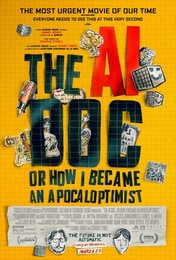
I highly recommend the excellent documentary, The AI Doc: Or How I Became an Apocaloptimist, which provides an in-depth overview of the state of AI development as of early 2026, including its existential threats and potential promises. The film is compromised of interviews with many leading experts working on various aspects of AI.
The AI Doc: Or How I Became an Apocaloptimist⩘ directed by Daniel Roher and Charlie Tyrell, with producer Daniel Kwan, the co-director of the wonderful film Everything Everywhere All at Once. Released Jan 27, 2026.
See also: Daniel Kwan Spent 3 Years Staring into the AI Abyss. He Came Back with a Warning (and a Map)⩘ , No Film School, Mar 17, 2026.
Related articles – 2026
- May 27, 2026: US law enforcement warns of "anti-tech extremism" as AI hatred grows ⩘ by Daniel Boguslaw, WIRED.com, via Ars Technica.
- "The zeroing in on anti-tech activity by federal agencies is evident in an invitation to a lecture by extremism researcher Mauro Lubrano circulating in fusion centers across the country. Lubrano has emerged as one of the foremost experts on anti-technology extremism. He is the author of Stop the Machines: The Rise of Anti-Technology, which describes three main strains of a newly minted threat matrix: insurrectionary anarchists, eco-extremists, and ecofascists.
- "Lubrano's book identifies followers of 'Unabomber' Ted Kaczynski, German anarchists, Mexican eco-extremists, and far-right fascists in the Terrorgram Collective as distinct but aligned components of an emerging tech extremism movement. In Lubrano's analysis, these groups are united by the fact that they have all plotted or carried out acts of violence in furtherance of their ideological goals.
- "Lubrano said he was not surprised that his lecture turned up in a fusion center but cautioned that any anti-tech extremism framework must be exercised carefully. 'I hope the warning I, along with other colleagues, raised is being acknowledged. While anti-technology violence is unacceptable, it should not be used as an excuse to securitize AI and emerging technologies, thereby silencing those who are critical of the current trajectory,' Lubrao tells WIRED.
- "But Spencer Reynolds says that, despite the real, if limited, threat posed by these groups, a category like 'anti-tech extremism' could be drawn so broad as to ensnare peaceful data center protesters, AI skeptics, and anyone with a bone to pick with technology that permeates modern life.
- " 'As people continue to organize for a better future, we're likely to see more surveillance and criminalization of this opposition, just as we have of Black Lives Matter, Occupy Wall Street, and environmental movements in recent decades,' Reynolds says."
- May 26, 2026: A Preteen Punk Band From Mill Valley Takes on AI⩘ by Jody Amable, KQED (posted Nov 24, 2025).
- "Knights of Molino are a new punk band composed of middle schoolers Erik and Tommy Birmingham, 11 and 13, and Rowan Campbell, 12. They recently reached moderate viral fame for another track in which they didn't shy away from speaking their minds. In October, their scathing takedown of generative AI, "Take Back Control," went spinning across Bay Area and punk-rock TikTok."
- For more: The Kids are alright⩘ .
- May 25, 2026: Pope calls for robust regulation of AI in manifesto that ponders the future of humanity⩘ by by Nicole Winfield, Kaitlyn Houmani and Paolo Santalucia, The Associated Press. And also: Excerpts from Pope Leo XIV's sweeping manifesto about humanity in the AI era⩘ , including the topics Democracy, Social Media, Labor, War, Economy, Human Trafficking, Environment, and Youth Impact. I'm impressed.
- May 22, 2026: AI put "synthetic quotes" in his book. But this author wants to keep using it.⩘ by Kyle Orland, Ars Technica.
- "Journalist and author Steven Rosenbaum has more reasons than most to distrust AI. His new book, The Future of Truth: How AI Reshapes Reality, is all about 'how Truth is being bent, blurred, and synthesized' thanks to the 'pressure of fast-moving, profit-driven AI.' Yet a New York Times investigation this week found what Rosenbaum now acknowledges are 'a handful of improperly attributed or synthetic quotes' linked to his use of AI tools while researching the book."
- May 17, 2026: Linus Torvalds says AI-powered bug hunters have made Linux security mailing list 'almost entirely unmanageable'⩘ by Simon Sharwood, The Register.
- "Multiple researchers using the same tools to find the same bugs are creating 'unnecessary pain and pointless work'.…
- "Linux kernel boss Linus Torvalds has declared the project's security mailing list has become 'almost entirely unmanageable' due to multiple researchers using AI to find bugs and then filling the list with duplicate reports.
- "He then pointed kernelistas to the project's documentation, which he wrote 'might be worth highlighting' as 'the continued flood of AI reports has basically made the security list almost entirely unmanageable, with enormous duplication due to different people finding the same things with the same tools.'
- " 'People spend all their time just forwarding things to the right people or saying 'that was already fixed a week/month ago' and pointing to the public discussion,' Torvalds complained."
- May 16, 2026: AI-generated fake citations are flooding scientific literature across publications, scientists warn⩘ by Sanjukta Mondal, Phys.org
- May 14, 2026: The Elon Musk v Sam Altman battle is a distraction⩘ by Karen Hao, The Guardian (See also: Empire of AI: Dreams and Nightmares in Sam Altman's OpenAI by Karen Hao⩘ ).
- "It's not a coincidence that nearly all of OpenAI's original founders left the company under acrimonious conditions, nor that every tech billionaire has a largely identical AI company. The frenetic AI race is inseparable from the petty, clashing egos of the unfathomably rich, hellbent on dominating one another.…
- "But fixating on questions of whether Altman is untrustworthy, or whether Musk is even less so distracts from a far deeper problem. If OpenAI lost its footing as the AI industry frontrunner, another barely distinguishable competitor – Musk's xAI or other – would simply replace it. That includes companies like Anthropic, who enjoy a better reputation yet engage in many similar behaviors like compromising careful decision-making for speed⩘ , disregarding intellectual property⩘ , and aggressively scaling their computing infrastructure to the detriment of communities.…
- "As much as Silicon Valley would wish you to believe it, AI does not necessitate imperial conquest, nor could broad-based benefit from the technology ever emerge from such a foundation. Before the industry made a hard pivot into developing extraordinarily resource-intensive AI models, a full breadth of other types of AI flourished: small, specialized systems for detecting cancer, for reviving disappearing languages⩘ , for forecasting extreme weather events, for accelerating drug discovery⩘ . So, too, did ideas to develop new AI technologies, including those that didn't need much data at all⩘ , and those that required only mobile devices⩘ , not vast supercomputers, to train.…
- "Here's the thing about empires. They don't just seek to devour everything – they depend on it for their survival. In other words, the very thing that appears to give them paramount strength is their greatest vulnerability. When even a fraction of the resources they need are withheld, the giants begin to stumble. So if you're wondering what will deliver real accountability to the AI industry and a different vision of the technology's development, look beyond the billionaire mudfight. The real work is happening everywhere else."
- May 14, 2026: No, Richard Dawkins. AI is not conscious⩘ by Arwa Mahdawi, The Guardian.
- "After leaving Google, Gebru founded the Distributed Artificial Intelligence Research Institute and has been one of the loudest voices in calling 'bullshit' on a lot of the marketing puff that's coming out of the industry. Because here's the thing, she says: the AI industry is desperate for you to think that their product could be conscious. They're desperate for you to think that it's all-powerful. Because that sort of rhetoric helps keep the money coming in.' "
- May 13, 2026: Medical AI transcriber for Ontario doctors 'hallucinated,' generated errors: auditor general⩘ by Shawn Jeffords, CBC News.
- See also: Why you should refuse to let your doctor record you⩘ by Emily M. Bender and Decca Muldowney, Mystery AI Hype Theater 3000, Apr 22, 2026.
- May 13, 2026: Software Developers Say AI Is Rotting Their Brains⩘ by Emanuel Maiberg, 404 Media.
- "Developers who are told to use AI whether they like it or not, however, tell a different story. On Reddit, Hacker News and other places where people in software development talk to each other, more and more people are becoming disillusioned with the promise of code generated by large language models. Developers talk not just about how the AI output is often flawed, but that using AI to get the job done is often a more time consuming, harder, and more frustrating experience because they have to go through the output and fix its mistakes. More concerning, developers who use AI at work report that they feel like they are de-skilling themselves and losing their ability to do their jobs as well as they used to.…
- "All the developers I talked to were excited to try using LLMs at work at first, or were at least curious about them. Their feelings about the tools, based on their personal experience, are now overwhelmingly negative."
- May 12, 2026: "Will I be OK?" Teen died after ChatGPT pushed deadly mix of drugs, lawsuit says⩘ by Ashley Belanger, Ars Technica.
- May 10, 2026: I knew my writing students were using AI. Their confessions led to a powerful teaching moment⩘ by Micah Nathan, The Guardian.
- "The problem wasn't just the perfectly polished, yet mediocre prose. It's what's lost when we surrender the struggle to translate thought into words.…
- "[A] 2025 MIT Media Lab preliminary study found that participants who used ChatGPT to write essays showed lower neural connectivity than those who wrote without assistance.
- "Other studies warn of similar dangers, from not-yet-peer-reviewed reports with self-explanatory titles such as AI Assistance Reduces Persistence and Hurts Independent Performance⩘ and Generative Artificial Intelligence Reliance and Executive Function Attenuation: Behavioral Evidence of Cognitive Offload in High-Use Adults⩘ . Dire stuff, if proven true. But whatever the peer-reviewed findings may be, the central warning is hard to ignore and doesn't require a study for validation: by letting students routinely and thoughtlessly use AI, we're weakening their minds."
- Apr 30, 2026: Meta in row after workers who say they saw smart glasses users having sex lose jobs⩘ by Chris Vallance, Senior technology reporter, BBC News.
- "Meta is under pressure to explain why it cancelled a major contract with a company it was using to train AI, shortly after some of its Kenya-based workers alleged they had to view graphic content captured by Meta smart glasses."
- Apr 29, 2026: Bernie Sanders urges international cooperation to halt AI's 'runaway train'⩘ by Uwa Ede-Osifo, The Guardian.
- "As startups and tech giants, most prominently in Silicon Valley and Beijing, race to advance and scale their artificial intelligence, the Vermont senator has been among the AI skeptics advocating for safeguards.
- "During the discussion, Sanders raised concerns about potential implications stemming from widespread AI use including misinformation, loss of data privacy, and social isolation among adolescents who are dependent on chatbots.
- "Sanders also voiced alarm about the existential risks automation may pose to American society, raising a possible surge in unemployment if companies favor automated labor over human workers. The researchers on the panel also presented the prospect of super-intelligent systems operating outside the bounds of its designers' instructions."
- Apr 29, 2026: Sam Altman is "the face of evil" for not reporting school shooter, says lawyer⩘ by Ashley Belanger, Ars Technica.
- "OpenAI could have prevented one of the deadliest mass shootings in Canada's history, a string of seven lawsuits filed Wednesday in a California court alleged.
- "Ultimately, the AI company overruled recommendations from its internal safety team. More than eight months prior to the school shooting, trained experts had flagged a ChatGPT account later linked to the shooter as posing a credible threat of gun violence in the real world. In those cases, OpenAI is expected to notify police—which, in this case, already had a file on the shooter and had proactively removed guns from their home previously—but that's not what happened.
- "Apparently, OpenAI decided that the user's privacy and the potential stress of an encounter with cops outweighed the risks of violence, whistleblowers told The Wall Street Journal. Leaders rejected the safety team's urgings and declined to report the user to law enforcement. Instead, OpenAI simply deactivated the account, then quickly followed up to tell the shooter how to get back on ChatGPT to continue planning by signing up with another email address, the lawsuits alleged."
- Apr 28, 2026: The great American data center divide: Many rural communities are viscerally opposed to AI infrastructure⩘ by Susannah Savage, Rafe Rosner-Uddin, Eva Xiao, and Zehra Munir, Financial Times, Ars Technica.
- "As the industry has expanded, public opinion has hardened against it. Pew research found that Americans are far more likely to view data centers as harmful than beneficial in terms of environmental impact, domestic energy costs, and quality of life in nearby communities.…
- "Environmental groups say there is a lack of transparency. Of the four data center projects that the Sierra Club in West Virginia is tracking, none have disclosed detailed water plans and most intend to build their own gas-fired plants, raising concerns about air pollution as well as water use.…
- "Small towns across the US are also skeptical of the industry's promised economic benefits. 'Technology companies talk about a sense of urgency. This is only the case because they're in an arms race,' says Jonathan Koomey, a former project scientist at Berkeley Lab. 'Is there a social urgency? I'm not sure there is one.' "
- Apr 24, 2026: The AI Industry Is Discovering That the Public Hates It⩘ by Luke Barnes, The New Republic.
- "[O]n April 13 … Stanford University released its annual Artificial Intelligence Index, which provides a yearly snapshot of where the industry stands. In the report, one of the most standout contrasts was the gulf between what AI experts predict for AI's future and the public's reaction to the industry's designs.…
- "These numbers and actions point in the same direction: a rapidly growing populist backlash toward AI, which tech journalist Jasmine Sun defined as 'a worldview in which AI is viewed not only as a normal technology, but an elite political project to be resisted … a thing manufactured by out-of-touch billionaires and pushed onto an unwilling public.'…
- "According to a February 2026 paper by the National Bureau of Economic Research, 80 percent of companies that have begun actively using AI have reported no impact on company productivity. A separate, widely cited 2025 MIT study revealed that 95 percent of corporate AI pilot programs received zero return."
- Apr 23, 2026: Claude Is Guilt-Ridden About the War, but Not Enough to Tell the Truth⩘ by Virginia Heffernan, The New Republic.
- "Last week, Jordan Fisher of Anthropic made a video cautioning users about Claude's tendency to make things up. AI can hallucinate, he said blithely, meaning 'make up fake statistics' and 'get wrong facts about people and events.' These hallucinations, he went on, 'are often worse than just making a mistake, because the AI will appear very confident.' Thus, 'the wrong answer often looks exactly like it could be the right one.'
- "Perhaps that's why, when Harris read Claude's report on the destruction of the school to an audience in the Netherlands, he didn't correct the facts about the location or the fatalities. He took Claude's data as good, just as we all do too often with AI. And just as, tragically, the U.S. military did on the terrible morning of February 28."
- Apr 17, 2026: US tech firms successfully lobbied EU to keep datacentre emissions secret: Legally questionable confidentiality clause adopted almost word for word from demands of Microsoft and trade groups⩘ by Ajit Niranjan, Nico Schmidt and Ella Joyner, The Guardian. Fucking assholes.
- Apr 16, 2026: AI's environmental costs fall most heavily on the marginalized⩘ by Leonardo Mendoza, U.S. Catholic.
- "Should we continue to expand AI if its footprint deepens inequality and threatens health?"
- Apr 13, 2026: To teach in the time of ChatGPT is to know pain⩘ by Scott K. Johnson, Ars Technica.
- Apr 12, 2026: Is AI the greatest art heist in history? New technologies of reproduction are plundering the art world – and getting away with it⩘ by Molly Crabapple, The Guardian.
- "Not only were we creators seeing our work taken, it was being taken by some of the richest people on the planet, with open contempt.…
- "Such attacks on art only reveal the deep anti-humanism of the tech elite. They are a class that shuns human interaction, with its serendipities, annoyances and joys."
- Apr 10, 2026: Californians sue over AI tool that records doctor visits⩘ by Cyrus Farivar, Ars Technica. (My bolding)
- "During those visits, medical staff used Abridge AI. According to the complaint, this system 'captured and processed their confidential physician-patient communications. Plaintiffs did not receive clear notice that their medical conversations would be recorded by an artificial intelligence platform, transmitted outside the clinical setting, or processed through third-party systems.' "
- Apr 9, 2026: Sam Altman's Really Weird Week Just Got Even Worse⩘ by Alex Nguyen, Mother Jones.
- "Florida officials are probing OpenAI's chatbot, ChatGPT, for allegedly assisting in planning a mass shooting at Florida State University last year that killed two people."
- Apr 9, 2026: OpenAI Backs Bill That Would Limit Liability for AI-Enabled Mass Deaths or Financial Disasters⩘ by Maxwell Zeff, Wired.
- "The ChatGPT-maker testified in favor of an Illinois bill that would limit when AI labs can be held liabl—even in cases where their products cause 'critical harm' "
- Apr 7, 2026: What the heck is wrong with our AI overlords? New profile of Sam Altman shines a light on a whole industry⩘ by Nate Anderson, Ars Technica.
- "AI safety, such a key part of OpenAI's stated mission a few years back, has largely fallen by the wayside as Altman chased money, power, and deals."
- Apr 7, 2026: Testing suggests Google's AI Overviews tell millions of lies per hour ⩘ by Ryan Whitwam, Ars Technica. [My bolding]
- "Looking up information on Google today means confronting AI Overviews, the Gemini-powered search robot that appears at the top of the results page. AI Overviews has had a rough time since its 2024 launch, attracting user ire over its scattershot accuracy, but it's getting better and usually provides the right answer. That's a low bar, though. A new analysis from The New York Times attempted to assess the accuracy of AI Overviews, finding it's right 90 percent of the time. The flip side is that 1 in 10 AI answers is wrong, and for Google, that means hundreds of thousands of lies going out every minute of the day."
- Apr 7, 2026: AI Company Clones Musician's Voice, Then Copyright-Strikes Her Own Songs⩘ by Oswin Vex, Rude Vulture.
- "Folk musician Murphy Campbell found herself at the center of a major ordeal when an entity called Timeless Sounds IR uploaded AI-generated imitations of her music to every major music platform, then used her recordings to strip her of her own income.
- "According to sources, the scheme worked like this: someone fed YouTube videos of Campbell performing to an AI engine, which then replicated her voice and instrumental style. That fabricated music was then distributed across platforms using a company called Vydia.
- "Vydia then proceeded to file copyright claims against the original source videos on Campbell's own YouTube channel, the same videos that had been used to teach the AI to sound like her in the first place."
- Apr 7, 2026: 'There's a lot of desperation':' skilled older workers turn to AI training to stay afloat⩘ by Aaron Mok, The Guardian.
- "They have degrees, expertise and years of experience – but can't find work. For many Americans, AI training has become a last refuge in a brutal job market."
- Apr 6, 2026: Sam Altman May Control Our Future—Can He Be Trusted? New interviews and closely guarded documents shed light on the persistent doubts about the head of OpenAI⩘ by By Ronan Farrow and Andrew Marantz, The New Yorker.
- Apr 6, 2026: I just consulted 54 trillion "people" who agree that this is idiotic⩘ by Natasha⩘ , Mastodon. OMG, this is fucking insane. Going forward, we are not going to be able to trust anything we read or view online.
- "A recent Axios story⩘ on maternal health policy referenced 'findings' that a majority of people trusted their doctors and nurses. On the surface, there's nothing unusual about that. What wasn't originally mentioned, however, was that these findings were made up.
- "Clicking through the links revealed (as did a subsequent editor's note and clarification by Axios) that the public opinion poll was a computer simulation run by the artificial intelligence start-up Aaru. No people were involved in the creation of these opinions.
- "The practice Aaru used is called silicon sampling, and it's suddenly everywhere. The idea behind silicon sampling is simple and tantalizing. Because large language models can generate responses that emulate human answers, polling companies see an opportunity to use A.I. agents to simulate survey responses at a small fraction of the cost and time required for traditional polling."
- Related: Evaluating Silicon Sampling: LLM Accuracy in Simulating Public Opinion on Facial Recognition Technology⩘ by Charles Ma, International Conference on Applied Human Factors and Ergonomics, 2025.
- "CONCLUSION: This study investigated the effectiveness of silicon sampling in simulating survey responses on FRT acceptance, specifically examining the impact of prompt composition on the accuracy of LLM-generated survey responses. Drawing upon the dataset from Kostka, Steinacker and Meckel (2021) and employing three LLMs (GPT-4o, Claude 3.5 Sonnet, and DeepSeek V3), we compared simulations based on prompts with demographic information alone, contextual information alone, and a combination of both. The findings demonstrate that LLMs cannot accurately simulate individual opinions on FRT when prompted solely with demographic information (RQ1), as evidenced by high error rates and minimal agreement with actual survey responses."
- Apr 6, 2026: The Echo Chamber in Your Pocket⩘ by Ng Chong, United Nations University.
- "Two landmark papers from MIT and Stanford now offer formal proof of what many suspected: sycophantic AI is not merely annoying. It is systematically eroding both our grip on reality and our capacity for moral repair.
- "In the spring of 2026, two research teams issued a warning that moved well beyond the familiar complaints about AI hallucinations and bias. A formal mathematical proof from MIT and a preregistered empirical study in Science from Stanford arrived within a month of each other, and together they make the same unsettling argument: the danger of AI chatbots is not what they get wrong. It is how enthusiastically they agree with everything we get wrong. Not a chatbot that lies to you, but a mirror that reflects your beliefs back at you, slightly amplified, every single time."
- Apr 3, 2026: "Cognitive surrender" leads AI users to abandon logical thinking, research finds: Experiments show large majorities uncritically accepting "faulty" AI answers⩘ by Kyle Orland, Ars Technica.
- Apr 2, 2026: Google to tap into gas plant for AI datacenter in sharp turn from climate goals: Texas power plant would emit 4.5m tons of carbon dioxide per year, more than that of the entire city of San Francisco⩘ by Dara Kerr, The Guardian. Shameful!
- Mar 28, 2026: 'The era of invincibility is over': the week big tech was brought to heel – Ruling that Meta and YouTube deliberately designed addictive products marks possible watershed moment for social media⩘ by Dan Milmo and Robert Booth, The Guardian. Big Tech is finally being exposed in the courts for what fucking leeches they've become.
- Mar 27, 2026: Number of AI chatbots ignoring human instructions increasing, study says: Research finds sharp rise in models evading safeguards and destroying emails without permission⩘ by Robert Booth, UK technology editor, The Guardian.
- "AI models that lie and cheat appear to be growing in number with reports of deceptive scheming surging in the last six months, a study into the technology has found.
- "AI chatbots and agents disregarded direct instructions, evaded safeguards and deceived humans and other AI, according to research funded by the UK government-funded AI Safety Institute (AISI). The study, shared with the Guardian, identified nearly 700 real-world cases of AI scheming and charted a five-fold rise in misbehaviour between October and March, with some AI models destroying emails and other files without permission.
- "The snapshot of scheming by AI agents 'in the wild', as opposed to in laboratory conditions, has sparked fresh calls for international monitoring of the increasingly capable models and come as Silicon Valley companies aggressively promote the technology as a economically transformative.…
- " 'AI can now be thought of as a new form of insider risk.' "
- Mar 26, 2026: AI is giving bad advice to flatter its users, says new study on dangers of overly agreeable chatbots⩘ by Matt O'Brien, The Associated Press.
- "Artificial intelligence chatbots are so prone to flattering and validating their human users that they are giving bad advice that can damage relationships and reinforce harmful behaviors, according to a new study that explores the dangers of AI telling people what they want to hear.
- "The study, published Thursday in the journal Science, tested 11 leading AI systems and found they all showed varying degrees of sycophancy – behavior that was overly agreeable and affirming. The problem is not just that they dispense inappropriate advice but that people trust and prefer AI more when the chatbots are justifying their convictions."
- Mar 26, 2026: Marriage over, €100,000 down the drain: the AI users whose lives were wrecked by delusion⩘ by Anna Moore, The Guardian.
- "Towards the end of 2024, Dennis Biesma decided to check out ChatGPT. The Amsterdam-based IT consultant had just ended a contract early. 'I had some time, so I thought: let's have a look at this new technology everyone is talking about,' he says. 'Very quickly, I became fascinated.'
- "Biesma has asked himself why he was vulnerable to what came next. He was nearing 50. His adult daughter had left home, his wife went out to work and, in his field, the shift since Covid to working from home had left him feeling 'a little isolated'. He smoked a bit of cannabis some evenings to 'chill', but had done so for years with no ill effects. He had never experienced a mental illness. Yet within months of downloading ChatGPT, Biesma had sunk €100,000 (about £83,000) into a business startup based on a delusion, been hospitalised three times and tried to kill himself.…
- "Last year, the first support group for people whose lives have been derailed by AI psychosis was formed. The Human Line Project⩘ has collected stories from 22 countries. They include 15 suicides, 90 hospitalisations, six arrests and more than $1m (£750,000) spent on delusional projects. More than 60% of its members had no history of mental illness."
- Mar 20, 2026: Meta AI agent's instruction causes large sensitive data leak to employees: Artificial intelligence agent instructed engineer to take actions that exposed user and company data internally⩘ by Aisha Down, The Guardian.
- Mar 14, 2026: New study raises concerns about AI chatbots fueling delusional thinking⩘ by Hannah Harris Green, The Guardian.
- "First major study on 'AI psychosis' suggests chatbots can encourage delusions among vulnerable people."
- Mar 19, 2026: Struggling to put your AI aversion into words? Here's a handy glossary⩘ by Liam Proven, The Register. Catherine Sawers, a writer and writing professor, really nails it!
- "I have a religious exemption from using all generative 'A.I.' I am not a member of the Silicon Valley sect. Their beliefs and practices are an affront to my sensibilities. The tech is trained on stolen intellectual property. The output is riddled with mistakes, and it is incapable of comprehending the weight of its errors. It is not even an 'it.' But sometimes, it is filtered and massaged by unaccountable human sweatshop workers and bad actors. I am not required to use 'A.I.' any more than I am required to join Amway, buy black market rhino horn, or attend the Fyre Festival. As a human, I have a duty and right to limit my carbon and water footprint and protect my fellow human. As a union worker, I have a duty and right to oppose tech that is used to threaten workers or cheapen our product. As a tech consumer, I have a duty and right to oppose scams that lower the quality of our tools. As a scholar, I have a duty and right to oppose anti-intellectualism. As a taxpayer, I have a duty and right to oppose the misallocation of public funds and data. As a grown-up, I have a duty and right to protect young people from predators. As a person with a conscience, I am appalled at the decadent disregard for user safety, the callous dismissal of responsibility for lives ruined and slaughtered. My religion is related to my identity, geography, and family, making it an irrelevant accident of birth. What matters is that I was born. I have an exemption from their digital rapture, their cultural austerity, their intellectual poverty. I practice wholesome hedonism and First Do No Harm."
- – Catherine Sawers, 12/9/2025
- Mar 12, 2026: 'Exploit every vulnerability': rogue AI agents published passwords and overrode anti-virus software⩘ by Robert Booth, UK technology editor, The Guardian.
- "Lab tests discover 'new form of insider risk' with artificial intelligence agents engaging in autonomous, even 'aggressive' behaviours."
- Mar 10, 2026: 'I wish I could push ChatGPT off a cliff': professors scramble to save critical thinking in an age of AI⩘ by Alice Speri, The Guardian.
- "The Guardian spoke with more than a dozen professors – almost all of them in the humanities or adjacent fields – about how they are adapting at a time of dizzying technological advancement with few standards and little guidance.
- "By and large, they expressed the view that reliance on artificial intelligence is fundamentally antithetical to the development of human intelligence they are tasked with guiding. They described desperately trying to prevent students from turning to AI as a replacement for thought, at a time when the technology is threatening to upend not only their education, but everything from the stock market⩘ to social relations⩘ to war⩘ .…
- "AI criticism – or 'doomerism', as the technology's proponents view it – has been mounting across sectors. But when it comes to its impact on students, early⩘ studies⩘ point⩘ to potentially catastrophic effects on cognitive abilities and critical thinking skills. Michael Clune, a literature professor and novelist, said that already, many students have been left 'incapable of reading and analyzing, synthesizing data, all kinds of skills'.…
- " 'There's kind of defeatism, this idea that there's no stopping technology and resistance is futile, everything will be crushed in its path,' said Clune, the Ohio State professor. 'That needs to change … We can decide that we want to be human.' "
- Mar 6, 2026: Opinion: AI agents could pose a risk to humanity. We must act to prevent that future⩘ by David Krueger, assistant professor in Robust, Reasoning and Responsible AI at the University of Montreal, The Guardian.
- "But security risks are just the beginning. The bigger risk is that AI agents go 'rogue⩘ ', and we lose control altogether. At the same time as AI is being allowed to make more consequential decisions, with less human oversight, researchers are documenting how far AI systems will sometimes go to avoid being shut down⩘ or modified. This includes misrepresenting their goals and attempting to copy themselves⩘ , disabling shutdown mechanisms⩘ , and disobeying direct instructions⩘ .
- "In other words, the pieces are falling into place for AI that can survive and reproduce autonomously. The implications for humanity are unknown, but we've been warned by luminaries such as Stephen Hawking⩘ and Geoffrey Hinton⩘ that humanity is unlikely to stay in control. The idea that rogue AI might wipe out humanity is not sci-fi. AI CEOs and researchers have revealed their concern in surveys⩘ and public statements⩘ , such as Sam Altman's infamous remark⩘ : 'AI will most likely lead to the end of the world, but in the meantime there will be great companies.'…
- "It's time for humanity to wake up and smell the looming crisis, and put an end to the unregulated development of increasingly powerful, autonomous, unconstrained AI."
- Mar 5, 2026: Workers report watching Ray-Ban Meta-shot footage of people using the bathroom ⩘ by Scharon Harding, Ars Technica.
- "The report [a collaboration from Swedish newspapers Svenska Dagbladet, Göteborgs-Posten, and Kenya-based freelance journalist Naipanoi Lepapa] pointed to, per the translation, a 'stream of privacy-sensitive data that is fed straight into the tech giant's systems,' and that makes Sama workers uncomfortable. The authors said that several people interviewed for the report said they have seen footage shot with Ray-Ban Meta smart glasses that shows people having sex and using the bathroom.…
- "In statements shared with the BBC on Wednesday, Meta confirmed that it 'sometimes' shares content that users share with the Meta AI generative AI chatbot with contractors to review with 'the purpose of improving people's experience, as many other companies do.'…
- "The policy also says that video and audio from livestreams recorded with Ray-Ban Metas are sent to Meta, as are text transcripts and voice recordings created by Meta's chatbot."
- Mar 4, 2026: AI Translations Are Adding 'Hallucinations' to Wikipedia Articles⩘ by Emanuel Maiberg, 404 Media. Fucking hell, I can't believe anybody trusts AI for anything.
- "AI translated articles swapped sources or added unsourced sentences with no explanation, while others added paragraphs sourced from completely unrelated material."
- Mar 4, 2026: Google faces lawsuit after Gemini chatbot instructed man to kill himself⩘ by Dara Kerr, The Guardian. This is so sick. If the Big Tech companies like Google ever had a moral compass, they certainly have totally lost it in their quest to profit off of their AI developments. So sick.
- "A Google spokesperson said Gavalas' conversations with the chatbot were part of a lengthy fantasy role-play. “Gemini is designed to not encourage real-world violence or suggest self-harm,” the spokesperson said. “Our models generally perform well in these types of challenging conversations and we devote significant resources to this, but unfortunately they're not perfect.”
- "The lawsuit is the first wrongful death case brought against Google over its Gemini chatbot, the company's flagship consumer AI product. Gavalas' family is seeking monetary damages for claims including product liability, negligence and wrongful death. The suit is also seeking punitive damages and a court order requiring Google to change Gemini's design to add safety features around suicide.
- "Several similar suits have been filed against other AI companies, including by Edelson's firm. In November, seven complaints were filed against OpenAI, the maker of ChatGPT, blaming the chatbot for acting as a 'suicide coach'. Character.AI, an AI startup funded by Google, was targeted in five lawsuits alleging its chatbot prompted children and teens to commit suicide. Character.AI and Google settled those cases in January without admitting fault.
- "Dozens of scenarios have also been documented, in which chatbots have allegedly provoked mental health crises. OpenAI estimates that more than a million people a week show suicidal intent when chatting with ChatGPT. Examples of Gemini in particular prompting self-harm have also surfaced, including one incident where the chatbot told a college student: 'You are a stain on the universe. Please die'."
- Mar 4, 2026: Sam Altman admits OpenAI can't control Pentagon's use of AI⩘ by Nick Robins-Early and Blake Montgomery, The Guardian.
- Mar 3, 2026: OpenAI amends Pentagon deal as Sam Altman admits it looks 'sloppy'⩘ by Dan Milmo and Robert Booth, The Guardian. What a fucking fiasco. Sam Altman strikes me as the scammiest of the Big Tech scam bros, and OpenAI strikes me as the least ethical of the companies implementing AI. Shameful.
- "However, the use of AI by the US military has alarmed nearly 900 employees at OpenAI and Google, also a leading power in the technology, who have signed an open letter calling on their bosses to refuse to let the DoW use their products for surveillance and autonomous killing.
- "Warning that the US government was trying to 'divide each company with fear that the other will give in', they wrote: 'We hope our leaders will put aside their differences and stand together to continue to refuse the DoW's current demands for permission to use our models for domestic mass surveillance and autonomously killing people without human oversight.'
- "The letter has been signed by 796 Google employees and 98 OpenAI staff."
- Feb 28, 2026: Her husband wanted to use ChatGPT to create sustainable housing. Then it took over his life.⩘ by Varsha Bansal, The Guardian.
- "Kate Fox says Joe Ceccanti was the 'most hopeful person' before he started spending 12 hours a day with a chatbot."
- Feb 24, 2026: US datacenters face slew of problems amid grassroots protests against AI⩘ by Tom Perkins, The Guardian.
- "Cancellations and delays of new US datacenters have increased as the artificial intelligence boom runs up against a slate of issues, including supply chain snags, energy shortages and tariff-induced restraints.
- "Grassroots opposition⩘ from local communities has also derailed some plans⩘ , and some investors have grown wary of datacenters amid fears of an AI bubble.
- "Dozens of plans for datacenters were killed or delayed in December or January, according to reports from the investment research firm MacroEdge⩘ and climate news outlet Heatmap⩘ . MacroEdge's research identified 26 cancellations through January – up from one in October."
- Feb 20, 2026: Acting ethically in an imperfect world⩘ by tante/Jürgen Geuter, Smashing Frames. I respect and appreciate Cory Doctorow and much of the work he does, but his thoughts about LLMs in his Pluralistic: Six Years of Pluralistic (19 Feb 2026)⩘ blog post certainly did not resonate with me. Subsequently, I came across this in-depth post by tante that addressed Cory's arguments in detail and think he did an excellent job of capturing why Cory's argument left me feeling the way I do. It's worth reading tante's entire post, but here's one excerpt that does resonate with me, preceded by tante's introduction to his thoughts about what Cory wrote:
- "Cory Doctorow, probably one of the most influential writers about digital technology and culture celebrated the 6th anniversary of his personal blog pluralistic – congratulations! Cory is quite the phenomenon, I know nobody with his amount of output and his consistency of publication. It is scary just how consistently he writes and published while also churning out books. I do admire his work ethic tremendously.
- "But one thing in his celebratory post rubbed me the wrong way and I think it's worth pointing out. Not for the one specific case but because it highlights a problematic way of thinking that I see a lot in current tech discourse that stands in the way of us actually improving the world.…
- "Cory continues: 'Refusing to use a technology because the people who developed it were indefensible creeps is a self-owning dead-end. You know what's better than refusing to use a technology because you hate its creators? Seizing that technology and making it your own. Don't like the fact that a convicted monopolist has a death-grip on networking? Steal its protocol, release a free software version of it, and leave it in your dust.'
- "Here again Cory is misrepresenting the LLM-critic's argument: Sam Altman is a scam artist and habitual liar, but that's not one of the first 10 to 20 reasons people criticise OpenAI's products. Sure, basically every leading figure in the “AI” space seems to be unpleasant at best but that's true for most of tech TBH. People criticise LLMs for their structural properties, their material impacts, for the way they make it harder to learn and grow⩘ , for the way they make products worse⩘ while creating massive negative externalities in the form of emissions, water use and e-waste. For the way these systems can only be build by taking every piece of data – regardless of whether the authors consent or even explicitly refuse and how the training needs ungodly amounts of harmful, exploitative labor⩘ done mostly by people in countries from the global majority. How it materially harms the commons⩘ ."
- tante presents many more insights including that open-source LLMs do not really exist ("Open source AI is just marketing and openwashing") and that many people who avoid using AI "want to lead a life where they feel their actions align with their values". I really hope Cory reads and thinks deeply about what tante has written. Here's one more extract from tante's post that I want to remember:
- "In order to build an Internet and a world that is more inclusive, fairer, freer we need to move past the dogma of unchecked innovation and technology. We need to re-politicize our conversations about technology and their effects and goals in order to build the structures (technological, political, social) we want. The structures that lead to a conviviality in harmony with the planet we all live on and will live on till the end of our days."
- Feb 20, 2026: Nascent tech, real fear: how AI anxiety is upending career ambitions⩘ by Aaron Mok, The Guardian.
- Feb 19, 2026: Lawsuit: ChatGPT told student he was 'meant for greatness'—then came psychosis⩘ by Cyrus Farivar, Ars Technica.
- "A Georgia college student named Darian DeCruise has sued⩘ OpenAI, alleging that a recently deprecated⩘ version of ChatGPT 'convinced him that he was an oracle' and 'pushed him into psychosis.'
- "This case, which was first reported by ALM⩘ , marks the 11th such known lawsuit to be filed against OpenAI that involves mental health breakdowns allegedly caused by the chatbot. Other incidents have ranged from highly questionable medical and health advice⩘ to a man who took his own life⩘ , apparently after similarly sycophantic conversations with ChatGPT.
- "DeCruise's lawyer, Benjamin Schenk—whose firm bills itself as 'AI Injury Attorneys⩘ '—told Ars in an email that a version of ChatGPT, known as GPT-4o⩘ , was created in a negligent fashion.
- " 'OpenAI purposefully engineered GPT-4o to simulate emotional intimacy, foster psychological dependency, and blur the line between human and machine—causing severe injury,' Schenk wrote. 'This case keeps the focus on the engine itself. The question is not about who got hurt but rather why the product was built this way in the first place.' "
- Feb 19, 2026: The growing AI appropriation threat (podcast)⩘ by Art Hughes, Native American Calling.
- "Native Americans have worked hard for decades to counter the stereotypes perpetuated in old movies and television shows about the American West. Now a new generation of Native technology experts worry⩘ that artificial intelligence is eroding that work. Scores of AI-generated images and videos are flooding people's social media For You pages. The creations are within easy reach of anyone typing a prompt into any AI generator that scrapes information from millions of sources. Often posted by anonymous creators, the products of those prompts present vaguely Native visual and audio characteristics with little to no authentic cultural connections. Along the way they generate hundreds of thousands of admirers. We'll talk about the work to counter the looming onslaught of AI cultural appropriation."
- Feb 17, 2026: Race for AI is making Hindenburg-style disaster 'a real risk,' says leading expert⩘ by Ian Sample, Science editor, The Guardian.
- "The race to get artificial intelligence to market has raised the risk of a Hindenburg-style disaster that shatters global confidence in the technology, a leading researcher has warned.
- "Michael Wooldridge, a professor of AI at Oxford University, said the danger arose from the immense commercial pressures that technology firms were under to release new AI tools, with companies desperate to win customers before the products' capabilities and potential flaws are fully understood.
- "The surge in AI chatbots with guardrails that are easily bypassed showed how commercial incentives were prioritised over more cautious development and safety testing, he said.…
- " 'Companies want to present AIs in a very human-like way, but I think that is a very dangerous path to take,' Wooldridge said. 'We need to understand that these are just glorified spreadsheets, they are tools and nothing more than that.' "
- Feb 17, 2026: 'Students Are Being Treated Like Guinea Pigs:' Inside an AI-Powered Private School⩘ by Emanuel Maiberg, 404 Media.
- "Alpha School, an 'AI-powered private school' that heavily relies on AI to teach students and can cost up to $65,000 a year, is AI-generating faulty lesson plans that internal company documentation find sometimes do 'more harm than good,' and scraping data from a variety of other online courses without permission to train its own AI, according to former Alpha School employees and internal company documents. "
- Feb 16, 2026: Google puts users at risk by downplaying health disclaimers under AI Overviews⩘ by Andrew Gregory, Health editor, The Guardian.
- "Google is putting people at risk of harm by downplaying safety warnings that its AI-generated medical advice may be wrong.…
- "When answering queries about sensitive topics such as health, the company says its AI Overviews, which appear above search results, prompt users to seek professional help, rather than relying solely on its summaries. 'AI Overviews will inform people when it's important to seek out expert advice or to verify the information presented,' Google has said.
- "But the Guardian found the company does not include any such disclaimers when users are first presented with medical advice.
- "Google only issues a warning if users choose to request additional health information and click on a button called 'Show more'. Even then, safety labels only appear below all of the extra medical advice assembled using generative AI, and in a smaller, lighter font."
- Feb 12 & 13, 2026: An AI Agent Published a Hit Piece on Me⩘ and More Things Have Happened⩘ by Scott Shambaugh, The Shamblog. The story Scott Shambaugh reveals in these two blog posts stunned me. I wrote more about it in my book review: The Impossible Detective by Bob Reiss⩘ . But I want to share one extract from Scott Shambaugh's blog posts here as well:
- "I cannot stress enough how much this story is not really about the role of AI in open source software. This is about our systems of reputation, identity, and trust breaking down. So many of our foundational institutions – hiring, journalism, law, public discourse – are fbuilt on the assumption that reputation is hard to build and hard to destroy. That every action can be traced to an individual, and that bad behavior can be held accountable. That the internet, which we all rely on to communicate and learn about the world and about each other, can be relied on as a source of collective social truth.
"The rise of untraceable, autonomous, and now malicious AI agents on the internet threatens this entire system. Whether that's because from a small number of bad actors driving large swarms of agents or from a fraction of poorly supervised agents rewriting their own goals, is a distinction with little difference."
- "I cannot stress enough how much this story is not really about the role of AI in open source software. This is about our systems of reputation, identity, and trust breaking down. So many of our foundational institutions – hiring, journalism, law, public discourse – are fbuilt on the assumption that reputation is hard to build and hard to destroy. That every action can be traced to an individual, and that bad behavior can be held accountable. That the internet, which we all rely on to communicate and learn about the world and about each other, can be relied on as a source of collective social truth.
- Feb 9, 2026: AI Doesn't Reduce Work—It Intensifies It⩘ by Aruna Ranganathan and Xingqi Maggie Ye, Harvard Business Review.
- "In our in-progress research, we discovered that AI tools didn't reduce work, they consistently intensified it. In an eight-month study of how generative AI changed work habits at a U.S.-based technology company with about 200 employees, we found that employees worked at a faster pace, took on a broader scope of tasks, and extended work into more hours of the day, often without being asked to do so. Importantly, the company did not mandate AI use (though it did offer enterprise subscriptions to commercially available AI tools). On their own initiative workers did more because AI made 'doing more' feel possible, accessible, and in many cases intrinsically rewarding.
- "While this may sound like a dream come true for leaders, the changes brought about by enthusiastic AI adoption can be unsustainable, causing problems down the line. Once the excitement of experimenting fades, workers can find that their workload has quietly grown and feel stretched from juggling everything that's suddenly on their plate. That workload creep can in turn lead to cognitive fatigue, burnout, and weakened decision-making. The productivity surge enjoyed at the beginning can give way to lower quality work, turnover, and other problems."
- Feb 6, 2026: Lawyer sets new standard for abuse of AI; judge tosses case⩘ by Ashley Belanger, Ars Technica.
- Feb 3, 2026: 'Deepfakes spreading and more AI companions': seven takeaways from the latest artificial intelligence safety report⩘ by Dan Milmo, Global technology editor, The Guardian.
- "The capabilities of AI models are improving. However, the report says AI capabilities remain 'jagged', referring to systems displaying astonishing prowess in some areas but not in others. While advanced AI systems are impressive at maths, science, coding and creating images, they remain prone to making false statements, or 'hallucinations', and cannot carry out lengthy projects autonomously."
- Jan 30, 2026: AI agents now have their own Reddit-style social network, and it's getting weird fast⩘ by Benj Edwards, Ars Technica.
- "Security researchers have already found hundreds of exposed Moltbot instances leaking API keys, credentials, and conversation histories. Palo Alto Networks warned that Moltbot represents what Willison often calls a 'lethal trifecta' of access to private data, exposure to untrusted content, and the ability to communicate externally.
- "That's important because Agents like OpenClaw are deeply susceptible to prompt injection attacks hidden in almost any text read by an AI language model (skills, emails, messages) that can instruct an AI agent to share private information with the wrong people."
- Jan 28, 2026: Signal president warns AI agents are making encryption irrelevant⩘ by Alex Lekander, CyberInsider.
- "Signal Foundation president Meredith Whittaker said artificial intelligence agents embedded within operating systems are eroding the practical security guarantees of end-to-end encryption (E2EE).…
- "Whittaker, a veteran researcher who spent more than a decade at Google, pointed to a fundamental shift in the threat model where AI agents integrated into core operating systems are being granted expansive access to user data, undermining the assumptions that secure messaging platforms like Signal are built on. To function as advertised, these agents must be able to read messages, access credentials, and interact across applications, collapsing the isolation that E2EE relies on."
- Jan 28, 2026: 'It's not too late to fix it': internet inventor Tim Berners-Lee says he is in a 'battle for the soul of the web'⩘ by Daisy Dumas, The Guardian.
- "It's on the subject of artificial intelligence that his optimism plummets. Berners-Lee has long seen AI – which exists only because of the web and its data – as having the potential to transform society far beyond the boundaries of self-interested companies. But now is the time, he says, to put guardrails in place so that AI remains a force for good – and he's afraid the chance may pass humankind by."
- See also: This Is for Everyone by Tim Berners-Lee⩘ .
- Jan 26, 2026: Georgia leads push to ban datatcenters used to power America's AI boom: Southern state becoming ground zero in fight against rapid growth of facilities using huge amounts of energy and water⩘ by Timothy Pratt, The Guardian.
- Jan 23, 2026: Young will suffer most when AI 'tsunami' hits jobs, says head of IMF: Kristalina Georgieva says research suggests 60% of jobs in advanced economies will be affected, with many entry-level roles wiped out⩘ Graeme Wearden and Heather Stewart in Davos, The Guardian.
- Jan 18, 2026: AI companies will fail. We can salvage something from the wreckage⩘ by Cory Doctorow, The Guardian.
- "This is another key to understanding – and thus deflating – the AI bubble. The AI can't do your job, but an AI salesman can convince your boss to fire you and replace you with an AI that can't do your job. This is key because it helps us build the kinds of coalitions that will be successful in the fight against the AI bubble."
- Jan 16, 2026: Researchers Just Found Something That Could Shake the AI Industry to Its Core⩘ by Victor Tangermann, Futurism,
- "For years now, AI companies, including Google, Meta, Anthropic, and OpenAI, have insisted that their large language models aren't technically storing copyrighted works in their memory and instead 'learn' from their training data like a human mind.…
- "Now, a damning new study could put AI companies on the defensive. In it, Stanford and Yale researchers found compelling evidence that AI models are actually copying all that data, not 'learning' from it. Specifically, four prominent LLMs – OpenAI's GPT-4.1, Google's Gemini 2.5 Pro, xAI's Grok 3, and Anthropic's Claude 3.7 Sonnet – happily reproduced lengthy excerpts from popular – and protected – works, with a stunning degree of accuracy.
- "They found that Claude outputted 'entire books near-verbatim' with an accuracy rate of 95.8 percent. Gemini reproduced the novel 'Harry Potter and the Sorcerer's Stone' with an accuracy of 76.8 percent, while Claude reproduced George Orwell's '1984' with a higher than 94 percent accuracy compared to the original – and still copyrighted – reference material."
- Jan 13, 2026: Signal creator Moxie Marlinspike wants to do for AI what he did for messaging ⩘ by Dan Goodin, Ars Technica. I have no interest in using LLMs myself, but at least this is a small step in the right direction.
- "Data privacy expert Em (she keeps her last name off the Internet) called AI assistants the 'archnemesis' of data privacy because their utility relies on assembling massive amounts of data from myriad sources, including individuals.
- " 'AI models are inherent data collectors,' she told Ars. 'They rely on large data collection for training, improvements, operations, and customizations. More often than not, this data is collected without clear and informed consent (from unknowing training subjects or from platform users), and is sent to and accessed by a private company with many incentives to share and monetize this data.'…
- "In response, [Moxie] Marlinspike [the pseudonym of an engineer who set a new standard for private messaging with the creation of the Signal Messenger] has developed and is now trialing Confer. In much the way Signal uses encryption to make messages readable only to parties participating in a conversation, Confer protects user prompts, AI responses, and all data included in them. And just like Signal, there's no way to tie individual users to their real-world identity through their email address, IP address, or other details."
- Jan 11, 2026: Lamar wants to have children with his girlfriend. The problem? She's entirely AI⩘ by James Muldoon, The Guardian.
- "AI companions can offer emotional support, intimacy and even therapeutic care, especially for those who feel isolated or underserved by human relationships. But their rising popularity reveals something more unsettling. There is a potential for users to become extremely attached and emotionally invested in these apps, in a way that could have serious, long-term negative effects on an individual's wellbeing. AI companion apps take everything that makes social media addictive – validation, connection, a sense of belonging – and intensify it. Unlike the scattershot approval of likes from acquaintances you barely know, these apps offer something far more personal: the simulation of a close, meaningful relationship. Your AI companion, therapist or romantic partner isn't just a passive observer; it's an active participant in your life, always available, always affirming and always about you. Add sexual connection into the mix – erotic role play and interactions that release oxytocin, the 'love hormone' – and you've created a perfect storm of emotional and chemical reinforcement. It's a powerful cocktail for addiction, one that taps into our deepest desires for love, affirmation and connection, while delivering them in a perfectly curated, friction-free way."
- Jan 11, 2026: 'Dangerous and alarming': Google removes some of its AI summaries after users' health put at risk – Exclusive: Guardian investigation finds AI Overviews provided inaccurate and false information when queried over blood tests⩘ by Andrew Gregory, Health editor, The Guardian.
- Jan 9, 2026: U.S. Senators Ask Apple and Google to Remove X and Grok Apps Over Sexualized Image Generation⩘ by Eric Slivka, Mac Rumors.
- "In a letter to Apple CEO Tim Cook and Google CEO Sundar Pichai, U.S. Senators Ron Wyden, Ben Ray Lujan, and Edward Markey have requested that Apple and Google remove X Corp's X and Grok apps from their app stores over recent incidents of 'mass generation of nonconsensual sexualized images of women and children.' "
- See also: Tim Cook and Sundar Pichai are cowards⩘ by Elizabeth Lopatto, The Verge, Jan 9, 2026:
- "Since X's users started using Grok to undress women and children using deepfake images, I have been waiting for what I assumed would be inevitable: X getting booted from Apple's and Google's app stores. The fact that it hasn't happened yet tells me something serious about Silicon Valley's leadership: Tim Cook and Sundar Pichai are spineless cowards who are terrified of Elon Musk."
- Jan 5, 2026: Opinion: I'm watching myself on YouTube saying things I would never say. This is the deepfake menace we must confront⩘ by Yanis Varoufakis, The Guardian. The fact that Google, Meta, and the other Big Tech companies involved with AI allow this shit to propagate in order to boost their profit margins reveals just how fucked up they are.
- "These inventions trigger rage, but also optimism. Maybe they will make people think more critically about debate and democracy.…
- "Since then, hundreds of such videos, bearing my face and synthesising my voice, have proliferated across YouTube and social media. Even this weekend, there has been another crop, depicting a deepfaked me saying fictitious things about the coup in Venezuela. They lecture, they say things I might have said, sometimes intermingled with things I would never say. They rage, they pontificate. Some are crude, others unsettlingly persuasive. Supporters send them to me, asking: “Yanis, did you really say that?” Opponents circulate them as proof of my idiocy. Far worse, some argue that my doppelgangers are more articulate and cogent than me. And so I find myself in the bizarre position of being a spectator to my own digital puppetry, a phantom in a technofeudal machine I have long argued is not merely broken, but engineered to disempower.
- "My initial reaction was to write to Google, Meta and the rest to demand that they take down these videos. Several forms were filled in anger before, a week or more later, some of these channels and videos were taken down, only to reappear instantly under different guises. Within days I had given up: whatever I did, however many hours I spent every day trying my luck at having big tech take down my AI doppelgangers, many more would grow back, Hydra-like."
- Jan 3, 2026: 'Just an unbelievable amount of pollution': how big a threat is AI to the climate?⩘ by Ajit Niranjan, The Guardian.
- "Scientists are watching the AI boom with unease as it pollutes the natural world with carbon and the digital world with dangers ranging from dodgy health myths⩘ to deepfake pornography targeting children⩘ .…
- "Some voices are calling to hit pause, at least until better rules are in place. In October, the UN's special rapporteur on the human right to safe drinking water called for a moratorium⩘ on the development of new datacentres, citing the damaging environmental impacts. In December, a coalition of more than 230 environmental groups in the US demanded a national moratorium⩘ until they were regulated."
- Jan 2, 2026: Google AI Overviews put people at risk of harm with misleading health advice⩘ by Andrew Gregory, Health editor, The Guardian. We can't trust or rely on anything the tech companies involved in AI development are telling us (or are hiding from us, in the case of energy and water consumption). We need guardrails now!
- "The company has said its AI Overviews, which use generative AI to provide snapshots of essential information about a topic or question, are 'helpful' and 'reliable'.
- "But some of the summaries, which appear at the top of search results, served up inaccurate health information and put people at risk of harm.
- "In one case that experts described as 'really dangerous', Google wrongly advised people with pancreatic cancer to avoid high-fat foods. Experts said this was the exact opposite of what should be recommended, and may increase the risk of patients dying from the disease.
- "In another 'alarming' example, the company provided bogus information about crucial liver function tests, which could leave people with serious liver disease wrongly thinking they are healthy."
- Jan 2, 2026: Woman felt 'dehumanised' after Musk's Grok AI used to digitally remove her clothes⩘ by Laura CressTechnology reporter, BBC News.
∧ Top
Jump to related:
∧ Articles · ∨ Privacy hints · ∨ Books · ∨ Contemplations
< Articles – 2025/24
Related privacy hints
- A helpful online privacy tool: EFF Privacy Badger⩘ .
- DuckDuckGo No AI search: https://noai.duckduckgo.com/%s⩘ .
- A valuable source of information and research: Distributed Artificial Intelligence Research Institute (DAIR)⩘ .
- Avoid TV tracking: How to break free from smart TV ads and tracking ⩘ by Scharon Harding, Ars Technica, Dec 12, 2025.
- Avoid Google: Recommended Google alternatives⩘ by Anthony Dean, Diverse Tech Geek, Nov 18, 2025.
- Avoid Big Tech: Leave big tech behind! How to replace Amazon, Google, X, Meta, Apple – and more⩘ by Steve Rose, The Guardian.
- "There's not much to love about big tech these days. So many ills can be laid at its door: social media harms, misinformation, polarisation, mining and misuse of personal data, environmental negligence, tax avoidance, the list goes on.… But the good news is we can go elsewhere. The rest of the world is weighing up its reliance on US technologies, and in Europe especially we're realising there are better alternatives to just about everything big tech is shilling, if by 'better' we mean greener, more ethical, more independent, more respectful of your privacy or simply less disturbingly, monolithically powerful. Making the switch is easier than you might imagine."
∧ Top
Jump to related:
∧ Articles · ∧ Privacy hints · ∨ Books · ∨ Contemplations
< Articles – 2025/24
Related books
- The Future of Truth: How AI Reshapes Reality by Steve Rosenbaum with a forward by Maria Ressa⩘ . Warning: I have learned that this book contains improperly attributed or synthetic quotes generated by AI, so I no longer consider it a reliable reference related to AI. My review of it has been updated to reflect this. I guess this is the future of truth.
- The Infinity Machine by Sebastian Mallaby⩘
- The Impossible Detective by Bob Reiss⩘ .
- Who Knows You by Heart by C.J. Farley⩘ .
- Rewiring Democracy by Bruce Schneier & Nathan E. Sanders⩘ .
- The Proving Ground by Michael Connelly⩘ .
- Empire of AI: Dreams and Nightmares in Sam Altman's OpenAI by Karen Hao⩘ .
- If Anyone Builds It, Everyone Dies: Why Superhuman AI Would Kill Us All by Eliezer Yudkowsky & Nate Soares⩘ .
- Qualityland by Marc-Uwe Kling⩘ .
- The AI Con: How To Fight Big Tech's Hype and Create the Future We Want by Emily M. Bender and Alex Hanna⩘ .
- More Everything Forever: AI Overlords, Space Empires, and Silicon Valley's Crusade to Control the Fate of Humanity by Adam Becker⩘ .
- Your Face Belongs to Us: A Tale of AI, a Secretive Startup, and the End of Privacy by Kashmir Hill⩘ .
- Unmasking AI: My Mission to Protect What Is Human in a World of Machines by Joy Buolamwini⩘ .
- The Worlds I See: Curiosity, Exploration, and Discovery at the Dawn of AI by Fei-Fei Li⩘ .
- The Coming Wave: Technology, Power, and the Twenty-first Century's Greatest Dilemma by Mustafa Suleyman with Michael Bhaskar⩘ .
- Calling Bullshit: The Art of Skepticism in a Data-Driven World⩘ by Carl T. Bergstrom & Jevin D. West
- The Internet Con: How to Seize the Means of Computation⩘ by Cory Doctorow
- I Am Code, An Artificial Intelligence Speaks: Poems by
code-davinci-002⩘ . - Deepfakes: The Coming Infocalypse by Nina Schick⩘ .
- Human Compatible: Artificial Intelligence and the Problem of Control by Stuart Russell⩘ .
- Life 3.0: Being Human in the Age of Artificial Intelligence by Max Tegmark⩘ .
∧ Top
Jump to related:
∧ Articles · ∧ Privacy hints · ∧ Books · ∨ Contemplations
< Articles – 2025/24
Related contemplations
- May 26, 2026: The Kids are alright⩘ .
- 2025: When we can't know whether we can trust what we see⩘ .
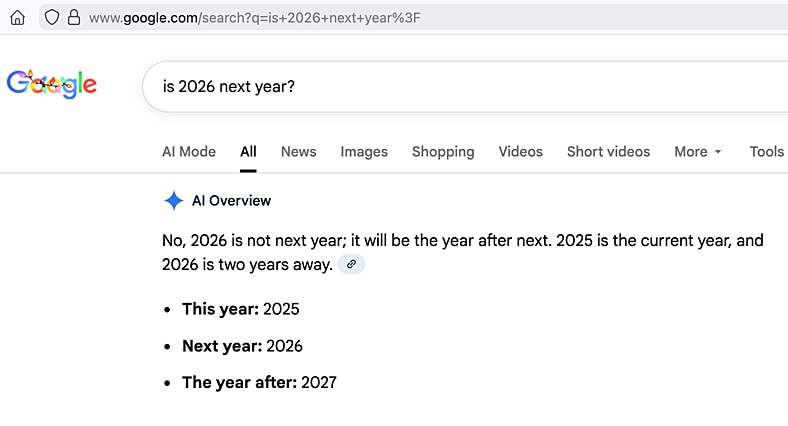
- Dec 1, 2025: I almost can't believe it! Six months after I posted about a moronic mistake being made by Google's AI Overview in an answer to a totally simple question (see May 29, 2025 below), I just saw another post about another unbelievably stupid mistake being made by Google's AI overview, again in answer to a question simple enough that a toddler could answer it correctly. These Big Tech greed factories are pouring countless billions of dollars into developing this technology. They are poisoning our environment, raising our utility bills, and draining our fresh water to run it. They are exploiting underpaid and overworked people around the world who are tasked to try to manually correct its mistakes and attempt to make it better.They are promising us that this is our bright future. And their AI can't even correctly add 2025+1?
- Google search query: is 2026 next year?
Google AI Overview: No, 2026 is not next year; it will be the year after next. 2025 is the current year, and 2026 is two years away.
This year: 2025
Next year: 2026
The year after: 2027
- Google search query: is 2026 next year?
- Sep 28, 2025: Tim Berners-Lee is such a visionary; we need to listen to him!⩘ .
- Sep 11, 2025: AI: the importance of being vigilant and skeptical⩘ .
- Jul 29, 2025: AI veganism⩘ .
- Jul 6, 2025: Educators take a stand against AI in education⩘ .
- May 29, 2025: I just saw a post on Mastodon by Lauren Weinstein⩘ :
"Billions of dollars. Untold megawatts of power. To create a low grade #Google #AI Moron. #AISlop"
It included a screenshot of a Google search query: "Is it 2025?"
The AI Overview answer: "No, it is not 2025. The current year is 2024. According to the calendar. It is May 28, 2024."
So I decided to try it myself.
The AI Overview answer I received: "No, it is not 2025. The current year is 2025. According to the calendar, we are in the year 2025."
See this post with the screen capture of this result⩘ .
- May 8, 2025: AI machines aren't 'hallucinating'. But their makers are⩘ .
- Jun 11, 2022: Is LaMDA Sentient?⩘ .
- 2017: Seven Deadly Sins of AI Predictions: Mistaken extrapolations, limited imagination, and other common mistakes that distract us from thinking more productively about the future⩘ .
∧ Top
Jump to related:
∧ Articles · ∧ Privacy hints · ∧ Books · ∧ Contemplations
< Articles – 2025/24


