Reading – & Now: Most recent
A love affair with books ∨ Most recent book reflection ∨ Additional notes ∨
A love affair with books
Reading has been a key continuity in the flow of my life, a primary focus since I was a child enthusiastically bringing home armloads of library books each week.
Appetizer:
This is the first printed illustration of a rhombicuboctahedron, based on an original drawing by Leonardo da Vinci. It is in the book De Divina Proportione by geometer Luca Pacioli, which was created in 1509.
This reproduction is from a facsimile of the book published in 1982 by Biblioteca Ambrosiana, which is one of the most treasured volumes in my personal library. More information about Leonardo's rhombicuboctahedron⩘ .
Most recent book reflection
Thich Nhat Hanh, Peace Is Every Step: The Path of Mindfulness in Everday Life
Beautifully narrated by Edoardo Ballerini
What a wonderful book, simple yet profound.
I like to listen to a few chapters most evenings just before falling asleep as a way to center myself and get beyond the turmoil that so often surrounds us these days. I don't think I'll ever tire of listening to these wise words.
Peace is every step … peace is every breath.
Bantam, 1991; Bookshop.org⩘ ; audiobook: Blackstone Publishing, 2015; Libro.fm⩘ .
See also: The fourteen precepts of the Order of Interbeing from Peace Is Every Step by Thich Nhat Hanh⩘ .
Additional notes
Ethical booksellers ∨ Good audiobook apps ∨ Unite against book bans ∨ About my book reflections ∨
Ethical booksellers
Unfortunately, the biggest online bookseller these days is, in my opinion, the least ethical. Fortunately, there are many other booksellers who are both excellent and ethical: they respect books, do not bully authors, and do not place draconian restrictive licensing on the books they offer.
For printed books, we have places like the friendly Barbed Wire Books⩘ in Longmont, Colorado, the town nearest to where we live. These local independent bookstores are vitally important community cornerstones.
Libro.fm⩘ , a 100% employee-owned Social Purpose Corporation, is a great choice. It helps support our local independent bookstores, and nearly all of its offerings are DRM-free, so you own what you buy.
Downpour⩘ . Although they don't support local independent bookstores, their prices are reasonable and their offering are, for the most part, DRM-free.
Bookshop.org⩘ helps support our local independent bookstores. Alibris.com⩘ provides an online marketplace for new and used books from independent book stores.
Birch Bark Books and Native Arts⩘ , an independent neighborhood bookstore run by Louise Erdrich in Minneapolis/St Paul with an online shop.
vital How to Resist Amazon, and Why ⩘
Per Ellen Cushing in The Atlantic ⩘ :
[O]ne person canceling Prime won't do much of anything to a multinational corporation's bottom line. "It's statistically insignificant to Amazon. They'll never feel it," Caine [the owner of Raven Book Store⩘ in Lawrence, Kansas] told me. But, he said, "the small businesses in your neighborhood will absolutely feel the addition of a new customer. Individual choices do make a big difference to them."
As Dave Eggers, author of The Every ⩘ interview by Sam Leith⩘ , The Guardian , Nov 6, 2021:
Amazon is a monopoly that uses unfair business practices to drive out competition. They do not play by the rules and they do not pay anywhere near their proper tax burden. Meanwhile, you can bet your local indie bookstore is paying taxes. Amazon loses money on book sales because they can make up those losses through other revenue streams. That's the essence of predatory pricing, and it should be illegal under existing antitrust laws.
See also: Shun Amazon!⩘ & Ethical Revolution: Amazon Alternatives⩘
Good audiobook apps
An important aspect of the audiobook listening experience is the player app, which is the audiobook's playground. I listen to books while hanging out at home, driving, taking walks, and even during those luxurious few minutes when I'm drifting off into sleep.
It's key that the player be well coded, that the app be both user-focused and versatile so it can be tweaked to personal tastes and doesn't otherwise get in way. I absolutely hate it when the main focus of an audiobook app is on selling more books rather than on the primary task of enabling users to enjoy listening to the books they already own.
Many of the apps come from vendors that sell audiobooks. Given that those apps are the primary interface between the vendors and their customers, it amazes me how poorly designed most of them are. Even the apps from the largest vendors (Amazon/Audible, Google, Apple), who should have the most resources to get it right, are just plain crappy. I find myself wondering if their employees have ever used their own apps, though perhaps the poor design choices are intentional.
Smart AudioBook Player⩘ (Play Store) for Android to be the best. It takes a little more work to download a book to it compared to typical vendor apps, which are all locked to and synced with the vendor, but that initial effort is richly rewarded by a well designed, versatile app that enables users to enjoy listening to audiobooks in the manner that is best suited to their own personal tastes, without the overly aggressive, in-your-face marketing that degrades so many of the vendor apps. Thanks to Alex Kravchenko, an app developer based in Ukraine, for this excellent audiobook player!
BookPlayer⩘ (App Store) by Gianni Carlo. Like the Smart AudioBook Player, it offers a lot of control for listening to audiobooks the way you want to. The only thing I miss is an equalizer control, but they are continually improving BookPlayer, so I'm hoping to see that feature added some time in the future. Definitely a project worth supporting. Thanks Gianni and team! BookPlayer.app⩘ .
About my book reflections
Reading has been a key continuity in the flow of my life, a primary focus since I was a child enthusiastically bringing home armloads of library books each week. When I launched this website in 1999, I decided it would be interesting to record my reflections on the books I was reading, and so it has gone over the decades since.
Once in awhile I take a few minutes to look back over my musings, to recall how a book left me feeling or reread a favorite passage. For me personally, that's highly valuable. Other than that, I think my impressions are of questionable value; I allow myself to be entirely subjective when I write them so they can be quite colored by my mood at the moment, sometimes saying as much about me as the book in question.
I'm grateful
Thank you to all the authors, narrators, and translators who have filled my life with stories. Thank you even to those authors whose books I haven't liked so much. I deeply respect the effort each has made to turn their thoughts and imagination into a book I can experience and absorb. A book I don't like can cause me to pause and ponder as much as one I truly enjoy.
A colleague of mine once showed me her beautifully creative book just as it was fresh off the presses. I had an inkling of something as I held it in my hands: the incredible feeling an author must experience when they bring a book into existence. By comparison, book reviews, even real ones with all their impact on readership and sales, are trivial things.
Et cetera: 2009 - 2014
After ten years of reading and recording my reflections at an average pace of a bit more than a book a week (1999 - 2008), I decided to do something different going forward: to share my musings only of the books I most enjoyed or appreciated, the ones I previously would've given the highest ratings. I titled this new section: Et cetera .
After a couple years of doing that, long enough that I had started a second Et cetera page, I reread an old favorite book, Siddhartha by Hermann Hesse, and decided it would be the final one I wrote about. My life had become intensely busy, so much so that I felt a need to prioritize how I spent my diminishing free time. I continued to read, though at a reduced pace, and a couple times over the next few years enjoyed a book so much that I couldn't resist writing about it, but that was it.
& Now: 2015 - present
In early 2015, the intensity of life finally began to wane a bit and I rediscovered the luxury of free time. I read a book that had a profound impact on me and realized I wanted to start writing the occasional reflections again. To celebrate this, I started this new section of reviews. I'm continuing to share my musings only of the books I most enjoyed or appreciated reading or listening to, which over the years has worked out to be about one in every three or four.
Appreciating the playground
Over the years, my relationship with books has shifted from being exclusively a reader for much of my life to becoming primarily a listener. I remember listening to my first few audiobooks and feeling almost like I was cheating, until I realized that I was actually taking a journey to the original roots of storytelling. While I still read a book occasionally¹, for years now, I've listened to the vast majority of books I experience.
Having listened to over 1,700 audiobooks, I can say this: initially, the quality of audiobook narration wasn't very good; a lot of readers sounded like bored older men who smoked too much, and the production quality was noticeably poor. Over the years, though, production quality has improved enough to disappear and narrators have become more diverse and artistic, so that the basic act of recording the reading of books has transformed into a performance rooted in the ancient art of storytelling.
A skilled narrator can impart a fresh dimension to a story, giving it added sparkle and depth. That's why I always acknowledge the narrator when I write about an audiobook, and give an extra shoutout for exceptional performances. Sometimes, a narrator is so good that I'll search through all their recordings looking for additional books to imbibe.
See also: How they make audiobooks⩘ with Michael Kramer and Kate Reading, by Merphy Napier, Aug 2021, Boing Boing .
1) For example, when an audiobook version isn't available or is available only from a vendor like Amazon/Audible that I don't want to do business with, or when I realize that I don't want to listen to a specific narrator.
No AI! I recently (2025) read that Audible has plans to use AI voices to narrate audiobooks, and to make this technology available to other publishers.
Let me be absolutely clear: NEVER
Follow up: Nope ! Bye !
See also:


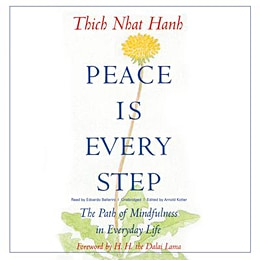 Beautifully narrated by Edoardo Ballerini