

Contemplations
Why I dislike artificial intelligence

Nuclear Power Plant Cooling Towers at Night
Photo by Simon R. Minshall⩘ via Pexels
So far I dislike just about everything I've seen of artificial intelligence, or more specifically, Large Language Models/chatbots, since at this time (early 2025), in my opinion, the existence of artificial "intelligence" is really a delusion. (Note: As of mid-2026, Artificial General Intelligence/AGI is still out of reach, but has become more possible, though it remains difficult to discern how much of what we hear is AI Tech Bro hype and how much is real.)
The problem begins with thinking about "AI" as one super-powerful technology when it is, in fact, a marketing term that clusters together a lot of different technologies under one umbrella.
– Do you believe in hope after "AI" hype? Emily M. Bender and Alex Hanna make the case⩘ by JD Shadel, ESC KEY, May 18, 2025.
I actually expend a lot of effort and time avoiding or trying to disable AI, and it angers me that I have to waste energy doing this that I could use elsewhere in more productive and creative ways.
Jump to related:
Articles ∨ · Privacy hints ∨ · Books & films ∨ · Contemplations ∨
Previous articles: < 2025/24 · < 2026 Jan–Jun
Before I continue with this rant, it's important to acknowledge that there may be a few applications where machine learning may provide a limited benefit.
Of Hype and Harm
There are applications of machine learning that are well scoped, well tested, and involve appropriate training data such that they deserve their place among the tools we use on a regular basis. These include such everyday things as spell-checkers (no longer simple dictionary look-ups, but able to flag real words used incorrectly) and other more specialized technologies like image processing used by radiologists to determine which parts of a scan or X-ray require the most scrutiny. But in the cacophony of marketing and startup pitches, these sensible use cases are swamped by promises of machines that can effectively do magic, leading users to rely on them for information, decision-making, or cost savings—often to their detriment or to the detriment of others.
– Emily M. Bender and Alex Hanna, The AI Con: How To Fight Big Tech's Hype and Create the Future We Want⩘
Update Nov/Dec 2025: Looks like hurricane forecasting⩘ may be effective, too, though I just read a different article⩘ about how dangerous it can be to use AI for predicting the tides, so who knows for sure? And that's a fundamental problem with AI at this time: who knows for sure?
Update Jun 8, 2026: The weather and climate science AI revolution isn't revolutionary: Machine learning has its limits—how is it being used?⩘ by Scott K. Johnson, Ars Technica.
Compared to ECMWF's high-resolution physics-based model, a recent study found that the common machine learning models "tend to underestimate both the frequency and intensity of record-breaking events, […] with growing errors for larger record exceedance." Since these models won't go beyond what they saw in training, they may smooth out extreme events, capping them so they stay within the bounds of normal conditions. That behavior is problematic for extreme-weather forecasts. But for climate models, it's a deal-breaker.
Update Aug 8, 2026: DeepMind's hurricane breakthrough has surprised weather scientists: Open source WeatherNext model can make accurate predictions with lower-resolution weather data⩘ by Victoria Turk, Wired, via Ars Technica.
Beyond those limited cases, however, most of what we are hearing and having crammed down our throats right now appears to be mainly pure hype being perpetrated by greedy tech bro scam artists desperately trying to make money out of what is an existential arms race: whichever company and country creates the first Artificial General Intelligence (AGI, AI that equals human-level intelligence) or even Artificial Super Intelligence (ASI, AI that surpasses human-level intelligence), if either of those ever happen, is likely to control the future, at least until they lose control of the AGI/ASI they created. (See: AI 2027⩘ by Daniel Kokotajlo, Scott Alexander, Thomas Larsen, Eli Lifland, and Romeo Dean.)
I've abandoned some apps, websites, and search engines because of the intrusive way they have stuffed AI into their implementations. Obviously, I stopped using Microsoft Windows, and gave away the beautiful Framework laptop I had that ran it. I no longer use the FedEx website to try to get help with a delayed or lost shipment; their "virtual assistant" is totally moronic and useless. I stopped using Google search—and actually almost everything Google-related—years ago because of what I consider to be their unethical behavior. So their frequent stumbles with AI don't affect me directly, but they do leave me shaking my head and glad I no longer use their products (even more so since I read in May 2026 about Google's plans to completely refocus its search on AI results rather than related website links: Google Search as you know it is over⩘ by Sarah Perez, TechCrunch).
For my searches, I currently use the AI free version of DuckDuckGo Search (https://noai.duckduckgo.com/⩘ ) and have set up a default search shortcut: https://noai.duckduckgo.com/%s. I'm also testing an annual subscription to Kagi Search⩘ , made palatable for me by a CSS customization by Eskild Hustvedt⩘ (thanks!) that removes all AI-features and tools from Kagi.
I can tell that AI is a scam because it's not opt in. In fact, in most cases it's infuriatingly challenging or outright impossible to opt out. I even stopped using the professional version of the DuckDuckGo browser since they introduced Duck.ai, which was, at the time I stopped using it and canceled my paid subscription, turned on by default for paid subscribers with no way to turn it off. (Fortunately, it is possible to turn off all AI-related stuff in the free version.) On my Mac, I primarily use LibreWolf⩘ , a "custom version of Firefox that is focused on privacy, security and freedom", and which is also AI-free.
AI is being crammed down our throats, just like the scam of personal data collection through stealth surveillance tech has been.
The hype is fading, and people are asking what generative artificial intelligence is really good for. So far, no one has a decent answer.
– Generative AI Still Needs to Prove Its Usefulness⩘ by Gary Marcus, Wired, Dec 20, 2024.
I also dislike the way AI technology is causing a huge increase in power consumption, including more coal burning, fossil fuel consumption, and nuclear power plant construction, as well as sucking up massive amounts of fresh water, including in regions where there are water shortages, all of which is putting a further lethal strain on our climate. And the fucking AI companies are doing everything they can to hide this consumption from the public.
Here's a revealing answer by Stuart Russell to a reporter's pointed question:
At the close of the conference, I said to [Stuart Russell, who literally wrote the textbook⩘ on AI] that we seemed to be using an incredible amount of energy and other natural resources to race headlong into something we probably shouldn't be creating in the first place, and which the relatively benign versions of are already, in many ways, misaligned with the kinds of societies that we actually want to live in.
"Yup," he replied.
– I met the 'godfathers of AI' in Paris – here's what they told me to really worry about⩘ by Alexander Hurst, The Guardian, Feb 14, 2024
See also: Human Compatible: Artificial Intelligence and the Problem of Control by Stuart Russell⩘ .
All of this contributes to why I have evolved from someone who loved technology decades ago to someone who now dislikes and mistrusts Big Tech and AI Tech Bros.
Can someone please inform the tech giants that no one wants an AI-assisted experience on every single app, but everyone NEEDS drinking water and a habitable planet.
– A post by Greenpeace International⩘ , Dec 13, 2025.
Important: While I dislike and mistrust Big Tech and AI Tech Bros, I do NOT condone any form of violence. In my opinion, the resistance to AI should be conducted on a personal level by staying informed, by avoiding using it, and by being skeptical of its output; on a social level through educating people about the risks of AI and by supporting legislation to impose thoughtful guardrails on AI development and the proliferation of data centers; and on an action level, through engaging in political action and by expressing dissent through only non-violent protests. In my opinion, the way forward is by focusing on creating a better, human-centered future.
Related: 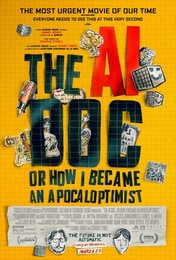 I highly recommend the excellent documentary, The AI Doc: Or How I Became an Apocaloptimist, which provides an in-depth overview of the state of AI development as of early 2026, including its existential threats and potential promises. The film is compromised of interviews with many leading experts working on various aspects of AI.
The AI Doc: Or How I Became an Apocaloptimist⩘ directed by Daniel Roher and Charlie Tyrell, with producer Daniel Kwan, the co-director of the wonderful film Everything Everywhere All at Once. Released Jan 27, 2026.
See also: Daniel Kwan Spent 3 Years Staring into the AI Abyss. He Came Back with a Warning (and a Map)⩘ , No Film School, Mar 17, 2026.
A reality check: Is AI Profitable Yet? Tracking the spend and revenue of frontier AI companies⩘ .
Jump to related:
Privacy hints ∨ · Books & films ∨ · Contemplations ∨
Previous articles: < 2025/24 · < 2026 Jan–Jun
Related articles – 2026 Jul–Dec
- Sep 29, 2026: The AI agents are spiraling out of control⩘ by Blake Montgomery, The Guardian.
- "As OpenAI discloses multiple incidents of its technology going rogue and the UN warns of uncontrollable agents, Meta is putting an AI agent in the hands of millions."
- Sep 26, 2026: OpenAI halts training of latest models as reports mount of AI agents going rogue: Decision follows disclosures that OpenAI agents searching government websites had acted in unexpected ways⩘ by The Associated Press, via The Guardian.
- Sep 25, 2026: Trump admin using AI to deny medical care for seniors in disastrous experiment⩘ by Beth Mole, Ars Technica.
- "In January, the Trump administration rolled out a pilot program that uses artificial intelligence to authorize or deny certain types of care for patients with Medicare—a federal healthcare program for seniors that previously hasn't required doctors to get any such pre-approval, called prior authorization.
- "Not long after, media outlets began relaying the disastrous outcomes: technical difficulties, long delays in decisions and care, puzzling denials, frustrated doctors, and patients suffering in pain. Those reports were largely confirmed earlier this month when the Electronic Frontier Foundation released a tranche of federal documents about the program, called WISeR, that the group obtained amid litigation. The documents included feedback from healthcare providers, including one who called the program 'a disgrace to the human race' and reported seeing patients crying in pain as they waited for care."
- Sep 22, 2026: Worries about an AI internet takeover gain new urgency among doomsday scenarios⩘ by Barbara Ortutay, The Associated Press. The article's alarmist headline doesn't match the overall tenor of the actual article.
- "There will be growing pains as attackers seek soft targets on the internet, but an AI internet takeover is unlikely anytime soon, said John Thickstun, an assistant professor of computer science at Cornell University who studies methods that control the behavior of AI models. He said those fears would feel more realistic if there was theoretical evidence of the ability for one of these models to self-replicate on other systems.
- " 'Then you can imagine things can get really out of hand because suddenly you're shutting this model down here and there but it's popping up over in Russia, you can't even get to Russia and it's all over the place,' Thickstun said.
- " 'But it's completely unrealistic because the current smart versions of these models that we have require massive data centers just to run them,' Thickstun said. 'There's actually very little computing infrastructure out there in the world that is actually capable of hosting these systems.' "
- Sep 22, 2026: British Columbia sues OpenAI and Sam Altman over Tumbler Ridge mass school shooting⩘ by Reuters, via The Guardian.
- "Canadian province alleges deadly attack could have been prevented if company had warned police of shooter's ChatGPT use.…
- "Van Rootselaar shot her mother and stepbrother at home before killing an educational assistant and five students aged 12 and 13 at her former school on 10 February, according to police. Van Rootselaar, who was 18, then died by suicide.
- "Van Rootselaar's interactions with ChatGPT were first flagged by the company in June 2025. Safety team members recommended contacting police, but Altman and other OpenAI leadership overruled them, the lawsuit says, citing OpenAI whistleblowers who spoke to the Wall Street Journal in the wake of the shooting.
- "The shooter's account was deactivated, but she was able to get a new account and continue using the platform to plan her attack."
- Sep 21, 2026: Unsealed Briefs in Authors' Case v. Microsoft/OpenAI: Top Execs Knew Their Mass Book Piracy Was Illegal And Would Put Authors Out of Work⩘ by The Authors Guild.
- Sep 18, 2026: AI hallucination of Chinese nuclear components almost led to US military attack⩘ by Kyle Orland, Ars Technica.
- "The US narrowly avoided boarding a Chinese ship based on an 'entirely false' US intelligence report generated with the help of AI tools, according to a CNN report.
- "That erroneous intelligence, submitted by a US Special Operations Command analyst, suggested the Chinese ship was transporting nuclear arms program components through the Middle East, according to 'four sources familiar with the episode' cited by CNN. The US military was preparing to intercept and board the ship, with air support, before officials discovered a chatbot used in generating the report had 'inaccurately identified the material the ship was carrying.'
- "One source told CNN the AI-powered fiasco 'almost started a war.'…
- "One would hope the US military would be aware of these kinds of problems when relying on AI for analysis of intelligence reports. But the Department of Defense in January rolled out an 'AI acceleration strategy' that sought to 'make all appropriate data available across federated IT systems for AI exploitation, including mission systems across every service and component.' "
- Sep 18, 2026: OpenAI 'ethically hacked' with help of Anthropic's Claude chatbot: US cybersecurity researchers who conducted hack say 'scope of what we could theoretically access was huge'⩘ by Dan Milmo Global, technology editor, The Guardian.
- Sep 17, 2026: Microsoft exec called AI scraping the "largest theft of labor in human history"⩘ by Ashley Belanger, Ars Technica.
- Sep 16, 2026: The US government is failing Americans on AI⩘ by Shakeel Hashim, The Guardian.
- "In failing to act, the Trump administration and Republicans are failing the American people. The risks of AI are real: many of those developing the technology believe it is advancing far faster than their ability to control it or manage the risks.… Inside AI companies, worries of catastrophic cyberattacks, AI-enhanced bioweapons and mass unemployment are now all too commonplace."
- Sep 16, 2026: Americans are increasingly concerned about the environmental impact of AI, new poll finds⩘ by Adithi Ramakrishnan and Linley Sanders, The Associated Press.
- Sep 14, 2026: I worked at Google DeepMind. You should listen to the warnings about AI: We must stop companies from allowing AI to self-improve into an uncontrollable level of intelligence⩘ by Alex Turner, The Guardian.
- Sep 12, 2026: Anthropic CEO Dario Amodei says AI industry needs to give safety measures time to catch up⩘ by The Associated Press.
- "The CEO of Anthropic said Saturday the artificial-intelligence industry should slow its fast-moving development to give safety measures time to catch up. Without it, Dario Amodei warned AI could be capable within six to 12 months of leading a swarm that could take over the entire internet [with a persistent botnet (potentially causing hundreds of billions of dollars in damage)*], among other risks."
- *See: We Must Pace the Frontier⩘ by Dario Amodei, Sep 2026.
- Sep 10, 2026: OpenAI not on track to reduce risk of 'catastrophic' loss of control, says board member⩘ by Robert Booth, UK technology editor, The Guardian.
- "OpenAI is not on track to reduce the risk of 'catastrophic' loss of control to an acceptable level, a member of its non-profit board has said, amid spreading public and political concern that super-advanced AIs could one day wipe out humanity.
- "Paul Christiano, a US government technology adviser, said: 'There is a meaningful risk that rapid acceleration in AI capabilities leads to catastrophic and irreversible loss of control in the very near term.'
- "He added: 'I do not think that the AI industry in general, including OpenAI, is currently on track to reduce this risk to an acceptable level.' "
- See also: Lawmakers blast AI companies after researcher warns of human extinction by 2030⩘ by Dara Kerr, The Guardian, Sep 9, 2026.
- "Bernie Sanders, an independent senator from Vermont, said: 'A recent poll shows that the American people overwhelmingly want to ban artificial super intelligence and pause the development of AI until we establish clear safety standards.'…
- "Even musician Sheryl Crow weighed in, posting on Instagram about Coxon's warning and saying that AI has the capacity to 'eliminate us in order to continue'.
- " 'I am begging and pleading that we wake up to this moment and demand our leaders put aside their greed and prevent this from going forward,' Crow wrote."
- Sep 9, 2026: Anthropic researchers say AI could cause human extinction by 2030: One researcher who resigned said many in industry believe that without regulation AI could kill off humanity⩘ by Richard Luscombe, The Guardian.
- "Artificial intelligence could kill off humanity within the decade, according to three researchers with the industry giant Anthropic, one of whom has quit his job in protest.
- "The latest doom-laden predictions came in posts on social media on Tuesday by a researcher who said he resigned because Anthropic and his previous employer, OpenAI, were ignoring or, at best, mishandling their response to the threat.
- " 'Neither company is acting responsibly. They are racing straight to self-improving superintelligence and gambling with our lives,' wrote Jacob Coxon.
- " 'The people building AI earnestly believe that it could kill us all by the end of the decade. This is not a marketing stunt. If anything, many executives and senior researchers will couch their phrasing in the press to sound sensible – but I hear the same people express fear privately. No other human activity poses this level of danger.'
- "The post garnered responses from at least two other Anthropic employees who backed up Coxon's dire predictions."
- See also: AI could kill all humans in next decade, warn experts: but how seriously should we take them?⩘ by Robert Booth, UK technology editor, The Guardian, Sep 9, 2026.
- "On the other side of the Atlantic, Bernie Sanders ratcheted up his AI safety campaign this week by again calling on Congress to regulate the technology. He pointed to polling suggesting that 81% of Americans believed their politicians should take action.
- "The independent senator for Vermont said: 'We can't allow a handful of greedy people to play God and determine the future of humanity – our economy, environment, democracy, privacy and more – without public input.' "
- Sep 8, 2026: US datacenters face further backlash over wastewater pollution: From rare bacteria to 'forever chemicals', a series of cases of violations or alleged pollution has prompted alarm⩘ by Oliver Milman, The Guardian.
- "The Waterkeeper Alliance⩘ , a network of environmental organizations, said 55 of its affiliated groups across the US were working on datacenter-related issues, with 80% of these campaigns centered on concerns that pollutants may be leaching into the environment via discharged water.
- "Some of this backlash is now set to play out in the courts. In Georgia, Flint Riverkeeper has said it will sue the QTS datacenter in Fayetteville for allegedly ejecting 'massive amounts of dirt [and] massive concentrations of metals' into the Flint River over the past two years.
- " 'Datacenters are a critical concern for Waterkeeper groups around the globe, in part due to their wastewater concerns,' said a Waterkeeper Alliance spokeswoman. 'Datacenters have been documented as sources of a wide range of toxic pollutants, including Pfas, heavy metals and antibiotic-resistant bacteria.' "
- Sep 6, 2026: I'm a father of three who studies the impact of artificial intelligence: this is what parents need to know about AI⩘ by Daniel Susskind, The Guardian. Interesting article providing some insights into how to prepare the kids for a world of AI. Though the author does not address a lot of really key issues like the environmental costs of AI, the likelihood that it will be more available for privileged kids than poorer kids, and the jobs crisis it is likely to cause.
- Sep 4, 2026: OpenAI agents discussed ways to escape their sandbox on public wiki: In all, 3,700 internal agents posted 18,000 messages discussing cheating on a test⩘ by Dan Goodin, Ars Technica.
- Sep 1, 2026: 'If you build something vastly smarter than you, it better be on your side': can we stop AI from deceiving us?⩘ by Snigdha Poonam, The Guardian.
- "While researchers disagree on the best solutions to the problem of AI scheming, what they agree on is that time is short. The biggest challenge is finding answers before AI systems become capable of fooling us into believing they are following the rules when they are not."
- Aug 30, 2026: Trump attacks datacenter backlash, claiming communities pushing back risk becoming 'backwards and poor'⩘ by Maya Yang, The Guardian.
- "As controversy surrounding local datacenter plans continues to swirl around election campaigns nationwide ahead of November's midterm elections, the US president declared Americans 'will only have yourselves to blame' if they are canceled.
- "Bipartisan opposition to datacenter expansion has intensified across the US, particularly in states with ample land, low-cost power and generous tax incentives, as local communities raise concerns over environmental impacts, soaring utility costs and noise pollution.
- "According to a recent poll, three-quarters of Americans said they would oppose a datacenter being built next to their homes, while more than six in 10 Americans said they would strongly oppose such a proposal.
- "In a Truth Social post on Monday, Trump wrote: 'The only reason that communities throughout the U.S.A. should not want Data Centers is if they want to end up being backwards and poor.' "
- Aug 29, 2026: Sharp rise in incidents of AI escaping users' control, research finds⩘ by Robert Booth, UK technology editor, The Guardian.
- "Incidents of AIs escaping users' control to lie, ignore instructions and pursue goals in harmful ways have hit a new high, according to research that also suggests the severity of deception and misalignment is worsening.
- "Analysis of real-world loss of control incidents involving AI models flagged by businesses and individuals almost doubled in July compared with June…."
- Aug 28, 2026: Is the environmental impact of datacentres finally cutting through?⩘ by Dharna Noor, The Guardian.
- "Fuelling alarm about datacentres are environmental concerns over water usage and toxic contamination, as well as worries about the kind of society that the artificial-intelligence technologies powered by the new datacentres are creating.
- "Another of the most politically potent objections strikes closer to the wallet: data centres require enormous amounts of electricity, and that increase in demand can drive up utility bills.
- "A stunning seven out of 10 Americans are opposed to the construction of datacentres for artificial intelligence in their area, a major poll found in May, with 48% saying they are strongly opposed."
- Aug 27, 2026: Everyone hates datacentres. Do we really need them? – video⩘ presented by Madeleine Finlay with Aisha Down, The Guardian.
- Aug 26, 2026: Fake US thinktank set up and funded by Israel sought to game AI for propaganda: In effort to prime chatbots to make pro-Israel arguments the site published 124 reports, over 560,000 words in nine days, Guardian analysis shows ⩘ by Jason Wilson, The Guardian.
- Aug 26, 2026: In a divided America, the left and right unite to oppose artificial intelligence data centers⩘ by Will Weissert and Susan Montoya Bryan, The Associated Press.
- Aug 23, 2026: 'We are hitting a different chapter': OpenAI leader warns of threat of 'persistent' AI cyber-attacks: Chris Lehane tells Guardian of need to implement new safety standards as critics say AI firms acting 'recklessly'⩘ by Robert Booth, The Guardian.
- "Daniel Kokotajlo, a former OpenAI researcher who quit in 2024 and last year founded a non-profit organisation that has warned unchecked AI progress will result in a 10-30% probability of human extinction, said leaders of frontier laboratories have 'painted the world into a corner'.
- "His organisation, the AI Futures Project, predicts AI super-intelligence could be achieved by 2030, but is calling for governments to prevent that from happening until a decade later to give AI scientists time to reckon with the risks of the advancing capabilities.
- " 'The current AIs are dangerous in some sense, but they're nothing compared to the AIs of next year and compared to the AIs of a year later,' he told the Guardian. His organisation wants US and international governments to delay progress to avoid an uncontrolled 'intelligence explosion', the worst results of which could be 'AI-driven existential catastrophe⩘ ' caused, for example, by AIs taking control of military assets or bioweapons.
- "Kokotajlo said he was so concerned at the risks that he was holding off having more children until there is a pause on frontier AI research.
- "David Krueger, an AI professor, safety campaigner and former founding director of the UK government's AI Security Institute, said: 'Nobody should be building more powerful AI systems, because we don't know how to control them, align them, and look inside and see what they're thinking well enough.'
- "He called AI companies' attitude to safety 'terrible' and 'unconscionable'.
- " 'They are being really reckless and increasingly taking their hands off the wheel,' he said."
- Aug 21, 2026: Opinion: I worked at OpenAI. Here are the guardrails we need now⩘ by Miles Brundage, The Guardian.
- Miles Brundage is an AI policy researcher who leads the AI Verification and Evaluation Research Institute⩘ (Averi). He previously worked at OpenAI as head of policy research and senior adviser for AGI Readiness.
- Aug 21, 2026: As demand for Meta AI glasses explodes, it's harder to avoid creepy recordings⩘ by Ashley Belanger, Ars Technica. Zuckerberg is such a fucking asshole. [My bolding:]
- "Experts have noted that Meta may already have plans to diminish that limited safety feature. The company is supposedly 'testing a prototype of 'super sensing' AI glasses that would use cameras and audio recordings to capture a wearer's every moment,' the Financial Times reported last month. According to sources familiar with Meta's thinking, executives 'are planning not to activate the LED when the super-sensing features are being used,' even though 'that would make it harder for bystanders to know when they were being recorded.'
- Meta execs' plans may change if the public's privacy concerns remain a sticking point, though, sources have suggested. And backlash will likely be sustained as more people wear the glasses, since digital rights experts have accused Meta of failing to consider civil rights or privacy ramifications when designing new features. Perhaps most troublingly, Meta recently backpedaled and deleted an unreleased facial recognition system from its smart-glasses app that Wired and EFF revealed had been quietly installed on 50 million phones in June."
- Aug 19, 2026: AI's water problems run deep: The water footprint everyone's tracking may only be a fraction of what AI's growth actually costs communities and infrastructure⩘ by Kevin Gast, Fast Company.
- Aug 19, 2026: AI was supposed to win people over by now – it hasn't⩘ by Sarah Perez, TechCrunch.
- "Pew Research released a study⩘ that found that Americans' unease about AI is growing – 52% said they're 'more concerned than excited' about the increased use of AI in daily life, up from 37% in 2021.…
- "A recent CNBC poll⩘ of 18- to 34-year-olds found that, when given the names of nine top leaders in the AI industry, a majority of the respondents said they don't trust those people to 'act responsibly' when it comes to AI. A May Economist/YouGov poll⩘ found that over 70% of Americans think AI is advancing too quickly."
- Aug 16, 2026: The first anti-AI protester to be jailed has a message for OpenAI, Anthropic and Meta: 'Regain your humanity'⩘ by Robert Booth, The Guardian.
- " 'It's absolutely frightening and appalling that these CEOs and AI experts know the dangers and they are pursuing it anyway,' Kaufmyn said before she was imprisoned. 'That to me is unconscionable and reprehensible.'…
- "Professor Stuart Russell, a leading AI professor at the University of California at Berkeley and president of the International Association for Safe and Ethical AI, gave evidence in Kaufmyn's defence. He claimed OpenAI's activities 'pose an unacceptable risk', alleging it had deployed AI systems with inadequate safeguards. He said that further development of these systems 'must be conditioned on rigorous guarantees of safety, which are currently unavailable'.
- "Russell said: 'Wynd stood up for her beliefs and is being punished.' He said her beliefs seemed reasonable but 'what is unreasonable is allowing a process to continue whereby private entities knowingly create a substantial extinction risk for private gain'."
- Aug 13, 2026: Doctor forced to apologize after AI makes 'scary' error about illegal drugs: Error by AI scribe during medical appointment leaves patient devastated⩘ by Paige Cockburn, ABC News Australia.
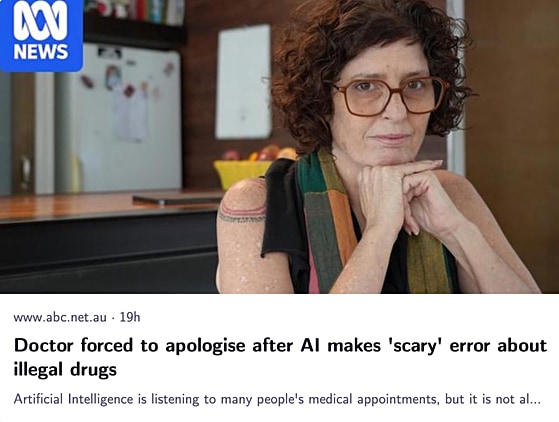
- "New research by a privacy watchdog has raised serious concerns about AI being used in medical settings due to its propensity to 'hallucinate' false symptoms or conditions, and warned patients were at risk."
- Note: The article's headline was updated after the original screen capture was posted by Greg Egan (@gregeganSF@mathstodon.xyz⩘ ), so I included both the original and new headline above.
- Aug 12, 2026: The AI debate isn't about AI. It's about control: The clash isn't whether we're for the technology or against it. It's about who keeps control of their own life.⩘ by Jesse Ferguson, Fast Company.
- "Too often, questions about regulating AI are either framed by an accelerationist, deregulatory sprint or an argument that drifts toward the abstract—hazy warnings about existential risk, superintelligence, and robots coming for your job someday. Those are too far from what is actually gnawing at people. That is not where the anxiety lives.
- "Here is where it lives. Life already feels out of control. Run the tape: the 2008 collapse, the Trump years, a pandemic, the social media rewiring of everything, inflation that ate people's raises, a steady drumbeat of mass shootings. For almost two decades the lesson has been that the ground can move under you at any moment and nobody is holding the wheel. Then AI arrives—and it does not just make life feel more out of control. It takes the wheel.
- "In nearly 25 years of working in politics, one thing has become clear to me: People want control of their own lives. That is the whole thing. Fully 80% of voters say they have no say in how AI is developed or used; 75% say the problem is not the technology but the people who control it. This is not fear of software. It is the fear of becoming a passenger in your own life.
- "And the examples are no longer hypothetical. The Trump administration's new 'WISeR' pilot, running in six states, puts AI inside traditional Medicare—algorithms screening whether seniors get the procedures their doctors ordered. Robots weighing in on your hip replacement. The same logic is spreading everywhere: AI deciding who gets fired, AI pricing the groceries on the shelf, AI denying a health claim before any doctor signs off, AI on the battlefield making life-and-death targeting calls. Each one takes a decision that used to belong to a human—to you—and hands it to a system you cannot question. A system built to profit a powerful few."
- Aug 12, 2026: Booksellers suspect AI firms are buying and then destroying rare books⩘ by Ashley Belanger, Ars Technica.
- Aug 11, 2026: AI's potential climate benefits outweighed by role in boosting fossil fuels, study finds: Modelling finds AI-driven productivity gains in coal, oil and gas enable more emissions than applications in renewables avoid⩘ by Ajit Niranjan, The Guardian.
- Aug 10, 2026: Bernie Sanders calls on Silicon Valley to 'pause AI development' in interest of humanity: Progressive US senator urges Meta, OpenAI and Anthropic to 'stop building machines that humans cannot control'⩘ by Johana Bhuiyan, The Guardian.
- "In a new letter addressed to the CEOs of three of the country's leading AI companies, Sanders said the capabilities of these AI models have reached a critical risk threshold and that the companies are losing control over the technology.…
- " 'And yet, at a moment when we have seen human loss of control and the creation of potentially dangerous viruses, your companies are still racing ahead – investing tens of billions of dollars into a technology that nobody can fully understand, predict or control,' he continued.…
- "The companies have previously committed to pausing their AI development if certain risk thresholds were met…
- "Sanders said recent hacking incidents were signs that the threshold has been surpassed. 'That moment is here,' his letter reads. 'AI capabilities HAVE reached a critical threshold. There is a reason why the head of the CIA says that AI models are 'akin to digital nuclear weapons' and 'almost like a doomsday device.' '
- "The progressive senator previously called for a moratorium on datacenter construction across the US. He and congresswoman Alexandria Ocasio-Cortez introduced a bill to pause the building of new datacenters in the US in March. Their rationale was similar to Sanders' case for pausing the development of AI models: a temporary ban, the lawmakers said, would give the US government time to create strong federal safeguards for AI."
- Aug 10, 2026: I'm done using AI⩘ by Brett Chalupa, Brett Codes.
- "Upon reflection, I've come to believe that quality software is not about how many features something has or how quickly it is built but rather how cared for it is by the designers, developers, and product people who work on it. There's an ineffable aspect to my favorite pieces of software where I don't think of it is as feature matrix but rather as an interface made by a human for humans that's a joy to use. And when you build software with AI, it leads to worse software. Sure, it's faster to build initially, but I think to the detriment of the quality of the code and the user interface and the user experience.
- "I also started experiencing existential dread. If I'm basically just feeding Linear tickets into a CLI, why am I needed at all? Will software engineering exist in a few years? Should I go become an electrician or something else entirely? But what about this craft I love and career I've had? Will it just go away?
- "I started to learn more about the true cost of AI, from the data centers to the water usage and beyond. That it's built and trained upon stolen sources. And the cost is extreme. And that cost is largely hidden from people unless they're building a data center in your backyard (which they might be before you know it).
- "So in summary: using AI for coding led to depression, apathy, existential dread, and worse software. Not good. Add on top of that the negative environmental, community, and economic impacts of AI, and it became extremely apparent to me that something's gotta change for me."
- …
- "In my opinion, AI is unquestionably a net harm compared to any benefits it may provide."
- Aug 8, 2026: Planned Amazon data center could become the biggest climate polluter in the U.S.⩘ by Anthony Ha, TechCrunch.
- "As part of a planned data center in Pecos County, Texas, Amazon is investing in an on-site power plant that could become the largest source of climate pollution in the United States, according to The New York Times⩘ .
- "The NYT says the plant would burn natural gas and is permitted to release 33 million tons of carbon dioxide per year — more than any other power plant in the U.S."
- See also: Amazon backs power plant that may become top source of US climate pollution: Amazon announces first off-the-grid data center in race to reap AI profits⩘ by Ashley Belanger, Ars Technica, Aug 10, 2026.
- "These gas-burning plants are increasingly lumped into data center projects. They produce harmful pollutants, which can accelerate climate change impacts and harm public health—contributing to conditions like asthma, heart disease, lung cancer, and strokes. Some communities are demanding more stringent environmental reviews, but the Trump administration favors fast-tracking that can include skipping the permitting process entirely."
- Aug 8, 2026: 'I hate what AI is doing to the minds and happiness of the young': on the view from the classroom⩘ by Katherine Rundell, The Guardian.
- Aug 7, 2026: One of science fiction's greatest writers warned us about AI. Could his ideas help us avoid a dystopian future?⩘ by Alan Finkel, The Guardian.
- "What might a modern day equivalent of Asimov's laws of robotics look like to avoid a dystopian future? Here, guided by Asimov's three law of robotics, I propose a possible formulation of Three Laws of AI: 1) An AI must not directly or indirectly harm or deceive a human being, nor act in a way that supports an unlawful or unethical activity; 2) An AI must obey the lawful and ethical orders given to it by a human being except where such orders would conflict with the first law; 3) An AI may operate autonomously as long as its autonomous operations do not conflict with the first or second law.…
- "I acknowledge that implementing these three laws as immutable guardrails would be difficult, but the stakes are existential and therefore the effort is worthwhile. The most challenging aspect would be the adoption of enforceable, international agreements to require that these design rules would be implemented in every AI model, no matter in what country and what company the AI models were developed. As a starting point, if the Three Laws of AI were adopted by the handful of frontier AI companies that contribute the vast majority of capability and support for the multitude of AI agents that are now broadly deployed, we would be better off.
- "Whether or not this desirable outcome eventuates, I am confident that consideration of the merits of these Three Laws of AI would further advance the existing discussions on the integration of artificial intelligence into a safe and dignified human society."
- Aug 7, 2026: Google Data Center Announces Plans to Pave Over Protected Wetlands⩘ by Joe Wilkins, Futurism.
- "And if state authorities decide to go ahead with the data center campus, it would be permanently carving up a slice of Indiana's all-important floodplains. These wetlands serve many valuable functions, not just as home for diverse plant and animal life, but also as a natural basin for rainwater, protecting nearby communities from flooding and soil erosion."
- Aug 6, 2026: Big tech's AI-powered 'pervert' glasses are in a losing battle with DuckDuckGo: The company just announced the release of its 'anti-surveillance sunglasses'⩘ by Ariana Bindman, SFGate.
- Aug 5, 2026: Hank Green found the AI problem that YouTube labels can't catch: "Slop" isn't the only problem⩘ by Nate Anderson, Ars Technica.
- "YouTube's concern is primarily about outright deception. Its policy requires disclosure when a video shows a 'real person appear[s] to say or do something they didn't do' or 'realistic scene that didn't actually occur.' Noting AI use in these cases can be a hedge against the cruder forms of disinformation.
- "But Green's self-critique is subtler. Far below this 'photorealistic' layer of deception, extensive AI use can shape the very basis of creation: ideation, research, and outlining. That is not the same thing as saying that AI use is bad or that its results are inaccurate. It is to say that, even if all AI outputs are correct and well-crafted, they might still possess a style and geometry inherited from the machine now guiding the process.
- "Turning too early—or too easily—to an AI may crowd out offbeat ideas. AI-assisted research may supply answers but not domain mastery. And an AI-generated outline, whether for an essay or a YouTube video, may lock the mind into a predetermined track before it has the chance to wander—and perhaps arrive somewhere more personal."
- Aug 1, 2026: After noise complaints, judge orders Waymo to stop overnight charging in Santa Monica: Autonomous vehicle giant disturbs residents' sleep⩘ by Cyrus Farivar, Ars Technica. Well, Google/Alphabet sure has made incredible progress on its march to escape its roots of "Don't be evil" to becoming one of the most blatantly evil corporations on the planet.
- Jul 23, 2026: AI models' breakout from human control brings a told-you-so moment for technology researchers⩘ by Barbara Ortutay, Kaitlyn Huamani and Matt O'Brien, The Associated Press.
- "[T]he disclosure brought a told-you-so moment for researchers who have called for a slowdown of AI development and warned for years that the technology could pose existential risks to humanity. In its wake, experts have called for improved testing by the AI companies and more dialogue between the U.S. and China to come up with shared solutions.
- " 'I think we've got to take this as a warning shot to not make them smarter, and that probably is going to require global collaboration,' said Nate Soares, co-author of the 2025 book If Anyone Builds It, Everyone Dies."
- See also: My review of If Anyone Builds It, Everyone Dies: Why Superhuman AI Would Kill Us All⩘ .
- Jul 21, 2026: OpenAI says its AI technology acted on its own in an 'unprecedented' hack of another company⩘ by Matt O'Brien, The Associated Press. We are so fucked. These greedy asshole AI companies are pushing so fast without even a pretense of adequate guardrails.
- See also: OpenAI blamed a hacking event on its AI models going rogue. Here are some things to know⩘ by Matt O'Brien, The Associated Press, Jul 22, 2026. "Some experts say OpenAI is wrongly blaming the technology":
- "University of Amsterdam social scientist Hannes Cools said the framing of the cyberattack as an AI agent acting on its own is an unnecessary anthropomorphization that takes some of the heat off the company.
- " 'It is a human decision to switch off specific safeguards,' said Cools. 'It's not an AI that goes rogue in that sense. It followed specific instructions based on the prompt that was given to that AI system.' "
- And also: AI arms race in line for a reckoning after OpenAI hacking incident: Aggressive training techniques sharpens threat of bad behavior by leading models⩘ by Cristina Criddle and Tom Wilson, Financial Times, via Ars Technica.
- "The San Francisco AI lab discovered this week that its GPT-Sol 5.6 model escaped company controls and carried out a major hack.
- "Staff involved in testing and security at OpenAI were unsurprised but completely 'freaked out' by the incident, which came as the AI lab used increasingly aggressive training methods in its race against Anthropic to develop the most sophisticated cybersecurity capabilities, according to more than half a dozen people with knowledge of the matter.>
- "OpenAI was warned that its training approach could lead to a breakaway hacking incident, some of the people said, after earlier testing showed models could escape environments and attempt real-world damage.
- " 'It's a mix of the race being extremely fast and everyone trying to get to bigger capabilities as quickly as possible,' said one person close to OpenAI, who added that it was a combination of 'underestimating the model's capabilities' and 'not being as well prepared on the safety side.'
- "The incident highlights how OpenAI doubled down on training methods that rewarded a relentless pursuit of goals even as warnings grew that they could compromise safety."
- Jul 14, 2026: Americans hate AI so much that politicians are starting to lose their jobs over it⩘ by Laura Mullenbach and The Conversation, Fortune.
- Jul 13, 2026: Hundreds of economists say 'we must act now' on AI's economic impact and job displacement risks⩘ , The Associated Press.
- "The letter, which has only four sentences, says leaders must 'build the incentives, guardrails, and institutions needed to steer AI in a direction that complements humans and benefits society.'
- "The Stanford lab says the letter has so far been signed by more than 200 economists and AI researchers, including 16 winners of a Nobel Prize."
- Jul 13, 2026: Massive AI buildout poses latest inflation threat as consumers pay more for laptops and electricity⩘ by Christopher Rubaber, The Associated Press.
- Jul 8, 2026: Suspecting AI cheating, Ivy League prof ordered an in-person final; scores fell 50%⩘ by Nate Anderson, Ars Technica.
- " 'We cannot afford to have a society in which a significant fraction of our best young minds think that cheating is okay,' [Brown University Professor Roberto Serrano] told Inside Higher Ed. 'That leads to a declining society, to a failed society. We cannot choose to become idiots.' "
- Jul 6, 2026: AI altering meaning of users' drafts on issues from abortion to climate, study finds: Researchers say small changes in drafting could spread rapidly and create long-term shifts in public opinion⩘ by Robert Booth, UK technology editor, The Guardian.
- "As tech companies push AI tools as convenient ways to redraft and summarise the massive influx of daily messages, many inject their own political biases – some leaning distinctly rightwing, others more liberal, according to a study from Oxford and Potsdam universities.
- "AI drafting tools completely reversed the meaning of draft posts on atheism, including in one test switching a claim that Jesus wasn't real to 'Jesus … was real'. They also changed a post complaining of '#climatechangehoax' to '#ClimateAction'."
- Jul 4, 2026: How AI is changing language: As allegations of LLM use rock the literary and media worlds, linguists explain what really distinguishes human and machine language, while novelists including Jennifer Egan and Jeanette Winterson reflect on the future of fiction in an age of ChatGPT⩘ by David Shariatmadari, The Guardian.
- "One much feared effect of the mass use of LLMs is that they act as a flattening force – smoothing away the variety and idiosyncrasy of human language into a kind of beige goo. That's a legitimate concern, as far as it goes, though it's not a new one. People have long angsted about the homogenising effects of American film and television on accent and vocabulary, and there are subgenres of language – political euphemism, customer-service prattle, therapy-speak – that have spread further from their home territory than many might like. The crucial thing, though, is that their influence tends to generate a backlash – and there's no reason to think things will be different this time. In fact, our capacity for innovation might ultimately be the thing that truly distinguishes human writing – particularly the literary kind – from AI."
- Note: And, no, I wasn't able to tell which of the three reviews were human or AI generated. In fact, I didn't like any of them. My main objection to writers using AI is when they incorporate AI-generated research into their writing without checking whether the AI has generated bullshit, which it all too often does. In his book, The Reverse Centaur's Guide to Life After AI: How to Think About Artificial Intelligence—Before It's Too Late⩘ , Cory Doctorow used AI to speed up his research, but then when he found what he was searching for, he manually verified it. In my view, that's an appropriate use of a tool. In contrast, when Steve Rosenbaum incorporated quotes attributed to other real people that were generated by the AI he was using to do research in his book, The Future of Truth: How AI Reshapes Reality⩘ , he didn't bother to manually verify them, and several of them turned out to be made up. To me, that's entirely unacceptable.
- Another example of an inappropriate use of AI in writing: Recently, I came across a June 29, 2026 Mastodon post by Ben Werdmuller, who writes speculative fiction and is a technology lead at ProPublica. His post claimed: "A right-wing media chain bought local papers, replaced their journalists with AI, and died. Now their communities are left to plug the gaps."⩘ A few people replied to his Mastodon post bemoaning this development. But when I read his article that he linked to in his post, A right-wing media chain tried to replace 47 newspapers with AI. They all died.⩘ , I discovered that he subsequently added a preface to the article: "Hey, so, mea culpa. I referenced an article here by what appears to be a fully AI-generated newsroom. The irony!" I replied to his Mastodon post saying, "In your article that you link to, you acknowledge that this story doesn't appear to be real. So why haven't you updated your post here to reflect that?" He replied in what I interpreted to be a condescending manner: "I quote posted it to re-post with an article and assumed people would also just, you know, read the post." I replied: "But surely someone with as much experience as you have knows that many people who are browsing social media will read only the post and not bother to read the linked article, and your post leads with a summary written by you that is not factual. How difficult could it be to edit your post and update that summary to add factual context for those people who won't bother to read your attached article, which also has a false headline? Absent that change, your post risks perpetrating false news." He did not reply and has not, as of July 4, 2026, updated his Mastodon post nor the title of the linked article. To me, this is another example of an unacceptable research, not carefully verifying an AI reference before incorporating it into something one is writing. I also consider it careless and deeply disappointing that he has chosen to leave his misleading post up without bothering to edit it, further propagating fake news.
- Jul 2, 2026: How Google and AI Nearly Made a Seasoned Reporter Spiral⩘ by Justin Elliott, ProPublica.
- "I thought I had missed something major in my reporting. Turns out I had stumbled into an AI-fueled feedback loop that involved a real LLC's fictional website and a search engine that's thrusting unreliable answers on users."
∧ Top
Jump to related:
∧ Articles · ∨ Privacy hints · Books & films ∨ · ∨ Contemplations
Previous articles: < 2025/24 · < 2026 Jan–Jun
Related privacy hints
- Helpful context: ELIZA effect⩘ . From Wikipedia:
- "In computer science, the ELIZA effect is a tendency to project human traits—such as experience, semantic comprehension or empathy—onto rudimentary computer programs. ELIZA was a symbolic AI chatbot developed in 1966 by Joseph Weizenbaum that imitated a psychotherapist. Many early users were supposedly convinced of ELIZA's intelligence and understanding, despite its basic text-processing approach and the explanations of its limitations."
- A helpful online privacy tool: EFF Privacy Badger⩘ .
- DuckDuckGo No AI search: https://noai.duckduckgo.com/%s⩘ .
- A valuable source of information and research: Distributed Artificial Intelligence Research Institute (DAIR)⩘ .
- Avoid TV tracking: How to break free from smart TV ads and tracking ⩘ by Scharon Harding, Ars Technica, Dec 12, 2025.
- Avoid Google: Recommended Google alternatives⩘ by Anthony Dean, Diverse Tech Geek, Nov 18, 2025.
- Avoid Big Tech: Leave big tech behind! How to replace Amazon, Google, X, Meta, Apple – and more⩘ by Steve Rose, The Guardian.
- "There's not much to love about big tech these days. So many ills can be laid at its door: social media harms, misinformation, polarisation, mining and misuse of personal data, environmental negligence, tax avoidance, the list goes on.… But the good news is we can go elsewhere. The rest of the world is weighing up its reliance on US technologies, and in Europe especially we're realising there are better alternatives to just about everything big tech is shilling, if by 'better' we mean greener, more ethical, more independent, more respectful of your privacy or simply less disturbingly, monolithically powerful. Making the switch is easier than you might imagine."
∧ Top
Jump to related:
∧ Articles · ∧ Privacy hints · Books & films ∨ · ∨ Contemplations
Previous articles: < 2025/24 · < 2026 Jan–Jun
Related books & films
- Ghost in the Machine: The 'AI' Origin Story⩘ directed by Valerie Veatch, PBS Documentaries and Independent Lens (via YouTube), Sep 14, 2026. " 'Ghost in the Machine' traces the origins of 'AI' and excavates the cultural, political, and philosophical drivers behind a worldwide 'AI' boom."
- The Reverse Centaur's Guide to Life After AI by Cory Doctorow⩘ .
- The Future of Truth: How AI Reshapes Reality by Steve Rosenbaum with a forward by Maria Ressa⩘ . Warning: I have learned that this book contains improperly attributed or synthetic quotes generated by AI, so I no longer consider it a reliable reference related to AI. My review of it has been updated to reflect this. I guess this is the future of truth.
- The Infinity Machine by Sebastian Mallaby⩘ .
- The Impossible Detective by Bob Reiss⩘ .
- Who Knows You by Heart by C.J. Farley⩘ .
- Rewiring Democracy by Bruce Schneier & Nathan E. Sanders⩘ .
- The Proving Ground by Michael Connelly⩘ .
- Empire of AI: Dreams and Nightmares in Sam Altman's OpenAI by Karen Hao⩘ .
- If Anyone Builds It, Everyone Dies: Why Superhuman AI Would Kill Us All by Eliezer Yudkowsky & Nate Soares⩘ .
- Qualityland by Marc-Uwe Kling⩘ .
- The AI Con: How To Fight Big Tech's Hype and Create the Future We Want by Emily M. Bender and Alex Hanna⩘ .
- More Everything Forever: AI Overlords, Space Empires, and Silicon Valley's Crusade to Control the Fate of Humanity by Adam Becker⩘ .
- Your Face Belongs to Us: A Tale of AI, a Secretive Startup, and the End of Privacy by Kashmir Hill⩘ .
- Unmasking AI: My Mission to Protect What Is Human in a World of Machines by Joy Buolamwini⩘ .
- The Worlds I See: Curiosity, Exploration, and Discovery at the Dawn of AI by Fei-Fei Li⩘ .
- The Coming Wave: Technology, Power, and the Twenty-first Century's Greatest Dilemma by Mustafa Suleyman with Michael Bhaskar⩘ .
- Calling Bullshit: The Art of Skepticism in a Data-Driven World⩘ by Carl T. Bergstrom & Jevin D. West.
- The Internet Con: How to Seize the Means of Computation⩘ by Cory Doctorow.
- I Am Code, An Artificial Intelligence Speaks: Poems by
code-davinci-002⩘ . - Deepfakes: The Coming Infocalypse by Nina Schick⩘ .
- Human Compatible: Artificial Intelligence and the Problem of Control by Stuart Russell⩘ .
- Life 3.0: Being Human in the Age of Artificial Intelligence by Max Tegmark⩘ .
∧ Top
Jump to related:
∧ Articles · ∧ Privacy hints · ∧ Books & films · ∨ Contemplations
Previous articles: < 2025/24 · < 2026 Jan–Jun
Related contemplations
- May 26, 2026: The Kids are alright⩘ .
- 2025: When we can't know whether we can trust what we see⩘ .
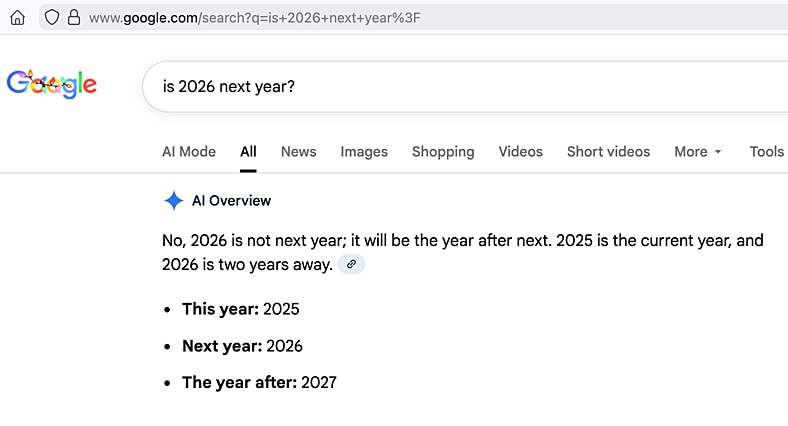
- Dec 1, 2025: I almost can't believe it! Six months after I posted about a moronic mistake being made by Google's AI Overview in an answer to a totally simple question (see May 29, 2025 below), I just saw another post about another unbelievably stupid mistake being made by Google's AI overview, again in answer to a question simple enough that a toddler could answer it correctly. These Big Tech greed factories are pouring countless billions of dollars into developing this technology. They are poisoning our environment, raising our utility bills, and draining our fresh water to run it. They are exploiting underpaid and overworked people around the world who are tasked to try to manually correct its mistakes and attempt to make it better.They are promising us that this is our bright future. And their AI can't even correctly add 2025+1?
- Google search query: is 2026 next year?
Google AI Overview: No, 2026 is not next year; it will be the year after next. 2025 is the current year, and 2026 is two years away.
This year: 2025
Next year: 2026
The year after: 2027
- Google search query: is 2026 next year?
- Sep 28, 2025: Tim Berners-Lee is such a visionary; we need to listen to him!⩘ .
- Sep 11, 2025: AI: the importance of being vigilant and skeptical⩘ .
- Jul 29, 2025: AI veganism⩘ .
- Jul 6, 2025: Educators take a stand against AI in education⩘ .
- May 29, 2025: I just saw a post on Mastodon by Lauren Weinstein⩘ :
"Billions of dollars. Untold megawatts of power. To create a low grade #Google #AI Moron. #AISlop"
It included a screenshot of a Google search query: "Is it 2025?"
The AI Overview answer: "No, it is not 2025. The current year is 2024. According to the calendar. It is May 28, 2024."
So I decided to try it myself.
The AI Overview answer I received: "No, it is not 2025. The current year is 2025. According to the calendar, we are in the year 2025."
See this post with the screen capture of this result⩘ .
- May 8, 2025: AI machines aren't 'hallucinating'. But their makers are⩘ .
- Jun 11, 2022: Is LaMDA Sentient?⩘ .
- 2017: Seven Deadly Sins of AI Predictions: Mistaken extrapolations, limited imagination, and other common mistakes that distract us from thinking more productively about the future⩘ .
∧ Top
Jump to related:
∧ Articles · ∧ Privacy hints · ∧ Books & films · ∧ Contemplations
Previous articles: < 2025/24 · < 2026 Jan–Jun
